
By Ansarul Karim Jamee
Originally published: April 21, 2024 | Substantially revised: August 22, 2026
Ansarul Karim Jamee holds master’s degrees in Environmental Science and Management, History, and Business Administration. For nearly three decades, he has worked across diverse industries, advancing sustainability, well-being, and systems awareness.
Author profiles: LinkedIn | Google Scholar | Academia.edu | ORCID
To learn more about the author and the HealthGodzilla project, visit the HealthGodzilla homepage.
What the Article Is About
Mercury pollution does not remain where it is released. This article follows mercury through air, water, microorganisms, food webs, wildlife, and humans to show how one persistent element can connect environmental health, biodiversity, and human well-being.
The Mercury Moves Across the Palm
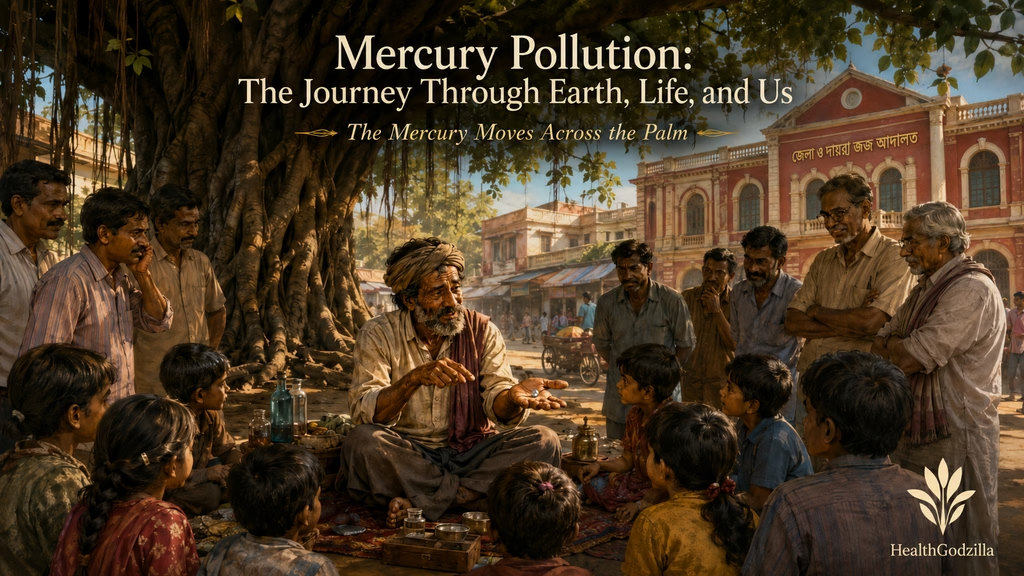
My first encounter with mercury came long before I knew the words mercury pollution. Between the ages of nine and thirteen, I was a regular spectator at the gatherings of hawkers and folk medicine practitioners in the large courtyard beneath two giant banyan trees in front of the red court building in our town. Snake charmers came there, along with sellers of tabij—amulets—coal- or neem-based tooth powders, rare honey, mysterious oils, and remedies whose names I can no longer remember.
At that age, I understood little about the diseases they claimed to treat. What fascinated me was something else: their mystical lectures and extraordinary performances. They sang, told jokes and stories, displayed strange objects, and slowly built their demonstrations toward a climax that often persuaded people to buy.
One hawker, however, left a particular memory.
He claimed to sell a rare medicine that could bring happiness to a family. According to him, it was made from parod—mercury. He held up a bottle containing the shining liquid metal, placed a small drop on his palm, and told the crowd that through a secret formula he could transform the parod into a totka, a special remedy.
That was the first time I saw mercury.
Decades later, as I began thinking about mercury pollution in our environment, that scene returned unexpectedly: the banyan trees, the crowd, the hawker’s voice, and the small silver drop moving across his palm.
Of course, I now understand mercury very differently.
What once appeared mysterious and almost magical is an element capable of traveling through air, soil, water, sediments, food webs, wildlife, and ultimately human bodies.
Alas, I cannot return to those afternoons beneath the banyan trees. But perhaps I can return to that first drop of mercury—and follow where it really goes.
Mercury Does Not Stay Where We Put It
But where does that mercury go once it leaves the hand, the bottle, the workshop, the mine, or the smokestack?
We tend to imagine mercury pollution as something that remains where it was released: smoke above a chimney, waste beside a factory, contaminated soil around a mine, or an unwanted chemical disappearing downstream.
Yet mercury pollution refuses to remain within such neat boundaries.
Once released, mercury can enter the atmosphere, travel considerable distances, settle onto vegetation, soil, rivers, lakes, and oceans, and then return to the air—or move onward with water. Some of it may remain stored in soils and sediments for years, decades, or far longer. Meanwhile, some may enter living systems.
Consequently, mercury pollution is less like a stain on one place and more like a traveler moving through the connected rooms of the Earth.
Its journey may begin naturally. Volcanoes, weathering rocks, and other geological processes release mercury into the environment. However, human activity has profoundly altered this natural circulation. Mining, coal combustion, metal production, industrial processes, mercury-containing products, and waste all release mercury into the environment. Artisanal and small-scale gold mining is an especially important source.
UNEP estimates that human activities have raised atmospheric mercury concentrations far above natural levels. Meanwhile, historical releases continue circulating through the biosphere as legacy mercury.
At this point, the story becomes more complicated.
Mercury Has an Environmental Memory
Mercury is an element. In other words, stopping its use does not make what we have already released disappear. What leaves a smokestack may later settle onto a forest. Mercury entering soil may eventually reach a stream. In a lake, it may become buried in sediment—or become available again under changing environmental conditions. Furthermore, mercury removed from one industrial process can reappear as contaminated waste requiring careful management.
Thus, nature does not merely receive mercury. It moves it, stores it, transforms it, and sometimes returns it.
One transformation matters especially. In aquatic environments, microorganisms can convert inorganic mercury into methylmercury, a highly toxic form that enters organisms and becomes increasingly concentrated as it moves through food webs. From microorganisms to fish, from smaller fish to predators, from aquatic ecosystems to birds, mammals, and humans, mercury begins to travel through the living world itself.
As a result, mercury pollution cannot be understood only as an industrial problem, a workplace hazard, or even a human-health issue.
It is an environmental story.
It is a story about the atmosphere and the ocean, soil and sediment, microorganisms and fish, predators and people. Moreover, it is a story about time: what one generation releases may continue circulating long after the machinery has stopped and the mine has closed.
To understand mercury pollution, therefore, we must follow the mercury—not only to where we release it, but to where the Earth carries it next.
How Mercury Moves Through the Earth
So, let us follow it.
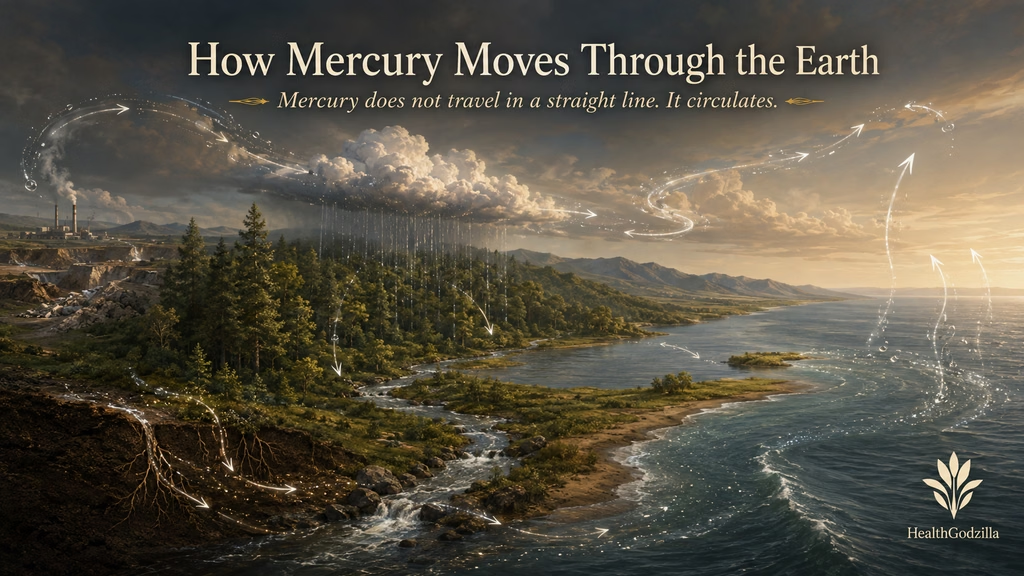
A mercury atom released into the atmosphere does not receive a fixed destination. Carried by air currents, mercury can travel far from where it entered the sky. Eventually, some of it returns to the Earth’s surface, settling onto land, freshwater, vegetation, or the ocean. Yet deposition is not necessarily the end of the journey. Mercury can later return to the atmosphere, move with flowing water, or continue into another part of the environment.
Forests are part of this circulation. Leaves can take up atmospheric mercury and later carry it to the ground through falling litter. Consequently, vegetation can help transfer mercury from the atmosphere into soils. Research has also found strong connections between mercury accumulated on land and mercury reaching rivers, lakes, and their sediments.
Water then becomes another road.
Rainfall, runoff, erosion, and rivers can carry mercury from terrestrial landscapes toward wetlands, lakes, estuaries, and seas. Meanwhile, the oceans are not merely final storage places. They exchange mercury with the atmosphere, returning some of it to the air through volatilization. Obrist and colleagues describe air–sea exchange as an important process that extends the environmental lifetime of anthropogenic mercury.
The Journey Is a Cycle, Not a Straight Line
Therefore, the movement of mercury is better imagined as a network of exchanges than as a one-way path.
Atmosphere → vegetation → soil → river → ocean may describe one journey.
But another portion may travel:
ocean → atmosphere → land → water.
Some mercury becomes stored in soils or sediments. Some is remobilized. Rivers continue connecting landscapes with the sea, while the atmosphere connects places separated by great distances. UNEP’s global mercury budget illustrates precisely this circulation among the atmosphere, soils, vegetation, freshwater, rivers, and oceans.
Human activity has intensified that circulation. However, once mercury enters these environmental reservoirs, mercury pollution can continue long after the original release. Controlling today’s emissions does not immediately remove yesterday’s mercury. UNEP notes that mercury already stored in soils can continue reaching the ocean through rivers and can later return to the atmosphere.
This is why the place where mercury is released and the place where its consequences appear may be separated by both distance and time.
Still, movement alone does not explain why mercury becomes so dangerous to living systems.
At some point in its journey—particularly in aquatic environments—something remarkable happens. Microorganisms encounter inorganic mercury and change its chemical form.
And when that happens, we are no longer following mercury only through air, soil, and water.
We are about to follow it into life.
When Microorganisms Change the Story
Mercury has reached the water. Until now, we have followed it through the atmosphere, forests, soils, rivers, and oceans. But movement is only part of the story.
In water and sediments, mercury can undergo a transformation that changes what happens next.
Certain microorganisms can convert inorganic mercury into methylmercury, a highly toxic organic form that readily enters living organisms. This transformation is one of the crucial reasons mercury pollution becomes so dangerous in aquatic ecosystems. Known as methylation, the process can occur in sediments as well as in the water column.
The microorganisms are not trying to manufacture a poison. Rather, mercury becomes caught up in ordinary microbial processes within their environment. Scientists have identified genes associated with mercury methylation in several groups of microorganisms, including some bacteria and methane-producing microbes.
Yet methylation does not occur equally everywhere.
Conditions within wetlands, sediments, lakes, estuaries, and oceans can influence how much methylmercury forms. Moreover, formation is only one side of the equation. Methylmercury can also break down through demethylation. Therefore, the amount present in an aquatic ecosystem reflects a changing balance among formation, decomposition, transport, and local environmental conditions.
A Small Transformation with a Large Consequence
This distinction matters enormously.
An ecosystem receiving more mercury does not automatically contain more methylmercury. Conversely, an area receiving comparatively little new mercury can sometimes have high methylmercury levels if environmental conditions favor its formation and uptake. UNEP notes that such differences help explain why some aquatic ecosystems become biological mercury hotspots.
In other words, mercury pollution is shaped not only by how much mercury enters an ecosystem, but also by what the ecosystem does with it.
Once methylmercury enters an organism, another journey begins.
The mercury that once traveled through atmosphere, soil, and water is now preparing to climb a food web.
A Poison Climbs the Food Web
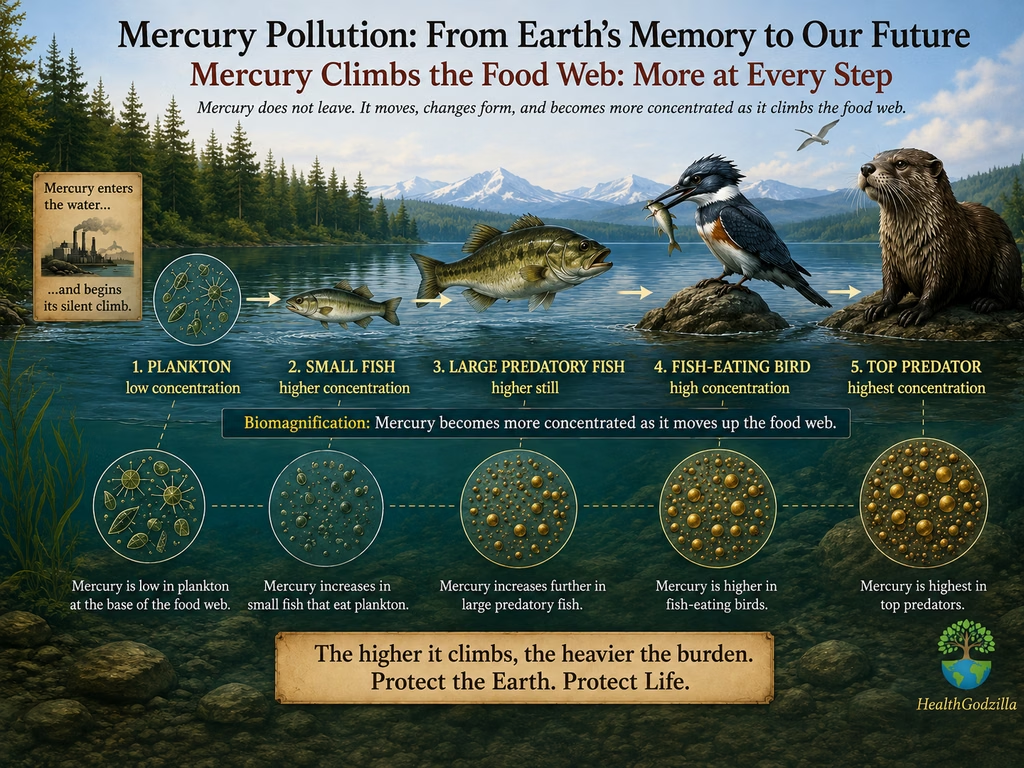
A tiny aquatic organism takes in methylmercury from its surroundings or food. That organism is then eaten by something larger. The predator takes in not only the meal, but also the mercury stored within it.
This is where two related processes become important.
Bioaccumulation occurs when mercury builds up within an individual organism over time because uptake exceeds elimination. Methylmercury is especially effective at this because it is readily absorbed, binds strongly within tissues, and is eliminated slowly.
Biomagnification, however, happens across the food web. As one organism eats another, methylmercury is transferred upward. Consequently, concentrations can become greater at progressively higher trophic levels.
The difference is simple:
Bioaccumulation builds within an organism. Biomagnification increases concentrations across successive trophic levels.
Together, they allow a pollutant that may be present at very low concentrations in water to become far more concentrated in living tissue. This biological concentration is one reason mercury pollution can become especially serious higher in the food web. UNEP reports that top predators can sometimes carry methylmercury concentrations millions of times greater than those measured in the surrounding water.
The Longer the Journey, the Heavier the Burden
Not every species accumulates mercury in the same way.
Size, age, weight, trophic position, food-chain length, habitat, physiology, and feeding behavior can all influence mercury concentrations in fish. The recent European systematic review by Fioravanti and colleagues found that larger, longer-lived predators often carry higher mercury burdens, partly because they feed at higher trophic levels and continue accumulating mercury over longer lifetimes.
That helps explain why large predators such as tuna and swordfish often attract particular attention. They have spent years feeding on organisms that had already accumulated mercury from organisms below them.
A predator, therefore, does not encounter only the mercury present in today’s water.
It inherits mercury from many previous meals.
And those meals may themselves contain the history of many other meals.
The food web becomes, in a sense, an ecological ledger.
The Pollution Begins to Wear Feathers and Fins
Yet the climb does not stop with large fish.
Fish may be eaten by birds, marine mammals, otters, and other predators. In this way, methylmercury can leave one part of an aquatic food web and enter another. The Biodiversity Research Institute notes that fish-eating wildlife can accumulate elevated mercury burdens, while birds, sea turtles, mammals, and fish themselves can reveal how mercury is moving through ecosystems.
At this point, mercury pollution is no longer merely something measured in air, water, or sediment.
It is swimming.
Then it takes flight.
Soon, it is feeding.
And once mercury begins appearing in the bodies of animals, a new question arises:
What does it do to the lives carrying it?
When Wildlife Carries the Burden
The answer is not written only in laboratory measurements. It can appear in the way a fish grows, a bird searches for food, or an animal succeeds—or fails—to reproduce.
Methylmercury is a potent neurotoxin. In fish and wildlife, exposure has been associated with physiological, neurological, behavioral, reproductive, and even survival effects. Yet these effects do not necessarily arrive dramatically. An animal may continue swimming, flying, feeding, or nesting while mercury quietly interferes with processes on which its life depends.
Fish provide one example. Studies summarized by the Biodiversity Research Institute report that elevated mercury concentrations can affect fish growth, behavior, and reproduction. A contaminant carried invisibly in tissue can therefore influence not merely the body of a fish, but how successfully that fish lives and reproduces.
The consequences can then travel farther.
A bird that eats contaminated fish receives the methylmercury those fish accumulated before becoming its meal. Fish-eating wildlife exposed to higher methylmercury concentrations can experience reduced reproductive success. Moreover, mercury-related behavioral effects may interfere with activities as ordinary—and as essential—as foraging or protecting a nest.
When Behavior Becomes an Ecological Matter
That point deserves attention.
Finding food, avoiding danger, defending territory, caring for young, and reproducing are not decorative details in an animal’s life. They are the behaviors through which populations continue.
Therefore, a pollutant does not need to kill an animal immediately to matter ecologically. This is one reason mercury pollution must be understood not only through mortality, but also through changes in behavior, reproduction, growth, and survival.
If exposure alters feeding, reproduction, or survival, the consequences may extend beyond the affected individual. Over time, such pressures can touch populations and the relationships among predators, prey, and habitats. The Biodiversity Research Institute accordingly combines mercury contamination with ecosystem sensitivity when assessing ecological threat, rather than treating mercury concentration alone as the whole story.
This also explains why scientists watch certain animals so carefully.
Fish, sea turtles, birds, and marine mammals can serve as bioindicators—living signs of how mercury is moving through an ecosystem. Freshwater fish can reveal changes in environmental mercury loads, while birds can indicate contamination in both aquatic and terrestrial environments. Sea turtles, otters, bats, and marine mammals can tell other parts of the same story.
In a sense, their bodies become records.
A feather, an egg, a fish muscle, or the tissue of a marine mammal can carry evidence of pollution that began somewhere else and perhaps long before. The Biodiversity Research Institute’s monitoring work uses precisely such biological measurements to trace patterns of mercury through species and ecosystems.
But there is a larger question waiting behind these individual animals.
If mercury can influence growth, behavior, reproduction, and survival—and if the effects move through food webs—then mercury pollution is no longer merely a story about poisoned organisms.
It becomes a question about biological diversity itself.
When Pollution Becomes a Biodiversity Question
A fish does not live alone.
Neither does a bird, an otter, a turtle, or a whale.
Each belongs to a web of feeding, breeding, migration, competition, shelter, and dependence. Therefore, when mercury interferes with the behavior, reproduction, or survival of one species, the concern does not necessarily end with that animal.
It can begin to touch biodiversity.
The Biodiversity Research Institute describes the greatest concern as occurring where three things meet: mercury exposure, ecosystem sensitivity, and biological diversity. In particularly sensitive ecosystems, elevated mercury burdens in high-trophic-level species may reduce reproductive success or survival, potentially contributing to harm at the level of biological diversity.
This distinction matters.
Mercury is rarely the only pressure acting on an ecosystem. Habitat loss, climate change, overexploitation, invasive species, and other forms of pollution may already be weakening populations. Consequently, mercury can become one more burden placed upon organisms that are struggling under several pressures at once. Biodiversity loss, after all, usually emerges from interacting causes rather than a single isolated threat.
Some Ecosystems Are More Vulnerable Than Others
The same amount of mercury does not produce the same ecological outcome everywhere.
Wetlands, freshwater systems, coastal habitats, forests, and other environments differ in the conditions that influence mercury movement, methylation, and food-web exposure. Likewise, species differ in diet, lifespan, trophic position, physiology, and sensitivity.
Thus, ecological risk depends not only on how much mercury arrives, but also on where it arrives and who lives there.
This is why researchers combine maps of mercury contamination with maps of ecosystem sensitivity and species distributions. The purpose is not simply to locate polluted places. It is to identify places where contamination and vulnerability overlap.
A heavily contaminated ecosystem may be dangerous.
But a biologically rich and highly sensitive ecosystem may tell an even more complicated story.
Biodiversity Is More Than a Count of Species
Biodiversity is often imagined as a catalogue: so many fish, birds, mammals, plants, insects.
Yet a living ecosystem is not merely a collection.
It is also the relationships among those lives.
A predator depends on prey. A bird depends on nesting habitat. A fish population depends on successful reproduction. Coastal and freshwater ecosystems depend on countless interactions occurring simultaneously.
Therefore, when pollution alters behavior, reproductive success, survival, or food-web relationships, what is being disturbed is not only an organism.
It is part of the architecture of life.
The Biodiversity Research Institute explicitly connects mercury pollution with biodiversity conservation and ecosystem function. Its work also places mercury within a One Health perspective, recognizing that the health of animals, ecosystems, and humans cannot be cleanly separated.
The Mercury Comes Home: Human Health in the Same Food Web
The return is quieter than we might expect.
For many people, mercury does not arrive as smoke from a chimney or as a shining drop on a laboratory floor. It arrives on a plate.
Fish, shellfish, marine mammals, and other foods are major sources of methylmercury exposure for many communities around the world. UNEP also distinguishes this pathway from exposure to elemental and inorganic mercury, which occurs more commonly in occupational settings or through mercury-containing products.
The distinction brings our journey into focus.
The mercury released into the environment may first travel through air and water. Microorganisms can then transform some of it into methylmercury. Aquatic organisms take it up. Predators accumulate more through repeated feeding.
Eventually, one of those predators may become our food.
So when we eat from an aquatic food web, we are not standing outside the ecological story described in the previous sections.
We have become part of the same food web.
The Nervous System Is Especially Vulnerable
Methylmercury is a powerful neurotoxin. Exposure has been associated with impaired motor function and vision, effects on fetal development, and learning difficulties. Developing fetuses and young children are of particular concern because the nervous system is still developing.
This is one reason mercury pollution carries such an unsettling intergenerational dimension.
An environmental contaminant released years earlier can move through ecosystems, become concentrated through food webs, and eventually reach a developing child who had no part in releasing it.
Yet diet is not the only road home.
Workers may encounter mercury through mining, industrial processes, laboratories, waste handling, or older mercury-containing equipment. In occupational settings, inhalation of mercury vapor is particularly important. Depending on the form and level of exposure, mercury can affect the nervous system, kidneys, respiratory system, gastrointestinal tract, skin, and eyes.
Thus, two apparently different stories meet.
One worker may encounter mercury close to its source.
Another person may encounter it after the element has traveled through atmosphere, water, microorganisms, and fish.
The routes—and often the chemical forms—differ.
The element connecting them is mercury.
We Were Inside the Ecosystem All Along
This is where the boundary between environmental health and human health begins to disappear.
A contaminated fish is not merely a wildlife issue before it becomes a food-safety issue. A polluted river is not merely an ecosystem problem before it becomes a community problem. The same mercury moves through all of them.
That is precisely why a One Health perspective matters here: human health, animal health, and environmental health are connected rather than separate domains.
And perhaps this is the deepest lesson of the journey so far.
We watched mercury leave the smokestack.
From there, we followed it into the atmosphere.
Then we watched it settle on land and water, enter microorganisms, climb food webs, and appear in wildlife.
All the while, we spoke as though it were traveling toward us.
But humans were never waiting at the end of the road.
We were living inside the road itself.
And once that becomes clear, another question becomes unavoidable:
Why did we release so much mercury into this living circulation in the first place?
The answer leads us to gold, coal, industry, products, and waste—the human sources that set so much of this journey in motion.
Gold, Coal, Industry, and Waste: Where the Mercury Comes From
The mercury that entered the fish, the bird, or the human body did not begin there.
Some of it came from natural sources. But much of the mercury now circulating through the environment has been mobilized by human activity. UNEP identifies several major pathways: coal combustion, metal smelting, cement production, mercury-containing products, industrial processes, and artisanal and small-scale gold mining.
Among these, artisanal and small-scale gold mining deserves particular attention.
Mercury forms an amalgam with gold, helping miners separate gold from ore or sediment. The process is simple enough to be used in small mining operations, but it can release mercury directly into air, soil, and water. UNEP identifies artisanal and small-scale gold mining as the largest source sector of mercury releases to air, water, and land, accounting for a major share of global anthropogenic mercury pollution.
Coal tells a different story.
Coal naturally contains small amounts of mercury. When coal is burned, especially at high temperatures, that mercury can be released into the atmosphere. Metal smelting, cement production, and other industrial processes can do the same. In these cases, mercury may not be the product being sought at all. It emerges as an unwanted passenger carried within fuels or raw materials.
Sometimes We Put Mercury There Deliberately
For centuries, humans also found mercury useful.
It appeared in lamps, batteries, measuring instruments, dental amalgam, chemical production, and other products and processes. Some of those uses have declined sharply, while others remain in particular places or industries.
The problem, however, does not end when the product reaches the end of its useful life.
A discarded lamp, battery, measuring device, or mercury-containing material can become another environmental source if it is broken, burned, dumped, or poorly managed. UNEP notes that mercury-added products can release mercury during waste disposal and that large amounts of mercury entering solid-waste streams may later become secondary sources to air or water.
So mercury has a peculiar industrial biography.
We mine it.
Sometimes, we uncover it while extracting other materials.
We also release it when burning fuel.
In other cases, mercury is deliberately placed into products.
Later, some of it is removed from emissions.
Then, unless it is safely contained, the mercury we thought we had “managed” may simply enter another chapter of its journey.
There Is No Simple “Away”
This is where the mercury life cycle becomes important.
Capturing mercury from emissions, removing it from products, or collecting contaminated waste does not make it disappear. Because mercury is an element, the challenge becomes one of safe containment, storage, recycling where appropriate, and preventing its return to the environment. UNEP warns that poorly managed recovered mercury can become a secondary source of pollution.
In that sense, mercury has an environmental memory.
Human use may end, but previously released mercury can remain in soils, sediments, water, and the atmosphere, continuing to circulate and enter food webs.
The life cycle, therefore, does not necessarily end when human use ends.
Sometimes, that is when the environmental afterlife begins.
Minamata: When a Local Tragedy Became a Global Warning
For years, mercury had been telling its story.
In Minamata, Japan, people finally had to listen.
Between 1932 and 1968, industrial wastewater containing mercury compounds was discharged into Minamata Bay. Fish and shellfish became heavily contaminated with methylmercury, while nearby communities depended strongly on seafood from those same waters.
Then the living world began to behave strangely.
Residents had already noticed disturbing changes among animals. Fish were reported rising abnormally to the water’s surface, while cats behaved erratically and birds showed unusual illness or died. Meanwhile, people began developing severe neurological symptoms. In 1956, the first Minamata disease patient was officially reported with neurological symptoms of unknown cause.
Investigators eventually traced the mystery to methylmercury exposure through contaminated fish and shellfish.
And suddenly, everything we have followed in this article could be seen within one landscape.
Industrial mercury entered water.
Mercury entered aquatic organisms.
It moved through the food web.
Animals carried the warning.
People ate from the same ecosystem.
The mercury came home.
The Body Revealed What the Water Could Not Say
Minamata disease became associated with profound neurological damage. Reported effects included loss of muscular control, sensory disturbances, impaired hearing and vision, paralysis, convulsions, and, in severe cases, death.
Yet perhaps one of the most disturbing lessons concerned unborn children.
Some women who showed few or no obvious symptoms gave birth to children with severe developmental and neurological impairments after prenatal exposure to methylmercury. The tragedy demonstrated with terrible clarity how vulnerable the developing nervous system can be.
Mercury pollution had crossed another boundary.
It was no longer merely traveling from factory to bay, or from fish to person.
It could cross from one generation into the next.
Minamata Was Not Only a Medical Disaster
It was also an ecological warning.
The strange behavior of animals was not an unrelated curiosity preceding human illness. Fish, birds, cats, and people were inhabiting the same contaminated system.
Seen this way, Minamata almost compresses the whole mercury cycle into one tragic place:
release → water → methylmercury → food web → wildlife → humans → future generations.
That is why the name eventually traveled far beyond Japan.
In 2013, governments adopted the Minamata Convention on Mercury, a global treaty intended to protect human health and the environment from the adverse effects of mercury. It entered into force in 2017.
Its scope follows mercury across much of the same life cycle we have followed here. The Convention addresses mercury mining, products and industrial processes, emissions to air, releases to land and water, artisanal and small-scale gold mining, storage, contaminated sites, and mercury waste.
There is something deeply significant in that.
A place once known because people and animals were poisoned by mercury gave its name to an international effort intended to prevent the same story from being repeated elsewhere.
But even a treaty cannot call every mercury atom back.
The mercury already released does not read conventions.
Some remains buried in sediment.
Elsewhere, mercury stays in soil.
In other places, it returns to water or air.
Meanwhile, some continues entering living organisms.
So Minamata gives us a warning—but it also leads directly to our next question:
What happens to yesterday’s mercury after society has finally understood the danger?
Yesterday’s Mercury Is Still Traveling
A smokestack can fall silent.
A mine can close.
A factory can change its process.
A treaty can prohibit or restrict future releases.
Yet the mercury already deposited in soils, sediments, lakes, rivers, and oceans may remain available to the environment for years, decades, or much longer.
This is legacy mercury—mercury released by earlier human activity that continues circulating long after the original source has changed or disappeared. UNEP notes that historical emissions still contribute substantially to the mercury stored in today’s soils and oceans.
So yesterday’s pollution can become today’s environmental reservoir.
And reservoirs are not always graves.
Mercury stored in soil may be carried by runoff into rivers. Rivers can transport it toward lakes and seas. Mercury in water may return to the atmosphere. Meanwhile, mercury already present in aquatic systems can continue undergoing methylation and entering food webs.
The past, therefore, does not simply sit still.
It circulates.
Cleaner Air Does Not Immediately Mean Cleaner Fish
This creates an uncomfortable delay.
Suppose mercury emissions to the atmosphere begin falling today. Atmospheric concentrations may respond relatively quickly. However, mercury concentrations in fish and other organisms may decline much more slowly because ecosystems contain large stores of mercury accumulated from earlier releases.
UNEP cautions that short-term trends in wildlife do not always follow short-term changes in atmospheric mercury. Even when both eventually decline, a substantial time lag may occur.
In some aquatic systems, the mercury already stored within the ecosystem can become more important than new inputs. Internal processes—methylation, transport, food-web uptake, and bioaccumulation—may continue operating on that inherited reservoir. Consequently, mercury in aquatic organisms may take much longer to decline than emissions themselves.
This means environmental recovery has its own clock.
Human beings may stop releasing mercury today.
The ecosystem may need much longer to answer.
The Oceans Remember for Generations
The oceans make this time scale especially visible.
UNEP’s global assessment concludes that the marine response to emission reductions will be far slower than the atmospheric response. Removing anthropogenic mercury from the world’s oceans may take many decades to centuries, depending on the ocean basin.
That is an extraordinary thought.
Mercury released before someone was born may still be circulating after that person’s grandchildren are born.
Indeed, modeling cited by UNEP suggests that a large share of anthropogenic mercury currently present in the oceans entered them through historical mining long before modern mercury regulation existed.
Our environmental memory has therefore become geological in scale.
Climate Can Disturb What We Thought Was Stored
And the story may become still more complicated.
Legacy mercury does not remain equally secure under all environmental conditions. Changes in climate and ecosystem processes can influence its movement, chemical transformation, and biological uptake. UNEP specifically identifies climate change as one factor that may affect the remobilization of mercury already stored in the environment.
Thus, warming, altered hydrology, fires, thawing landscapes, erosion, and changes in aquatic conditions can potentially change where stored mercury goes and how available it becomes.
The old mercury has not necessarily gone away.
Sometimes the environment has merely been holding it.
And this returns us to the paradox at the heart of mercury pollution:
We cannot undo yesterday’s release.
But we can decide how much more mercury tomorrow will inherit.
That decision brings us to the final practical question:
Can the Cycle Be Broken?
Not completely.
Mercury is an element, so we cannot make it cease to exist. But we can stop repeatedly feeding more of it into air, water, soil, workplaces, products, and waste streams.
That distinction matters.
The goal is not to “destroy” mercury. It is to reduce its extraction, use, release, exposure, and environmental circulation—and to manage what remains safely.
The Minamata Convention reflects this life-cycle approach. Among other measures, it addresses new and existing mercury mining, emissions to air, mercury-containing products, industrial processes, artisanal and small-scale gold mining, and waste. The ILO likewise emphasizes eliminating or reducing exposure and controlling mercury at its source.
The Best Mercury Release Is the One That Never Happens
Prevention begins upstream.
Where mercury-containing products or processes can be replaced with safer alternatives, substitution prevents a future waste problem as well as an immediate exposure problem. Likewise, cleaner industrial technology and emission controls can reduce mercury escaping from combustion and production.
In workplaces where mercury cannot yet be avoided, engineering controls become essential. Closed systems, local exhaust ventilation, careful spill management, environmental monitoring, good hygiene, and limiting the number of exposed workers can substantially reduce occupational exposure.
Artisanal and small-scale gold mining presents a more difficult challenge because mercury use is often closely tied to livelihoods. Consequently, reducing mercury there requires more than prohibition alone. It also requires safer technologies, technical support, regulation, and workable alternatives for mining communities.
Waste Is Part of the Solution—or Part of the Next Problem
Mercury captured from an emission does not disappear.
A removed lamp, battery, instrument, filter residue, contaminated sludge, or industrial waste may simply transfer mercury from one environmental pathway into another.
UNEP therefore stresses that recovered mercury and mercury-contaminated waste must be safely managed and stored. Otherwise, pollution control in one place can create a secondary source somewhere else.
This may be one of the most important principles in the entire mercury life cycle:
Control is not complete until the mercury has nowhere unsafe left to go.
We Also Have to Know Where the Mercury Is
Prevention depends on knowledge.
Countries need inventories of mercury sources and releases. Scientists need monitoring in air, water, sediments, fish, wildlife, and people. Moreover, ecological monitoring can reveal whether reductions at the source are eventually producing reductions in living systems.
The Biodiversity Research Institute notes that biological monitoring can identify contaminated sites, establish baselines, detect trends, and help evaluate whether mercury-control measures are actually working.
Likewise, national mercury inventories help countries identify where mercury enters their economies and environments, allowing policies to target important sources rather than treating mercury pollution as an abstract global problem.
So perhaps the cycle cannot be broken with one dramatic act.
It is weakened at many points:
at the mine,
at the power plant,
inside the factory,
in the product,
at the waste facility,
beside the contaminated river,
and through every decision that prevents another mercury atom from entering uncontrolled circulation.
That is where hope enters our story.
Not because the Earth forgets quickly.
But because we can stop giving it more to remember.
Author’s Reflection: Environmental Balance — The Earth Keeps the Ledger
I began this journey with a small silver drop moving across a hawker’s palm beneath two banyan trees.
At the time, mercury appeared almost magical.
Now its mystery feels different.
We have followed that element through smokestacks and mines, atmosphere and rain, forests and soils, rivers and oceans. Along the way, we watched microorganisms change its form. From there, we followed it into fish, through predators, into wildlife, and finally back into human bodies.
Along the way, one idea kept returning:
Nothing truly happens in isolation.
Mercury released into air can later be deposited onto water.
A change in water can become a change in a microorganism.
A microorganism can become a meal.
A meal can become a burden carried by a fish, a bird, a mammal, or a child.
Mercury pollution therefore reveals something larger than the story of one toxic element.
It reveals the connectedness of consequence.
The Earth Does Not Recognize Our Boundaries
We divide the world into categories because categories help us think.
Air pollution.
Water pollution.
Occupational health.
Food safety.
Wildlife conservation.
Waste management.
Public health.
Yet mercury passes through these borders without asking permission.
The atmosphere does not stop where the factory fence ends. A river does not distinguish between an industrial discharge and a fish habitat. A food web does not know whether we classify its contamination as an environmental problem or a health problem.
The divisions belong largely to us.
The circulation belongs to the Earth.
This is why environmental balance cannot mean merely keeping one pollutant below one regulatory limit at one location.
Balance requires us to see relationships.
The relationship between what we extract and what we release.
Between industry and ecosystem.
Between today’s convenience and tomorrow’s residue.
Also between the health of animals and the health of people.
And, perhaps most importantly, between an action taken in one place and a consequence appearing somewhere else.
The Earth Keeps the Ledger
Mercury teaches this lesson with unusual clarity because it does not simply vanish after use.
What is released may move.
Once in motion, it may settle.
After settling, it may be transformed.
And through that transformation, it may enter life.
And what enters life may return to us in forms we never intended.
That does not mean nature is punishing us.
Nature keeps no moral courtroom.
But physical systems do keep consequences.
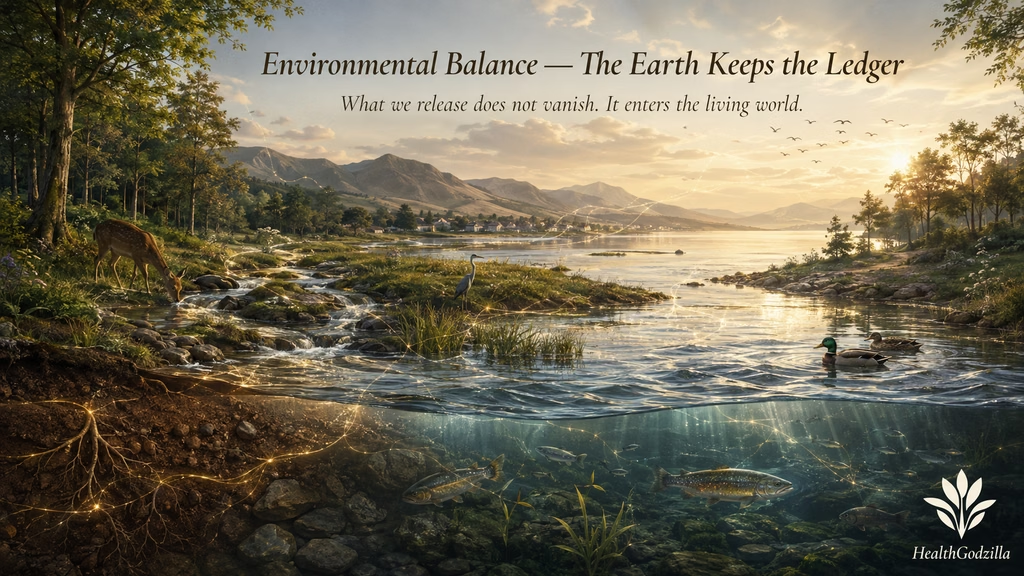
In that sense, the Earth keeps the ledger.
Every release enters some account.
Yet prevention can keep another entry from being written.
Meanwhile, every safer process, controlled emission, properly managed waste stream, protected river, and decision not to release unnecessary mercury changes what future ecosystems will inherit.
Perhaps environmental balance begins there—not with the illusion that human beings can stand outside nature and manage it from above, but with the recognition that we are participants inside the same circulation.
And now, after this long journey, I return once more to that childhood afternoon.
The banyan trees are still there in my memory.
The crowd gathers.
The hawker raises the bottle.
A silver drop moves across his palm.
He tells us that mercury can bring happiness to a family.
I was too young then to understand what I was seeing.
Today, I would look at that same drop differently.
I would see air.
Water.
Sediment.
Microorganisms.
Fish.
Birds.
Children.
Generations.
And perhaps that is the strangest thing about mercury.
A drop can look so small in the human hand.
Yet once released into the living Earth,
it may become far larger than the hand that let it go.
Frequently Asked Questions
Mercury pollution occurs when mercury—particularly from human activities—is released into air, water, soil, or waste streams and circulates through the environment. Natural processes also contribute mercury to the global cycle.
In aquatic environments, microorganisms can convert inorganic mercury into methylmercury. Small organisms absorb it, larger animals eat them, and concentrations can increase as mercury moves upward through the food web.
Mercury can affect the nervous system, behavior, reproduction, development, and survival. Wildlife may accumulate mercury through feeding, while humans are commonly exposed to methylmercury through contaminated fish and other aquatic foods.
Not immediately. Mercury already stored in soils, sediments, water, and oceans can continue circulating for years or much longer. Reducing new releases is therefore essential, even though ecological recovery may take time.
Articles You May Like
If this journey through mercury, memory, living systems, and environmental consequence has stayed with you, the following articles may open a few neighbouring doors.
- Biodiversity and Ecosystem Balance: Why Variety Keeps Life Alive
A wider exploration of how species, habitats, and ecological relationships sustain the balance of living systems—and what happens when those relationships are disturbed. - Biodiversity and Biomedical Discovery: Living Library of Medicine
A companion journey into biodiversity as a reservoir of biological knowledge, showing how the living world has contributed—and may continue to contribute—to medicine and human discovery. - Infectious Disease Ecology: Systems, Spillover, and One Health
An exploration of how human, animal, and environmental health meet within the same ecological systems, extending the One Health connection that appears in our mercury journey. - My Planet Home—Earth: The Future of Humanity and It
A broader reflection on belonging to a planet whose atmosphere, waters, soils, species, and human lives cannot ultimately be separated from one another.
Home is not only a room, a village, or a country. It is also the soil beneath us, the air around us, the water that remembers our footprints, and the living planet whose future cannot be separated from our own.
Principal Sources
The following works provided the scientific, historical, and policy foundations for this article. Together, they shaped its understanding of mercury cycling, methylmercury formation, bioaccumulation and biomagnification, wildlife and biodiversity effects, human health, Minamata disease, legacy mercury, and international mercury control.
- International Labour Organization. (2022). Diagnostic and exposure criteria for occupational diseases: Guidance notes for diagnosis and prevention of the diseases in the ILO List of Occupational Diseases (revised 2010). https://www.ilo.org/publications/diagnostic-and-exposure-criteria-occupational-diseases-guidance-notes-0
- Obrist, D., Kirk, J. L., Zhang, L., Sunderland, E. M., Jiskra, M., & Selin, N. E. (2018). A review of global environmental mercury processes in response to human and natural perturbations: Changes of emissions, climate, and land use. Ambio, 47, 116–140. https://link.springer.com/article/10.1007/s13280-017-1004-9
- Fioravanti, R., Muzzioli, L., Maurel, E., Palma, G., Calabrese, G., Angioni, A., La Rocca, C., Mantovani, A., Pezzana, A., & Donini, L. M. (2025). Bioaccumulation and biomagnification of mercury along the seafood chain in Europe: A systematic review. Foods, 14(21), 3752. https://www.mdpi.com/2304-8158/14/21/3752
- Evers, D. C., Tear, T., & Burton, M. (2022). Mercury: A threat to biological diversity. Biodiversity Research Institute. https://briwildlife.org/wp-content/uploads/2023/03/FINAL-Mercury-and-Biodiversity-3-25-23.pdf
- United Nations Environment Programme. (2019). Global mercury assessment 2018. https://www.unep.org/globalmercurypartnership/resources/report/global-mercury-assessment-2018
- Ministry of the Environment, Government of Japan. (2002). Minamata disease: The history and measures. https://www.env.go.jp/en/chemi/hs/minamata2002/
- Minamata Convention on Mercury. (n.d.). Minamata Convention on Mercury: Text and annexes. United Nations Environment Programme. https://minamataconvention.org/en/documents/minamata-convention-mercury-text-and-annexes
- World Health Organization. (2021). Preventing disease through healthy environments: Exposure to mercury: A major public health concern (2nd ed.).
https://www.who.int/publications/i/item/9789240023567
These sources were interpreted through HealthGodzilla’s narrative and systems lens. The article does not attempt an exhaustive scientific review; rather, it draws upon authoritative research and institutional sources to follow mercury through environmental systems, food webs, wildlife, and human life, and explore what that journey reveals about environmental balance and interconnected health.
This article is also archived for open access on https://doi.org/10.5281/zenodo.22062090