
By Ansarul Karim Jamee
First published: February 18, 2024 | Updated: April 25, 2026
Ansarul Karim Jamee holds master’s degrees in Environmental Science and Management, History, and Business Administration. For over two decades, he has worked across diverse industries, advancing sustainability, well-being, and systems awareness.
Author profiles: LinkedIn | Google Scholar | Academia.edu | ORCID
To learn more about the author and the HealthGodzilla project, visit the HealthGodzilla homepage.
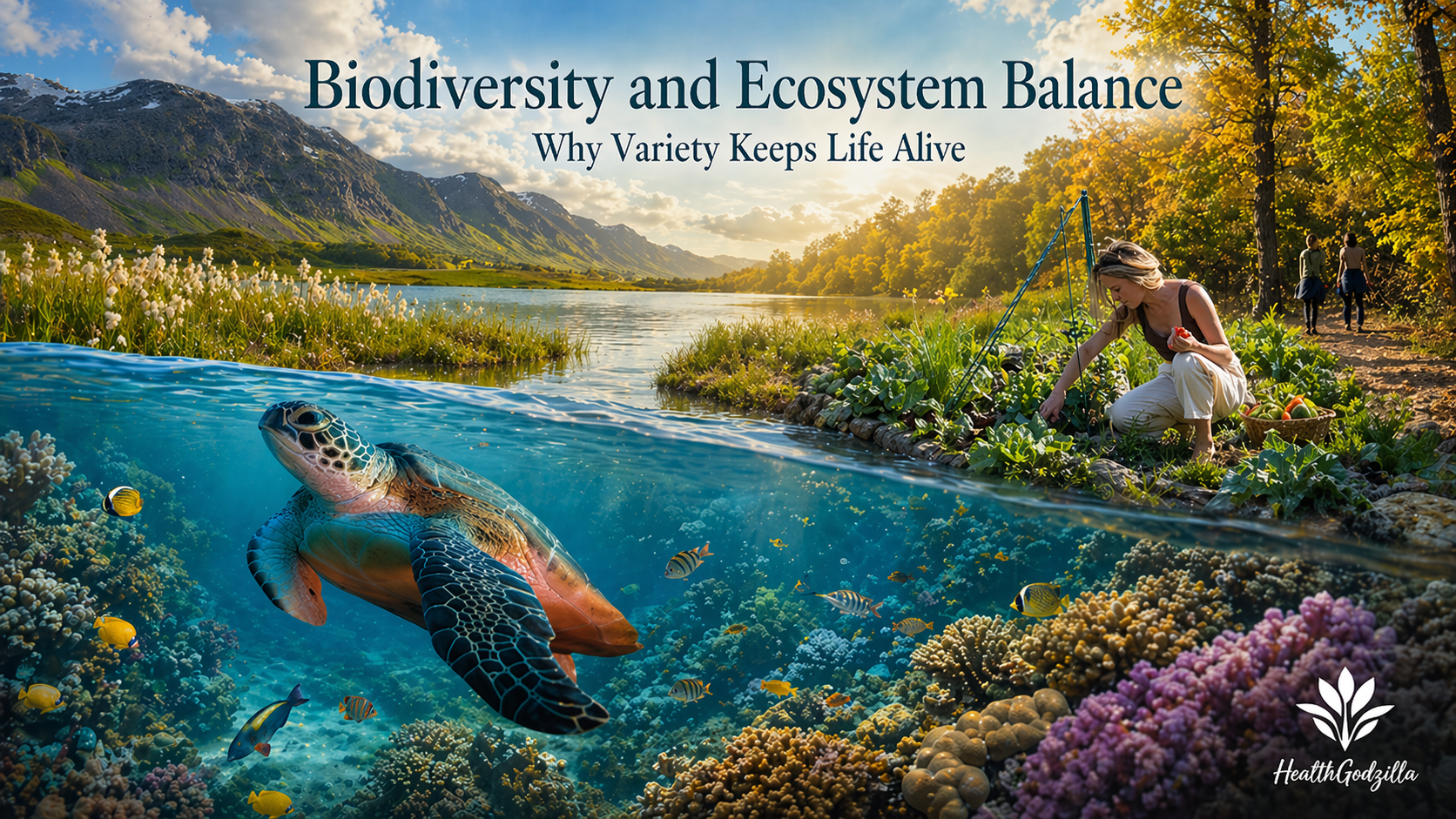
Biodiversity and ecosystem balance are not ornaments around life. They are part of life’s working body. This article explores how the variety of living beings—within species, between species, and across ecosystems—helps keep the world habitable, resilient, and quietly functional. Forests, wetlands, rivers, soils, insects, microbes, and the shifting relationships among them do not merely decorate Earth; they help shape the air we breathe, the water we drink, the food we grow, and the conditions that support health and survival.
The discussion moves beyond a textbook definition. It asks what biodiversity and ecosystem balance really mean, why they matter for human health and well-being, and what begins to fray when living systems lose variety, depth, and connection. It also asks how food systems, water security, resilience, and even our incomplete knowledge of life on Earth connect to this question. After all, humanity speaks often of controlling nature while still knowing only a fraction of the species that share this planet with us.
What Biodiversity and Ecosystem Balance Really Mean
People often speak of biodiversity and ecosystem balance as if they were simple, settled things. They are not. Biodiversity does not mean only a crowded catalogue of animals, plants, and microbes. It includes the differences within species, the differences between species, and the differences among ecosystems themselves. In other words, biodiversity lives in genes, in species, in forests and wetlands, in rivers and grasslands, and in the shifting patterns through which life arranges itself.
Ecosystem balance, then, is not a stiff perfection in which nothing moves. It is the living relationship among organisms, air, water, soil, climate, and the countless processes that let an ecosystem continue to function. Pollinators move, roots hold, fungi break down, wetlands filter, predators regulate, microbes converse in silence, and through these exchanges the world remains habitable. Balance is not stillness. It is a working harmony, sometimes delicate, sometimes rough, but always relational.
Green and Yield Do Not Guarantee Ecological Balance
That is why biodiversity should not be reduced to species count alone. A place may still look green and yet be ecologically thinned. A field may still yield and yet be biologically narrowed. Variety matters, but so do interaction, function, and resilience. Biodiversity is not merely how many lives exist in a place; it is also how those lives differ, support, compete, regulate, recycle, and make room for one another. When that web weakens, ecosystem balance does not vanish in a theatrical moment. More often, it frays quietly—through simplification, loss of redundancy, and the slow dulling of living relationships.
There is another humbling part of the story: even now, we do not fully know the breadth of life we are talking about. One widely cited estimate suggests that Earth holds about 8.7 million eukaryotic species, of which about 2.2 million are marine, while the great majority remain undescribed. That means human beings discuss the fate of biodiversity while still standing in partial ignorance before it. We have named much, but not enough. We have studied much, but not the whole choir. So when we speak of biodiversity and ecosystem balance, we are speaking not only of what we know, but also of a living abundance that still exceeds our inventory.
In that sense, biodiversity and ecosystem balance are not decorative ideas from environmental vocabulary. They are names for the deep arrangement of life—its variation, its reciprocity, and its capacity to keep the Earth from becoming a poorer, more brittle place.
Why Biodiversity and Ecosystem Balance Support Life
Biodiversity as Function
Biodiversity and ecosystem balance do not merely make the Earth look rich. They make it work. Life persists because countless organisms, seen and unseen, keep carrying out their quiet tasks: plants capture energy, microbes break down waste, fungi recycle nutrients, insects pollinate, predators regulate populations, and wetlands help filter water. These are not side effects of nature. They are part of its operating system. Biodiversity underpins ecosystem functioning, and from that functioning flow the goods and services on which human well-being depends.
This is why biodiversity should not be mistaken for beauty alone. A forest is not important only because it is green, nor a wetland only because it is scenic. Their value also lies in what they do: they hold, purify, buffer, cycle, regulate, and renew. When we speak of biodiversity and ecosystem balance, we are speaking of living work—work so constant that people often notice it only when it begins to fail.
Biodiversity as Support System
From that living work comes support. Food systems depend on diversity in crops, livestock, wild foods, pollinators, soil organisms, and pest-controlling species. Water systems depend on forests, wetlands, rivers, and the organisms that help regulate nutrient flows and water quality. Air quality is also shaped by ecosystems, which can absorb pollutants, influence local climate conditions, and help maintain breathable environments. In short, biodiversity and ecosystem balance help sustain food, water, air, pollination, nutrient cycling, pest control, and climate regulation—not as isolated miracles, but as linked ecological processes.
We, humans, are studying biodiversity and ecosystems, which means we are observing ourselves as well. Therefore, we shouldn’t be deceived into thinking that we are separate from this ecosystem. We are one tiny part of this biodiversity. Even health, so often treated as a matter of hospitals and medicine alone, leans on these deeper ecological foundations. The web does not begin where the human body ends. It continues through farms, watersheds, coastlines, microbes, and climates, then bends back toward us again.
Biodiversity as Resilience
There is another reason biodiversity and ecosystem balance support life: they help living systems absorb shock. More diverse ecosystems tend to be more resilient. They are often better able to cope with disturbance, recover from change, and continue providing essential functions even when stressed. When one strand weakens, another may still hold. When a system has depth, redundancy, and variation, it is less likely to collapse from a single blow.
This resilience matters in an age of climate disruption, pollution, land conversion, and ecological simplification. Intact wetlands can soften floods. Diverse agricultural systems can reduce vulnerability. Healthy ecosystems can better withstand pests, disease pressures, and environmental extremes. Diversity does not make nature invincible, but it often helps it bend instead of break. And because human life is braided into these systems, that resilience is not only ecological. It is civilizational.
So biodiversity and ecosystem balance support life not by ornamenting the world, but by sustaining its hidden labors. They are part of the deep scaffolding that allows Earth to remain fertile, breathable, drinkable, and, despite all our damage, still capable of repair.
How Biodiversity and Ecosystem Balance Shape Human Health
Health is more than the absence of disease. In its widely used formulation, it includes physical, mental, and social well-being. That matters here, because biodiversity and ecosystem balance do not touch human life at only one point. They shape the conditions in which people eat, drink, breathe, adapt, and endure.
Biodiversity and ecosystem balance influence health through many pathways at once. They help support food systems, protect water quality, affect air quality, contribute to disease regulation, and sustain forms of contact with the living world that matter for mental well-being and for the microbial relationships that shape human life. Human health, then, does not begin in the hospital and end in the body. It is braided with soil, wetlands, forests, insects, plants, microbes, and the ecological relations that make life livable.
When ecosystem integrity weakens, community well-being often weakens with it. The damage does not always arrive dramatically. Sometimes it appears through poorer water, thinner diets, greater vulnerability to disease, more fragile livelihoods, or the quiet erosion of the natural conditions that help communities remain steady. Biodiversity and ecosystem balance do not guarantee health in some magical way, but they help hold open many of the ecological possibilities on which health depends.
What Begins to Fail When Biodiversity and Ecosystem Balance Break Down
Biodiversity and ecosystem balance rarely collapse all at once like a tower in a storm. More often, the failure begins with simplification. A forest is cut back, a wetland is drained, a river is fragmented, a field is narrowed into monotony, or a coastline is stripped of its buffers. Land-use change, habitat loss, overexploitation, pollution, invasive species, and climate change do not merely remove pieces from nature’s surface. They interfere with the relationships that allow ecosystems to function.
As those relationships weaken, ecosystem balance grows more fragile. Pollinators decline. Water purification falters. Pest control weakens. Soil fertility becomes more dependent on artificial support. Species that once helped regulate disturbance disappear, while pressures that ecosystems once absorbed begin to pass through more harshly. A biologically rich system can often endure stress with more elasticity. A simplified system has fewer responses available to it. It may still stand for a while, but it stands with less memory, less redundancy, and less grace under pressure.
Weakened Biodiversity Does Not Only Mean Fewer Species
This is where resilience begins to thin. Weakened biodiversity does not only mean fewer species. It means reduced capacity to absorb shocks, recover from disruption, and continue providing the goods and services on which life depends. Floods strike harder where wetlands have been lost. Agricultural systems grow more vulnerable where genetic diversity and ecological support have been stripped away. Disease risks can rise when ecosystems are disturbed, habitats are fragmented, and the old balances among hosts, vectors, and environments are unsettled.
And the damage does not fall evenly. Those who depend most directly on ecosystems—especially the rural poor, marginalized communities, and people with the fewest substitutes—often bear the harshest burden. When local water degrades, when soils weaken, when fisheries decline, when forests retreat, or when the cost of adaptation rises, the loss is not abstract. It enters kitchens, bodies, work, and survival. Biodiversity and ecosystem balance break down first in ecological terms, but the consequences soon become social, economic, and deeply human.
So the sequence is cruelly simple: simplify life, weaken systems, magnify risk. The Earth may still appear busy, green, or productive for a while. But beneath that surface, the quiet labor of resilience may already be wearing thin.
Biodiversity and Ecosystem Balance in Food, Water, and Resilience
Biodiversity and Ecosystem Balance in Food Systems

Food does not rise from soil by arithmetic alone. It depends on living variety. Agricultural biodiversity includes the diversity of crops, livestock, fish, pollinators, soil organisms, and the genetic variation within them. That variation is not a decorative surplus. It helps food systems remain productive, adaptable, and less brittle under stress. A field filled with one uniform crop may look efficient, but efficiency can be a narrow throne. When diversity is stripped away, the system often becomes more vulnerable to pests, diseases, climatic swings, and failure.
Pollination offers one of the clearest examples. A large share of global food production depends on pollinators, and many of the most nutritious foods lean on their labor. This means biodiversity is not only linked to the quantity of food, but also to its variety and nutritional quality. Likewise, genetic diversity within crops and livestock matters because it gives food systems room to adapt. Different varieties and breeds carry different strengths: tolerance to heat, resistance to disease, survival in poor soils, or value in uncertain seasons. When monoculture replaces diversity too thoroughly, yield may rise for a time, yet vulnerability often rises beside it.
That is one of the quiet paradoxes of modern food systems: simplification can increase output while reducing resilience. A field may produce more and still become less secure. Biodiversity and ecosystem balance in food systems remind us that nourishment is not merely a matter of volume. It is also a matter of ecological intelligence.
Biodiversity and Ecosystem Balance in Water and Wetlands
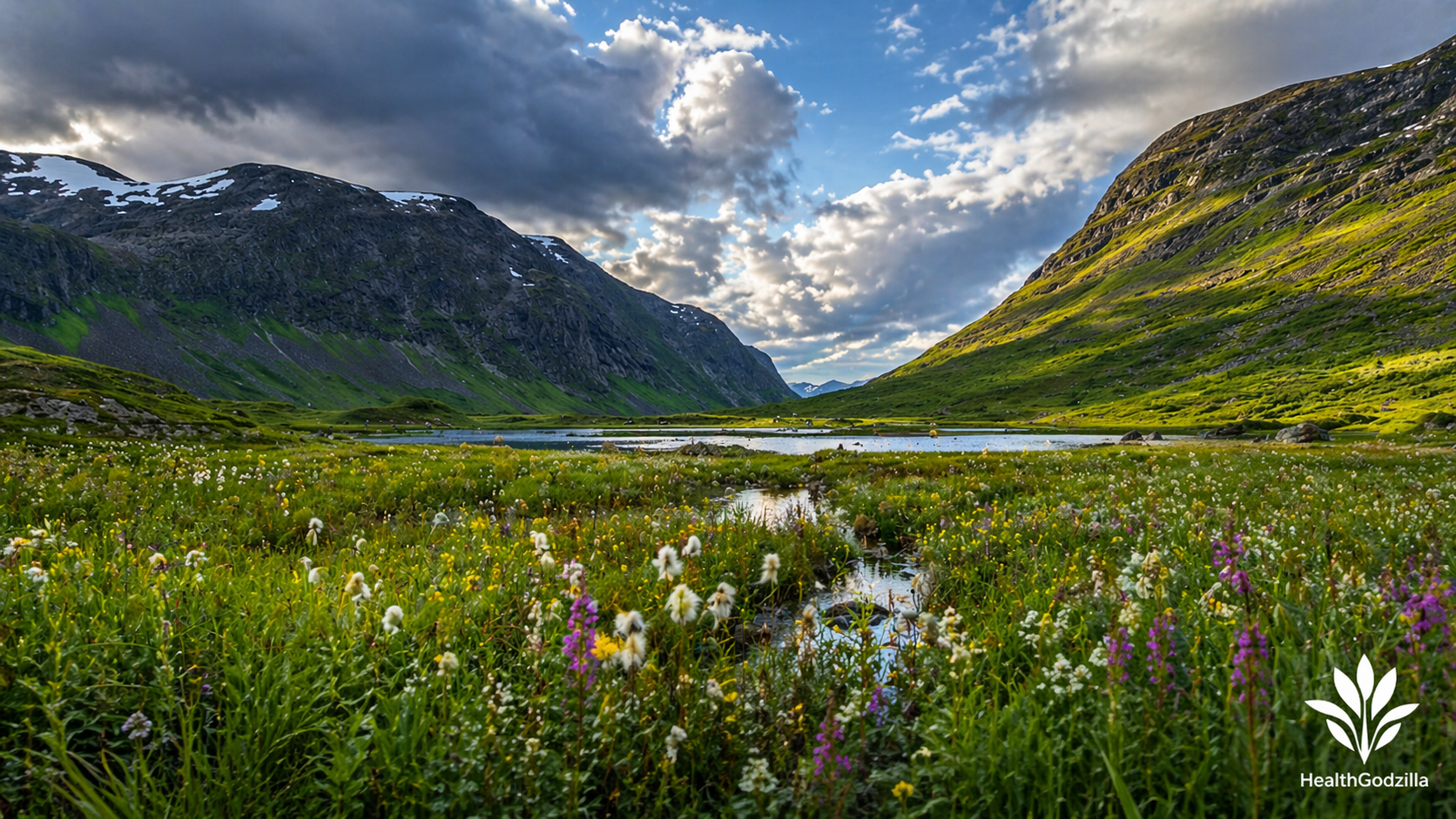
Water, too, is shaped by living systems. Forests, rivers, lakes, soils, and especially wetlands help regulate water quantity and quality. They store, filter, slow, absorb, and purify. Nutrients that would otherwise build into harm can be moderated. Sediment can be trapped. Pollutants can be reduced. In this sense, biodiversity and ecosystem balance do not sit beside water security; they help make it possible.
Wetlands are especially memorable teachers in this story. People often dismiss them as wasted land until their absence begins to speak. When human activity drains or degrades wetlands, downstream systems can suffer in multiple ways at once: poorer water quality, greater flood risk, weakened habitat, and reduced ecological buffering. The damage does not remain politely local. It travels. What one place loses may return as burden in another—downstream, downriver, or later in time.
So when we talk about biodiversity and ecosystem balance in water systems, we are not speaking only of fish, reeds, or riverbanks. We are speaking of the living processes that help water remain usable, cleaner, slower when needed, and less destructive when the weather turns harsh.
Biodiversity and Ecosystem Balance in Resilience
Resilience can sound abstract until a storm arrives. Then it becomes physical. Soon it becomes expensive. Eventually, it becomes a question of who remains standing.
Intact ecosystems often soften shocks in practical ways. Wetlands can reduce the force of floods. Coastal habitats can buffer wave action and storm surges. Diverse landscapes can slow erosion, absorb rainfall, and reduce the severity of ecological disturbance. This is not mystical balance. It is material function. A living system with more depth, diversity, and intact relationships often has more ways to respond when pressure comes.
That is why biodiversity and ecosystem balance matter so deeply in an era of climate instability and environmental stress. Resilience is part of nature’s real work, not a poetic bonus that comes afterward. When ecosystems remain intact, they can continue protecting, filtering, absorbing, and recovering. When human actions strip, fragment, or simplify them, shocks travel through them more violently—and through us as well.
Answer to the Question: Why Do Biodiversity and Ecosystem Balance Matter?
Biodiversity and ecosystem balance matter because life survives through variety, relationship, and renewal. When ecosystems remain diverse, they are better able to provide food, cleaner water, breathable air, pollination, nutrient cycling, disease regulation, and resilience against shocks. When that diversity thins, the systems that quietly support health and survival grow more brittle. Biodiversity is not a luxury around human life, nor a decorative fringe around the Earth. It is one of the conditions that makes life possible, including our own.
Frequently Asked Questions
1. What is the difference between biodiversity and ecosystem balance?
Biodiversity refers to the variety of life—within species, between species, and across ecosystems. Ecosystem balance refers to the living interplay among organisms, air, water, soil, and ecological processes that allows a system to continue functioning. In simple terms, biodiversity is about life’s variety, while ecosystem balance is about how that variety works together and holds.
2. Why is biodiversity important for human health?
Biodiversity matters for human health because it underpins many of the conditions that make health possible. It helps support food systems, clean water, air quality, disease regulation, nutrition, mental well-being, and even the microbial relationships that shape human life. Human health does not stand outside ecological systems; it depends on them.
3. How does biodiversity loss affect food and water?
When biodiversity declines, food and water systems often grow more fragile. Pollinators may decline, genetic diversity in crops and livestock may narrow, and ecosystems may lose some of their ability to regulate pests, cycle nutrients, and adapt to stress. In water systems, wetland loss, pollution, and ecosystem degradation can reduce purification, worsen water quality, and increase flood risk.
4. Does biodiversity only mean saving rare animals?
No. Biodiversity is much broader than protecting rare or charismatic species. It includes ordinary species, soil organisms, pollinators, microbes, crop varieties, wetlands, forests, rivers, and the relationships among them. A place may still look alive on the surface while losing the deeper variety and ecological function that help keep it stable.
5. How many species are there on Earth?
One widely cited scientific estimate suggests that Earth holds about 8.7 million eukaryotic species, including about 2.2 million marine species. The same source suggests that a large majority of species still remain undescribed, which reminds us how incomplete our knowledge of life on Earth still is.
6. Can ecosystems recover after biodiversity loss?
Sometimes they can, but recovery is neither automatic nor complete. Some ecosystems regain important functions when people reduce pressure, restore habitat, or protect key species and processes. Yet recovery may take a long time, and some losses leave scars that are difficult or impossible to reverse fully. That is why protection matters before collapse, not only after it.
Articles You May Like
More reflections from HealthGodzilla:
- Biodiversity and Biomedical Discovery: Living Library of Medicine
Biodiversity and Biomedical Discovery reveals how species, microbes, and ecosystems shape medicine, memory, antibiotics, and human health. - Leadership Mindset Decision-Making: Psychological Roots and Organizational Impact
A father-son journey into how leadership mindset shapes authority, decisions, and a company’s rise—or quiet collapse. - Eco-Nutrition: Systems Diversity and Sustainable Diets
A reflective exploration of how biodiversity, food systems, and human health intertwine. From soil microbes to school lunches, this piece traces how diversity nourishes resilience—not only in ecosystems, but in culture and policy.
Principal Sources
The following works helped shape the perspective behind this story.
- Convention on Biological Diversity. (2006). Global Biodiversity Outlook 2. https://www.cbd.int/gbo2
- Mora, C., Tittensor, D. P., Adl, S., Simpson, A. G. B., & Worm, B. (2011). How many species are there on Earth and in the ocean? PLoS Biology, 9(8), Article e1001127. https://journals.plos.org/plosbiology/article?id=10.1371/journal.pbio.1001127
- World Health Organization. (n.d.). Constitution of the World Health Organization. https://www.who.int/about/governance/constitution
- World Health Organization. (n.d.). Human rights. https://www.who.int/health-topics/human-rights#tab=tab_1
- World Health Organization, & Secretariat of the Convention on Biological Diversity. (2015). Connecting global priorities: Biodiversity and human health. https://www.who.int/publications/i/item/9789241508537
Relevant sections were interpreted through a narrative and systems lens rather than cited exhaustively.
However, this article also carries an intellectual debt to Rachel Carson’s Silent Spring, whose warning still echoes through modern environmental thought.
This article is also archived for open access on Zenodo: https://doi.org/10.5281/zenodo.19770283