
By Ansarul Karim Jamee
Originally drafted: March 2024 | Revised and published: July 2, 2026
Ansarul Karim Jamee holds master’s degrees in Environmental Science and Management, History, and Business Administration. For nearly three decades, he has worked across diverse industries, advancing sustainability, well-being, and systems awareness.
Author profiles: LinkedIn | Academia.edu | ORCID
To learn more about the author and the HealthGodzilla project, visit the HealthGodzilla homepage.
Clear Description of the Article
This article explores small fish and seaweed as humble aquatic foods that may connect nutrition, food security, and environmental balance. It asks whether a wiser food choice can nourish people without wounding the world unnecessarily.
Introduction: A Wiser Plate from Smaller Waters
Can a wiser food choice nourish the body without wounding the world unnecessarily?
This question sits at the heart of this article. It is neither a slogan nor a final verdict, but a small lamp placed beside the plate.
Small fish and seaweed may not look grand beside large steaks, fashionable seafood dishes, or perfect supermarket fillets. They do not arrive with the royal drama of abundance. Yet these modest aquatic foods ask us to think again about nourishment. What if food is not only about appetite? What if eating also reveals our relationship with rivers, seas, soil, workers, animals, and the future?
This article does not argue that small fish, bivalves, and seaweed are miracle foods. They are not. No single food can rescue the body, heal poverty, and save the planet at once. But these foods may help us see a wiser pattern: nutrition and environmental balance do not need to live in separate rooms.
Sometimes, a smaller food carries a larger lesson.
What Are Small Fish and Seaweed?
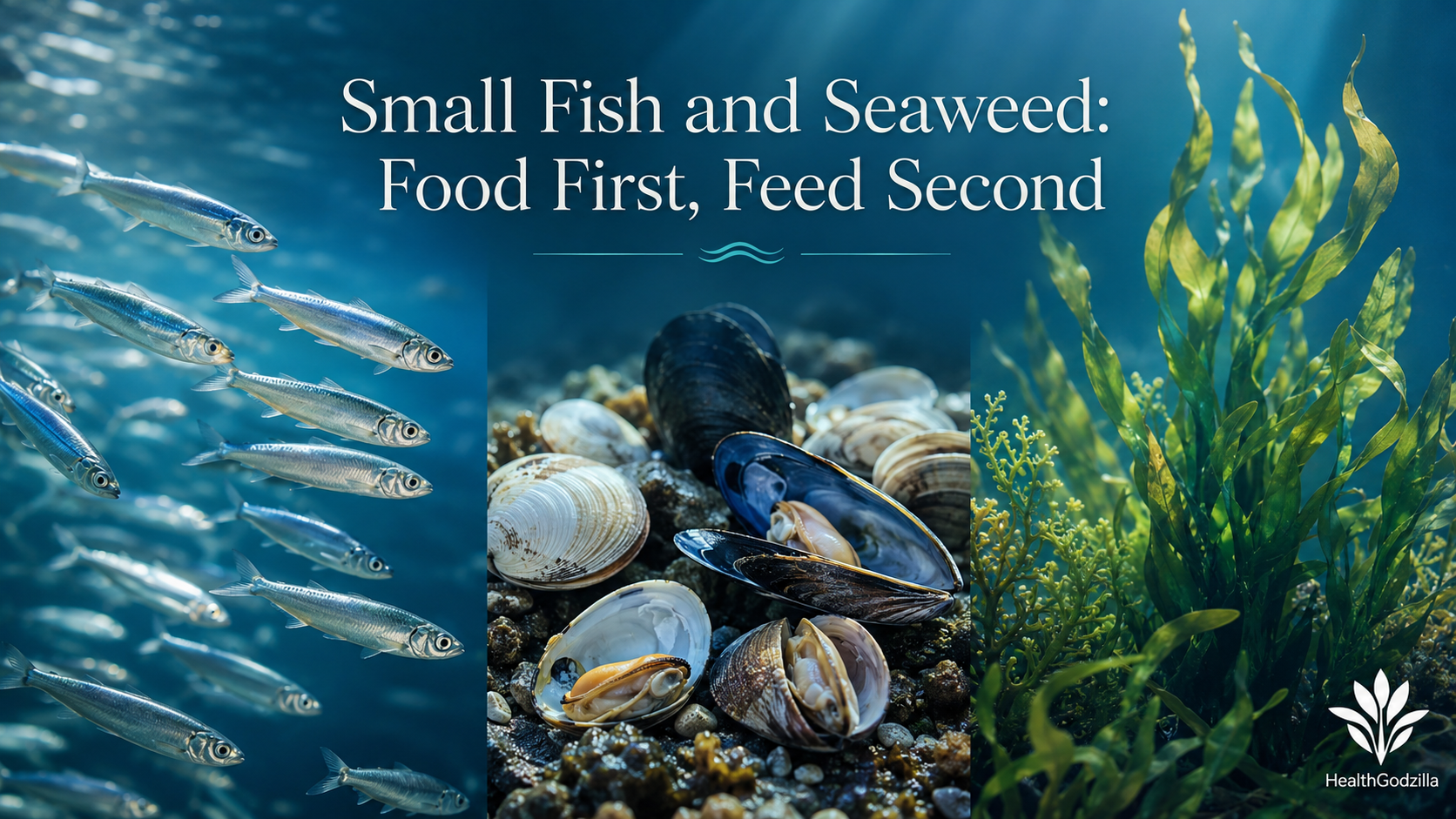
Small fish are usually small-sized fish that people often eat whole or nearly whole. Because the bones, head, eyes, and other parts may be consumed, small fish can provide nutrients that a large fish fillet may leave behind. In many communities, small fish are not luxury items. They are everyday food, market food, river food, family food.
Seaweed is an aquatic plant or algae eaten in many cultures. It may provide iodine, fiber, minerals, and other compounds, depending on type and amount. It is not new, though modern food systems are rediscovering it with fresh curiosity.
Together, small fish and seaweed belong to a wider group called aquatic foods or blue foods. These include foods from rivers, lakes, wetlands, coasts, and oceans: fish, shellfish, mollusks, seaweed, and other water-based foods.
The phrase “small fish and seaweed” in this article works as a doorway. Through that doorway, we also meet bivalves such as mussels, clams, oysters, and scallops, because they also carry part of the same story: food from water, food with nutrients, food that may ask less from the land.
Can Small Fish and Seaweed Nourish People Without Wounding the World?
Yes, small fish and seaweed may help nourish people with a lighter ecological footprint when they are chosen safely, sourced responsibly, and prioritized as food before feed.
But the answer should stay humble. Food systems change. Fish stocks change. Local waters change. Human needs change. A food that looks wise in one place may become careless in another if harvested badly, traded unfairly, or eaten without safety awareness.
So the answer is not a stone tablet. It is a river-current.
Small fish can offer protein, omega-3 fatty acids, calcium, iron, zinc, vitamin B12, vitamin D, and other nutrients, depending on species and preparation. Seaweed can offer iodine and minerals, though it should not be eaten carelessly in unlimited amounts. Bivalves can offer protein, zinc, vitamin B12, and other nutrients while often requiring little or no feed.
The important principle is not simply “eat more.” The wiser principle is:
Food first, feed second. Safety first, romance second. Balance first, abundance second.
Why Does “Food First, Feed Second” Matter for Small Fish and Seaweed?
Some small fish are eaten directly by people. Others are reduced into fishmeal and fish oil to feed farmed fish, livestock, or other animals. This is where the article’s moral question sharpens.
If a small fish is edible, nutritious, affordable, and culturally accepted, should it first nourish people before entering a longer feed chain?
The answer will not always be simple. Fishmeal industries, aquaculture systems, livelihoods, waste streams, and trade networks are complicated. Not every small fish can or should go directly to human plates. Some fish may be unsuitable, unsafe, damaged, or already part of a necessary production system.
Still, the principle deserves attention. When nutrient-rich small fish are diverted away from people who need affordable nutrition, the food system begins to look upside down. A fish travels through another animal before returning to a richer plate. Local low-income consumers may lose direct access to nutritious food, while distant wealthier markets receive the polished product.
That is why “food first, feed second” matters. It is not an angry slogan. It is a reminder that food systems should not forget hungry people while feeding profitable chains.
Why Do Small Fish Matter for Food Security?
Food security is not only about having enough calories. A person may eat enough and still miss essential nutrients. Hunger can be loud, but hidden hunger often walks quietly.
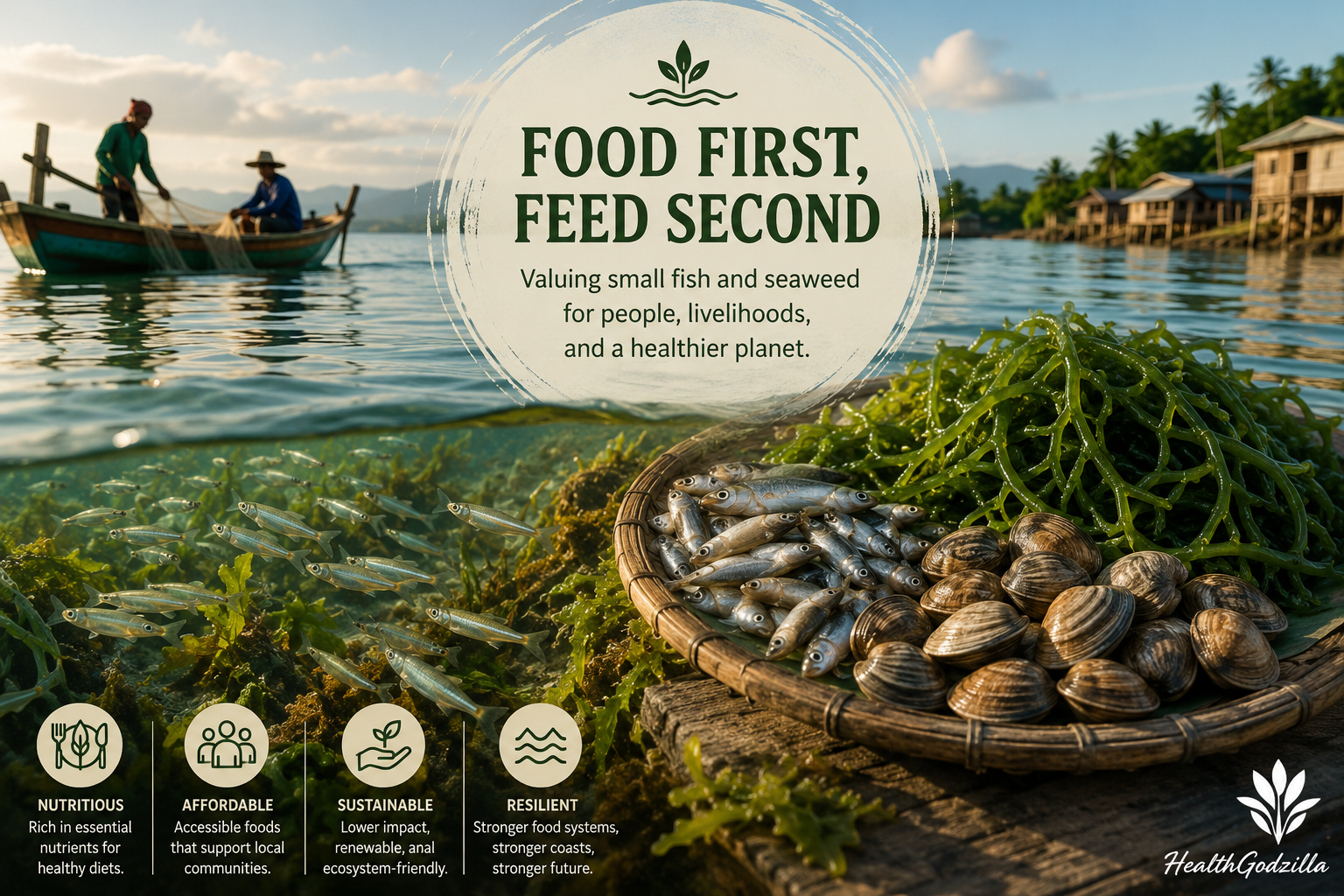
Small fish matter because they can bring dense nutrition in small portions. In many low- and middle-income countries, they are also familiar, affordable, and woven into daily food culture. They may support not only consumers, but also fishers, processors, traders, and market workers.
This is especially important because small fish often travel through human hands before reaching the plate. A small fish can carry income for a fisher, work for a processor, trade for a market seller, and nutrition for a child. It is food, but it is also a livelihood-thread.
When we discuss small fish, we should not see only a nutrient chart. We should see a whole system: water, boat, net, shore, basket, market, kitchen, child, and memory.
What Does Bangladesh Teach Us About Small Fish?
Bangladesh does not need to borrow the wisdom of small fish from a distant nutrition trend. Small fish already live in our rivers, coasts, markets, kitchens, and memories.
Here, fish is not only protein. It is livelihood, taste, affordability, identity, and daily habit. A small fish may pass through many human hands before reaching the plate: the fisher, the boat helper, the processor, the market seller, the mother, the cook, the child. This is why small fish belong not only to nutrition science but also to social life.
Research on marine fish in Bangladesh shows that many species can offer important nutrients such as protein, zinc, calcium, and DHA. Pelagic small fish, many of which are caught by artisanal small-scale fishers, may carry particular nutritional promise. This matters because malnutrition is not always a story of empty plates. Sometimes it is a story of plates missing the right small things.
The old kitchen knew this in its own way. Science now measures it with tables, charts, and nutrient profiles. But the river knew first.
Still, we should stay careful. Not every small fish is equally nutritious. Affordability varies by species and market, and not every water body is equally safe. Food wisdom begins when affection and evidence sit together without quarrelling.
Where Do Bivalves Fit into Small Fish and Seaweed Thinking?
Bivalves are not fish, but they belong in this story. Mussels, clams, oysters, and scallops are aquatic foods with two shells and a quiet talent for filtering water. They often require little or no external feed, and they can provide protein, zinc, vitamin B12, iron, and other nutrients.
In environmental language, bivalves often look modest. In moral language, that modesty is part of their beauty. They do not ask for vast fields of grain or demand a dramatic throne in the food system. In water, they simply filter, grow, and become food.
But this is where romance must bow to safety. Because bivalves filter water, they can also collect harmful pathogens or contaminants if the water is unsafe. So bivalves should come from reputable sources, follow local food-safety rules, and be handled and cooked with care.
A mussel can be a small environmental poem, but it still needs a clean page.
Is Seaweed a Future Food or an Old Wisdom?
Seaweed is often introduced today as a future food, but many cultures have known it for centuries. It is not a strange invention of modern sustainability. It is an old aquatic food returning to new conversations.
Seaweed may provide iodine, fiber, minerals, and other nutrients, depending on type and amount. It also has environmental appeal because it does not need farmland in the usual sense. It grows in water, and some forms of seaweed farming may offer opportunities for food, livelihood, and ecological imagination.
But seaweed also reminds us that natural foods need wise limits. Some seaweeds can be very high in iodine, and too much iodine may be unsuitable for some people, especially those with thyroid concerns. Seaweed should not become another health fashion where enthusiasm outruns understanding.
So yes, seaweed may be part of a wiser food future. But wisdom is not only saying yes. Sometimes wisdom says: yes, but carefully.
Can Small Fish and Seaweed Support Environmental Balance?
Environmental balance does not ask us to worship one food and condemn another. It asks us to notice relationships.
Some aquatic foods may require less land and produce fewer greenhouse gas emissions than many land-based animal foods. Bivalves may need little feed, while small fish can carry dense nutrition in small bodies. Seaweeds may grow without soil, irrigation, or fertilizer in the familiar agricultural sense.
But sustainability is never automatic. A small fish is not saintly simply because it is small. Seaweed is not harmless simply because it is green. A bivalve is not pure simply because it filters water. Everything depends on place, scale, harvesting method, farming practice, governance, contamination, trade, and access.
This is why “food first, feed second” matters. If edible and nutritious aquatic foods are diverted away from people and into longer feed chains, the food system may lose some of its moral geometry. The line between nourishment and extraction becomes blurred.
A wiser plate does not pretend to solve the world. It only tries not to deepen the wound unnecessarily.
How Can We Eat Small Fish and Seaweed Safely?
Safety must stand beside sustainability. Otherwise, good intentions can become a thought-trap.
Aquatic foods can carry risks from mercury, pathogens, parasites, harmful algal toxins, and environmental contaminants. Larger predatory fish often raise more mercury concerns because contaminants can build up along the food chain. Many smaller fish, such as sardines, anchovies, and herring, are generally lower-mercury choices, but safety still depends on species, source, local waters, and official guidance.
Children, pregnant people, breastfeeding people, and frequent seafood eaters should be especially careful. This does not mean aquatic foods should be feared. It means they should be chosen with knowledge.
A simple safety rhythm, guided by official fish-consumption advice, may help:
- Choose a variety of aquatic foods rather than depending on one species.
- Prefer lower-mercury options where official guidance recommends them.
- Buy fish, shellfish, and seaweed from reputable sources.
- Cook, store, and handle seafood safely.
- Follow local advisories, especially for fish from rivers, lakes, reservoirs, or polluted waters.
The kinder plate is not careless. It is careful, curious, and awake.
Hello, Artista

Artista once looked at a plate of small fish and said, “How can something so small carry so much argument?”
Organum smiled. “Because small things often expose large systems.”
A sardine is not only a sardine. It is a question with scales. Who caught it? Who could afford it? Was it eaten directly, dried for later, sold in a local market, or reduced into feed for another animal? Did it nourish a child, support a fisher, or disappear into an invisible chain of profit?
Artista nodded. “So the plate is not innocent?”
“No plate is entirely innocent,” Organum said. “But some plates are more awake than others.”
She picked up a small piece of seaweed and held it like a green bookmark from the ocean.
“Then maybe eating is not only hunger,” she said. “Maybe eating is a tiny vote for the kind of world we are willing to keep.”
That sounded almost too grand for lunch. But sometimes lunch is where civilization quietly confesses its philosophy.
Author’s Reflection
I first drafted this article in March 2024 and later archived it. Perhaps I feared the word “food.” The old draft did not yet know how to carry nutrition, ecology, safety, and philosophy in the same basket. Or perhaps it was simply young.
Returning to it now, I see the distance travelled. The old article had information, but it needed a spine. Small fish gave it that spine. Seaweed gave it a quieter green edge. Bivalves brought the reminder that usefulness does not always make noise.
Puti, or swamp barb fry, cooked with lily is one of my favorite curries. Yet sometimes I hesitate to eat it, because I also love this small silver fish and the lilies that grew beside it. They were not only ingredients to me. They were my neighbors.
The narrow canal where I once talked with them has now been buried under a paved road. The bamboo bush has also vanished, the same bush from which dry leaves used to fall into the clear water. How crystal clear that water was. Butterflies and grasshoppers seemed to play with us there.
I knew only a few names of the trees, fruits, and flowers around that small piece of land. Still, I remember viburnum, kadam, monkey fruit, fig, and many others whose names I did not know but whose colors I carried. Fish, birds, fruits, flowers—what variety they held. What a permutation and combination of birds’ tweets filled the air. Perhaps the seed of my “Symphony in Chaos” was sown in me there.
The central question
The central question remains: can a wiser food choice nourish the body without wounding the world unnecessarily?
I do not know if any food can answer this question perfectly. Perfection is often a polished trap. But small fish and seaweed suggest a gentler direction. They ask us to eat lower, think deeper, and notice the long journey between water and plate.
This is not a commandment. It is a compass.
In the end, environmental balance may begin not with heroic gestures, but with smaller forms of attention: what we choose, what we waste, what we feed, what we forget, and what we allow to disappear quietly from the table.
Frequently Asked Questions About Small Fish and Seaweed
Small fish and seaweed may support more sustainable food choices when they are responsibly sourced, safely prepared, and used as food before feed. However, sustainability depends on species, harvesting method, farming practice, local ecology, governance, and access.
“Food first, feed second” means edible and nutrient-rich small fish should, where possible and appropriate, nourish people directly before being diverted into fishmeal, fish oil, or animal-feed chains. This principle matters especially where affordable nutritious foods are needed.
Many small fish can provide protein, omega-3 fatty acids, calcium, iron, zinc, vitamin B12, vitamin D, and other nutrients. Some small fish are eaten whole, which may provide nutrients from bones and other parts usually removed from large fish fillets.
Seaweed can provide iodine, fiber, minerals, and other nutrients, depending on its type and amount consumed. Some seaweeds may contain very high iodine levels, which may not suit everyone, especially people with thyroid concerns.
Yes. Bivalves such as mussels, clams, oysters, and scallops are not fish, but they are aquatic foods that fit the same wider story of nutrition and environmental balance. They can provide nutrients and often require little or no external feed, but they must come from safe waters and reputable sources.
Pregnant people, breastfeeding people, and children should follow official fish-consumption guidance and choose lower-mercury options. Many smaller fish are generally lower in mercury than large predatory fish, but local advisories, safe sourcing, and proper preparation remain important.
Articles You May Like
From rivers to roots, from food systems to ecological memory—more HealthGodzilla journeys await:
- Infectious Disease Ecology: Systems, Spillover, and One Health—biodiversity change, human-nature systems, climate drivers, and governance.
- Urbanization and the Food Insecurity Myth—how diets, supply chains, poverty, and biodiversity shape the deeper hunger story beyond city growth alone.
- Climate and Traditional Food Transition—shifting diets, crop diversity, and climate-driven pressure on food systems.
- Wild Foods and Food Security—cultural stigma, political neglect, famine memory, development, and sustainability.
- Environmental Balance and Sustainability—how a balanced environment nurtures well-being and supports a sustainable, thriving planet.
Curated with river-light by Artista, under a sky full of questions.
Principal Sources
The following works helped shape this article’s understanding of small fish and seaweed, aquatic foods, nutrition, food security, environmental balance, and safe seafood choices.
- Food and Agriculture Organization of the United Nations. Small Fish for Food Security and Nutrition. FAO Fisheries and Aquaculture Technical Paper No. 694. Rome: FAO, 2023. https://www.fao.org/fishery/publication/294059/en?status=published
- Rifat, M. A., Wahab, M. A., Rahman, M. A., Nahiduzzaman, M., & Al-Mamun, A. “Nutritional Value of the Marine Fish in Bangladesh and Their Potential to Address Malnutrition: A Review.” Heliyon, 2023. https://www.sciencedirect.com/science/article/pii/S2405844023005923
- Robinson, J. P. W., Mills, D. J., Asiedu, G. A., Byrd, K. A., Cisneros-Montemayor, A. M., Cohen, P. J., Fiorella, K. J., Graham, N. A. J., MacNeil, M. A., Maire, E., Mbaru, E. K., Nico, G., Omukoto, J. O., Simmance, F. A. J., & Hicks, C. C. “Small Pelagic Fish Supply Abundant and Affordable Micronutrients to Low- and Middle-Income Countries.” Nature Food, 2022. https://www.nature.com/articles/s43016-022-00643-3
- Harvard T.H. Chan School of Public Health. “Aquatic Foods.” The Nutrition Source. https://nutritionsource.hsph.harvard.edu/aquatic-foods/
- WorldFish. “Small Fish: A Small Solution to Big Problems.” 2024. https://worldfishcenter.org/blog/small-fish-small-solution-big-problems
- U.S. Food and Drug Administration and U.S. Environmental Protection Agency. “Advice About Eating Fish.” https://www.fda.gov/food/consumers/advice-about-eating-fish
Note: These sources were interpreted through HealthGodzilla’s narrative and systems lens. The article does not attempt an exhaustive academic review; rather, it uses selected works to explore aquatic foods, nutrition, food security, safe seafood choices, and environmental balance.
This article is also archived for open access on https://doi.org/10.5281/zenodo.21164055