
By Ansarul Karim Jamee
Originally published: May 10, 2024 | Substantially revised: October 10, 2026
Ansarul Karim Jamee holds master’s degrees in Environmental Science and Management, History, and Business Administration. For nearly three decades, he has worked across diverse industries, advancing sustainability, well-being, and systems awareness.
Author profiles: LinkedIn | Google Scholar | Academia.edu | ORCID
To learn more about the author and the HealthGodzilla project, visit the HealthGodzilla homepage.
What the Article Is About
Migration and environmental health meet in everyday conditions: the water people drink, the air they breathe, the homes they occupy, and the care they can reach. Beginning with a family’s account of shelter during the 2022 flood in Sylhet, Bangladesh, this article explores how those conditions can protect or undermine health after arrival. Experiences differ, but one question accompanies the journey: what makes a place safe enough to live?
A Shelter, but What About Water?
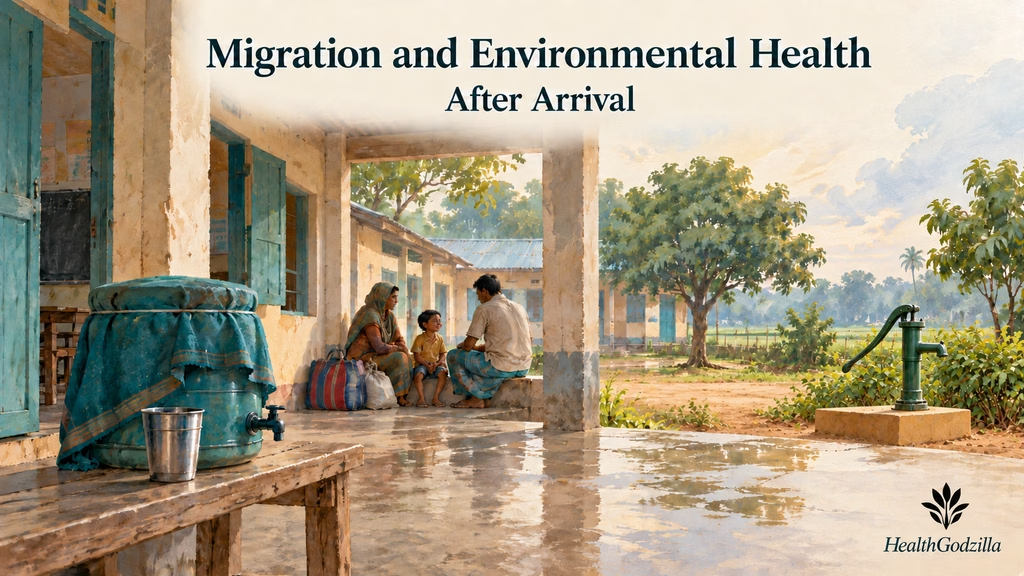
During the 2022 flood in Gowainghat, Sylhet, a family took shelter in a nearby primary school. Their home, cow, and ducks had washed away. The father was away from home and returned about eight days after the flood.
In an account published by the International Institute for Environment and Development, he described the conditions his family encountered: no sanitation facilities and floodwater to drink. He reported that his wife and child developed diarrhea.
The school offered shelter, but their need for safe water remained.
This account of disaster displacement brings one part of migration and environmental health into view: reaching another place does not settle every question of safety. People still need water to drink, somewhere to wash, and a toilet they can use.
From here, our attention turns to the conditions after arrival—and the resources that help people protect their health.
Migration and Environmental Health: What Changes?
Moving changes more than an address. It can change the water people drink, the air they breathe, the housing they occupy, and the services they can reach. These everyday conditions connect migration and environmental health.
The changes can bring benefits. A new place may offer safer housing, reliable water, or better access to care. However, someone escaping danger may arrive where those protections remain limited. The outcome depends partly on the conditions at the destination and the resources available to them.
WHO’s World report on the health of refugees and migrants explains that migrants share the same basic determinants of health as everyone else. Yet their migratory circumstances can add difficulties—for example, when limited income restricts housing choices or an unfamiliar language makes care harder to access.
Migration therefore tells us only part of the story. To understand the health implications, we need to ask what people encounter after moving—and what protection they can actually obtain.
The Conditions After Arrival
Water and Sanitation
A water source is only part of a safe supply. Water also needs protection from contamination during collection, storage, and use. WHO’s 2022 report describes difficulties in some refugee settings, including distant sources, shortages, poorly maintained equipment, and unsafe storage.
Sanitation and washing facilities matter alongside drinking water. A shared toilet needs maintenance; a handwashing point needs water and soap. Although hygiene information can help, people also need the facilities and supplies to put it into practice.
The question therefore extends beyond whether water is available: can people collect, store, and use it safely?
Air and Housing
A roof provides shelter, but conditions beneath it also shape health. WHO’s review describes settings where cooking smoke, dampness, mold, and inadequate ventilation create respiratory health risks. Crowded accommodation can also make some infections easier to spread.
These conditions vary. A secure home with sufficient space and suitable ventilation offers different protection from a crowded room where people cook and sleep together. However, income, housing availability, and eligibility for assistance can restrict the choices newcomers have.
Understanding migration and environmental health means looking closely at these everyday surroundings. The water container, cooking area, and shared toilet help us see what protection is available—and what remains missing.
When Care Is Hard to Reach
When someone becomes ill, a nearby clinic may still be difficult to use. Consultation fees, medicine costs, and transport expenses can put care beyond a household’s budget. Distance adds another obstacle, especially when reliable transport is unavailable.
WHO’s 2022 report describes further barriers in some migrant settings. People may struggle to understand registration requirements, establish their eligibility, or explain symptoms in an unfamiliar language. Discrimination and fear linked to immigration status can also discourage them from seeking help.
These barriers differ across circumstances. A family displaced within Bangladesh may face costs, damaged infrastructure, or distance; someone crossing a border may encounter additional language and administrative difficulties.
Access therefore involves more than the presence of a health facility. People need to know where to go, understand the process, afford the journey and treatment, and feel able to seek care. Without those conditions, an available service can remain out of reach.
What Makes a Place Safer to Live?
A safer place brings everyday protections within reach: reliable drinking water, maintained toilets, washing facilities, suitable housing, and accessible care. Each needs attention beyond its installation. A tap needs a dependable supply; a shared toilet needs cleaning and repairs.
Housing improvements matter, too. Reducing dampness, improving ventilation, and providing cleaner cooking options can help address the exposures described earlier. However, people need affordable, practical choices to make those changes.
Health services can become easier to use through clear information, language support where needed, and simpler registration procedures. Costs and transport also deserve attention. Asking residents what prevents them from seeking care can reveal obstacles that a service map misses.
These efforts should include newcomers and established residents. Planning for both helps communities meet shared needs as populations change.
For migration and environmental health, this is where protection becomes concrete: safe water people can collect, a home they can live in securely, and care they can reach when they need it.
Author’s Reflection
I keep returning to the school in Gowainghat. A family reached shelter, yet safe drinking water remained out of reach. That detail makes me pause before calling arrival the end of their hardship.
Perhaps we should stay with the story a little longer—long enough to ask what the new place makes possible.
A place to arrive, to recover, to live.
Frequently Asked Questions
Moving can change the water people drink, the air they breathe, their housing, and their access to care. These conditions can improve or undermine health. Outcomes depend on the circumstances of the move, conditions at the destination, and the resources people can obtain.
No. Migration can offer safer surroundings, better livelihoods, and improved access to services. However, crowded housing, unsafe water, or barriers to care can create new difficulties. Experiences vary across people and places.
No. People move for many reasons, including work, education, family, conflict, and persecution. Environmental pressures can also influence movement, often alongside economic and social factors. The Gowainghat account illustrates disaster displacement; it does not represent every migration experience.
A clinic can provide treatment, but safe water, sanitation, suitable housing, and cleaner air help prevent illness. People must also be able to reach and use care. Cost, distance, language, and administrative requirements can make an existing service difficult to access.
Articles You May Like
These articles continue our inquiry into the conditions that make a place livable—from access to food to the ecosystems that support health.
- Urbanization and the Food Insecurity Myth: Are Cities the Culprit?
Food may fill a city’s markets yet remain beyond a household’s reach. This article explores how affordability, time, and the organization of food systems shape access to nourishment. - Biodiversity and Ecosystem Balance: Why Variety Keeps Life Alive
Beyond housing and services, living systems help sustain water, food, and resilience. This reflection follows those ecological relationships into everyday health and well-being. - Infectious Disease Ecology: Systems, Spillover, and One Health
A closer look at how changing landscapes, human activity, and relationships among species shape disease risk—and why those connections require attention to context.
Principal Sources
The following sources provide the conceptual and research foundation for this article, covering migration, environmental exposures, living conditions, and access to health care.
- World Health Organization & Secretariat of the Convention on Biological Diversity. (2015). Connecting global priorities: Biodiversity and human health—A state of knowledge review.
Sections consulted include “Demographic factors, including migration” and “Urbanization as a challenge and an opportunity to manage ecosystem services” in Chapter 2 (pp. 40–41), alongside the chapter’s discussion of complex relationships between ecosystems and health (p. 43).
https://www.who.int/publications/i/item/9789241508537 - World Health Organization. (2022). World report on the health of refugees and migrants.
Sections consulted address determinants of health (pp. 41–42), air quality, water, sanitation, and housing (pp. 60–69), barriers to health services (pp. 193–196), and the report’s conclusions and evidence limitations (pp. 289–292).
https://www.who.int/publications/i/item/9789240054462 - Bharadwaj, R., Chakravarti, D., Karthikeyan, N., Islam, S., & Tanni, U. J. (2025). Exposed and exploited: Climate change, migration and modern slavery in Bangladesh. International Institute for Environment and Development.
Selected passages consulted include the research scope and framework (pp. 12–13) and a community member’s account of displacement during the 2022 flood in Gowainghat, Sylhet (p. 16).
https://www.iied.org/22604iied
The Bangladesh account is a participant’s testimony reported by the researchers, rather than an independently verified medical finding. It illustrates one experience of disaster displacement and does not represent all migrants or displaced people.
HealthGodzilla draws on these sources to explore how changing surroundings—and access to water, sanitation, safe housing, and care—shape health during migration and displacement. This is not an exhaustive review. Experiences differ across people and places, and migration does not inevitably lead to poorer health.
This article is also archived for open access at https://doi.org/10.5281/zenodo.23293360