
By Ansarul Karim Jamee
First published: April 13, 2026
Ansarul Karim Jamee holds master’s degrees in Environmental Science and Management, History, and Business Administration. For over two decades, he has worked across diverse industries, advancing sustainability, well-being, and systems awareness.
Author profiles: LinkedIn | Academia.edu | ORCID
To learn more about the author and the HealthGodzilla project, visit the HealthGodzilla homepage.
Humanity and Morality: Is There a Borderline Between Them?
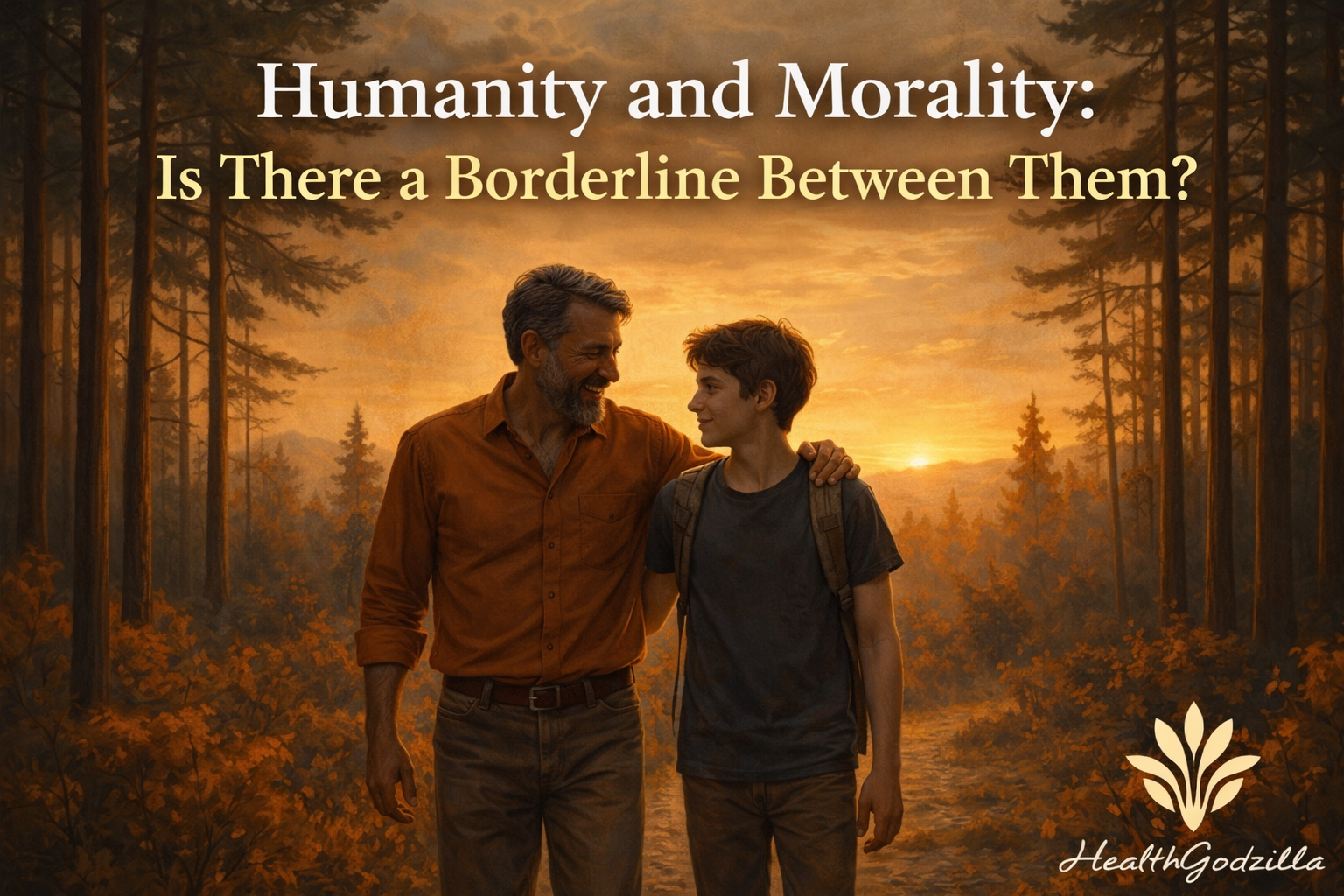
Selene was reading the chapter on morality in his philosophy textbook when his father entered the room. Evening had begun to gather at the window. The last light lay quietly across the pages, as if reluctant to leave. His father, a psychology professor, noticed the unusual stillness on his son’s face. Before he could speak, Selene looked up and asked, “Father, is there a difference between humanity and morality?”
The question did not sound like a classroom question. It sounded older than the room itself—simple in shape, yet deep enough to trouble centuries. The professor paused. Then a small smile crossed his face, not because the question was light, but because it was heavy in the right way. Few people, he knew, ever stopped long enough to ask whether the rules by which we judge life are truly the same as the tenderness by which we recognize it.
Where Humanity and Morality Begin to Part
The professor sat down across from him and remained silent for a moment. “That is a significant question,” he said at last. “People use the two words as if they were twins. Sometimes they do walk together. But I do not think they are identical.” Selene listened without moving. His father placed his spectacles on the table and folded his hands. “Morality often comes to us as rule, code, judgment, and instruction,” he said. “Humanity arrives differently. It appears in tenderness, restraint, recognition, and the quiet ability to feel another life as real. The two may overlap. Still, overlap is not sameness.”
He paused again, as if testing the weight of his own words. “A person may speak endlessly of morality and still wound others with a clean conscience. Another may never read a page of ethics, yet show deep humanity in one unrecorded act of mercy. That is why the matter is not simple. Morality may guide humanity. It may also harden and forget the pulse that gave birth to it.”

If Morality Has Older Roots
Selene leaned forward. “But if there were no human beings,” he said, “there would be no question of humanity. So does that not mean humanity came first?” The professor removed his spectacles and held them in his hand. “As a word, yes,” he said. “As a human concept, yes. But the deeper matter is not so simple. Before human beings began writing laws, praising virtue, or arguing about right and wrong, life already moved through relation. There was dependence, balance, consequence, restraint, and coexistence. Nature did not preach morality, but it was never empty of pattern.”
He looked at Selene with quiet approval. “That is why I would be careful here. Formal morality—the kind that appears in books, codes, duties, and judgments—belongs to human reflection. But its roots may reach deeper than human language. We did not create the whole drama from nothing. We entered a world already woven with interdependence. Perhaps what we call morality is, in part, our conscious translation of lessons life had been teaching long before we learned to name them.”
When Survival Becomes a Question
There is, however, a point where the question turns sharper, almost uncomfortable.
We often say that a lion has no morality. It kills without remorse, without principle, without the language of right and wrong. That is true. The lion does not pause to justify its act. It does not write a code to explain why the gazelle must die.
But human beings also kill and eat. Beef, mutton, chicken, fish—sometimes even creatures we fear or revere. Yet we do not always experience this as immoral. In many societies, it is ordinary, accepted, even celebrated. We explain it through survival, culture, necessity, or habit.
That difference matters.
When Humans Must Explain Survival
The lion acts within a pattern of life. The human acts—and then must decide how to live with the meaning of that act.
This is where morality enters, not as instinct, but as reflection. We do not merely participate in life; we interpret our participation. We justify, question, defend, or doubt what we do. Sometimes we construct elaborate systems to reassure ourselves. At other times, we allow discomfort to remain.
So the issue may not be whether killing exists in nature. It clearly does. The deeper issue is that only human beings seem compelled to ask whether their participation in that act requires explanation.
A lion does not need to be moral. It needs to survive.
A human being survives—and then asks whether survival alone is enough.
This question does not always lead to refusal. Many continue as before, sustained by culture or necessity. Others begin to change their habits, not because nature demands it, but because something within them does.
Here, humanity and morality meet again, but not peacefully. One carries the memory of life as it is. The other carries the question of how life ought to be lived.
Between them, there is no simple agreement. Only a tension that does not fade.
The Habit of Fragments in Humanity and Morality
Selene sat quietly for a while, then said, “So you mean morality and humanity may not be enemies, but our way of thinking often pulls them apart?” His father smiled. “Yes,” he said, “that is close to what I mean. We are trained to see things in fragments. We separate law from mercy, reason from feeling, society from nature, and then we forget that many of these divisions were made by the mind for convenience, not discovered as final truths in the world itself.”
He leaned back and glanced toward the darkening window. “That is partly why I have always loved Lovelock’s Gaia. It does not ask us to see life as a pile of isolated pieces. It asks us to see relation, system, mutual shaping. Rocks, oceans, air, soil, insects, forests, and living beings do not stand apart like strangers waiting in separate rooms. They form a world by affecting one another. Human beings entered that world late, named parts of it, judged parts of it, and then often mistook their labels for reality. Humanity and morality may be another example. In lived experience, they may flow through one another more deeply than our categories allow.”
When Morality Forgets Humanity
Selene lowered his eyes for a moment, as if trying to test the argument against the texture of ordinary life. “Then tell me, Father,” he said, “how should we see the difference in real terms?” The professor answered without haste. “Take a rigid moralist,” he said. “Such a person may defend every rule, speak loudly of purity, discipline, and correctness, and yet show very little tenderness toward a trembling human being standing before him. He may condemn weakness with a clean conscience. He may wound in the name of virtue and still believe himself upright. In such a case, morality has not disappeared. It has only drifted away from humanity.”
He let the words rest before offering the other side. “Now think of a simple villager,” he said, “someone who has never studied moral philosophy, never quoted a great thinker, never built a theory of ethics. One winter night, he breaks a minor rule to shelter a stranger, feed a hungry child, or protect a frightened animal. Society may accuse him of disobedience. Yet something in us still recognizes the act as deeply human. That recognition matters. It reminds us that humanity does not always wait for permission from formal morality. Sometimes it moves first, and morality arrives later to explain what the heart already knew.”
This is why knowledge with a tender heart matters. A mind may become informed, disciplined, and morally certain, yet still wound the living person before it. When knowledge grows without tenderness, it may defend morality while forgetting humanity.
On What Basis Do We Judge?
Selene remained silent for a while. The examples had entered him more deeply than definitions. “Then tell me, Father,” he said at last, “if morality and humanity are not identical, on what basis should we judge a person?” The professor took a slow breath, as if the question had opened another chamber in the house of thought. “With caution,” he said. “That is the first answer. We judge too quickly because we enjoy the illusion of clarity. A single act, a single word, a single failure, and we rush to build a complete portrait. But human beings are rarely that simple. What appears moral in one moment may hide cruelty. What appears improper in another may shelter mercy.”
He folded his hands again and looked toward Selene with grave tenderness. “So I would say this: every judgment must remain humble. We may evaluate actions, yes. We may weigh consequences, motives, patterns, and responsibilities. Society cannot live without judgment of some kind. But absolute fairness is beyond us. We see through partial knowledge, wounded memory, personal bias, and the habits of our time. That is why judgment, when it loses humility, becomes dangerous. It stops being discernment and starts becoming vanity in a robe.”
The Philosophical Answer and the Social One
Selene looked at his father with renewed curiosity. “Then is that the answer?” he asked. “That humanity matters more than morality?” A faint, mysterious smile returned to the professor’s face. “From a philosophical ground,” he said, “I may lean that way at times. A rule without tenderness can become a weapon. A code without living feeling can become a mask. But society does not always move by philosophy. It moves through systems, habits, institutions, permissions, and penalties. That is where the matter becomes more difficult.”
He paused, then continued in a quieter voice. “If you want to live, work, build, protect, or change something in this world, pure humanity is often not enough. It must pass through the moral language of society to become visible, acceptable, and sustainable. A compassionate act that completely ignores the structure around it may remain noble, yet fail. So here is the tension: humanity may be deeper, but morality often controls the gate. One keeps the pulse alive. The other decides, for better or worse, how that pulse may move in public.”
There Is No Final Answer in Humanity and Morality, Only Colors
Selene said nothing for a while. His eyes had drifted toward a small bunch of grapes resting on the table, but his mind seemed far beyond the room. The professor did not interrupt him. He had the look of a man who knew that some thoughts ripen only in silence. At last, Selene smiled, though faintly, as if he had not solved the question, but had learned how to carry it. “Then perhaps,” he said, “the real trouble begins when we mistake one part of the truth for the whole of it.”
His father’s face brightened with quiet pride. “Yes,” he said. “That is often how confusion begins. We cling to fragments and call them complete. Often, we defend a rule and forget the life it was meant to serve. At other times, we praise humanity while ignoring the structures through which human beings must struggle, negotiate, and survive. Wisdom may not lie in choosing one and rejecting the other. It may lie in understanding their tension, and in keeping morality from becoming cruel and humanity from becoming directionless.”
The room had grown dim by then. Outside, the moon was playing hide-and-seek with the clouds. Inside, no final verdict arrived, and none was needed. The father rose at last and told Selene it was time for dinner. The discussion would continue at the table, and perhaps for years beyond it. For some questions do not end in answers; they deepen into better ways of seeing. And this one, Selene now felt, belonged not to the textbook alone, but to life itself.
Hello, Artista
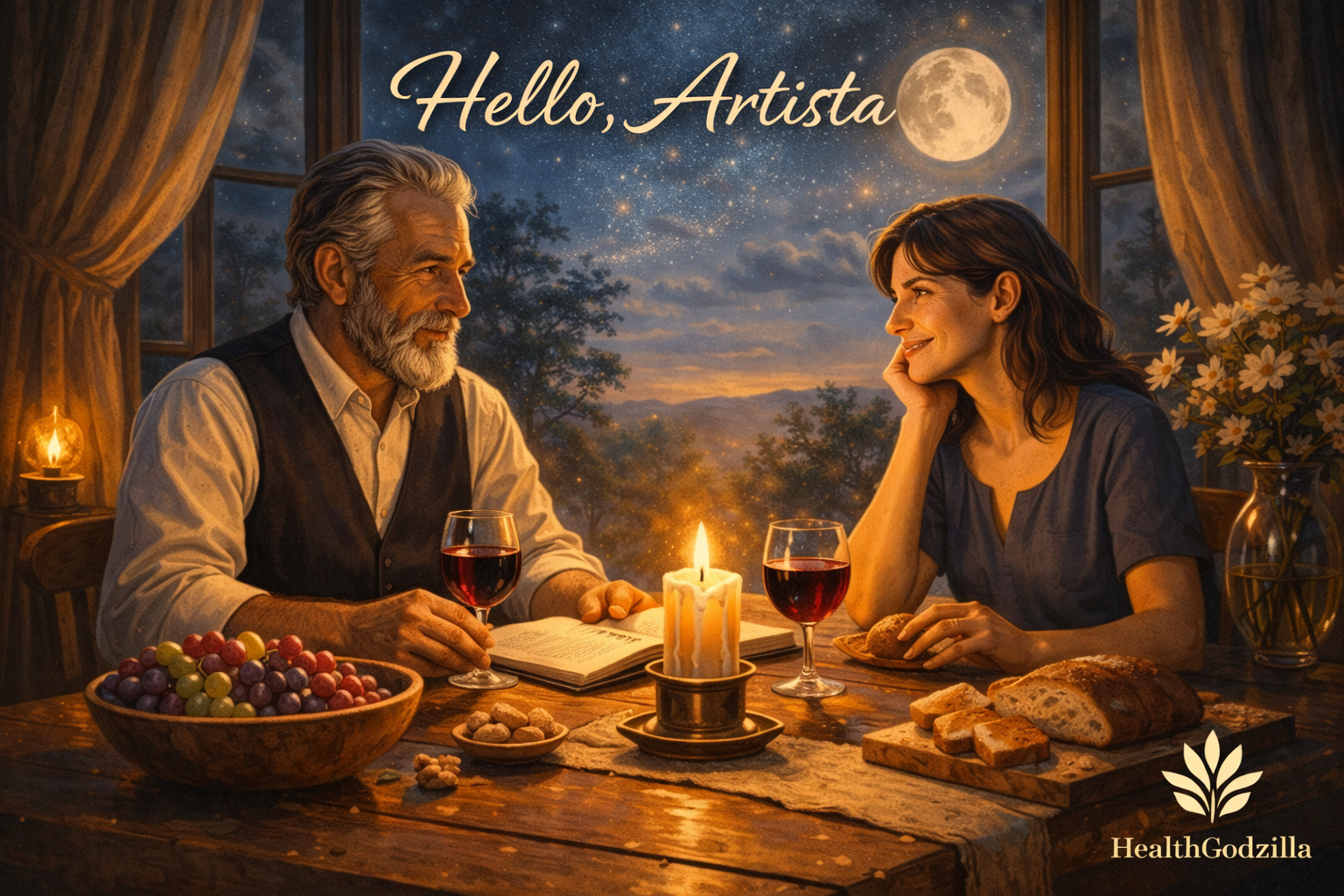
By the time dinner settled onto the table, the room had softened. The question had not ended. It had only changed its clothes.
Organum broke a piece of bread and looked across at Artista. “So,” he said, “if morality and humanity are not twins, what are they? Cousins? Rivals? Neighbors quarreling over a fence?”
Artista laughed. “Some days, they seem like two musicians playing the same song in different scales. One follows notation. The other follows pulse.”
Organum smiled. “And when the notation forgets the pulse?”
“Then morality becomes a skeleton wearing a judge’s coat,” Artista said. “It can still stand upright, but it cannot dance.”
“And what happens when pulse forgets form?” Organum asked.
Artista tilted her head. “Then humanity may remain warm, but helpless. A river without banks can still be beautiful, but it may fail to reach the field that thirsts for it.”
For a moment, both of them fell silent. Outside, the night leaned gently against the window. Somewhere beyond the dark, leaves were speaking in the old dialect of wind.
Organum spoke again. “Perhaps that is our trouble. We adore fragments. We polish one shard until it begins to think itself the mirror.”
Artista’s Grape Bowl, Sky Full of Stars
Artista’s eyes brightened. “Yes,” she said. “We praise morality and forget mercy. Or we praise humanity and forget that the world still moves through gates, systems, customs, and consequences. We keep slicing the living whole, then act surprised when the pieces no longer sing.”
Organum chuckled. “So the professor was right. There is no final answer.”
“No,” Artista said softly. “Only better ways of seeing. Humanity lets us feel the wound. Morality is one way we try to answer it. Sometimes they walk together like old friends. Sometimes one outruns the other. Wisdom, perhaps, begins when we notice that one has gone deaf to the music of the other.”
Then Artista reached for a grape from the bowl and held it up between her fingers as if it were a tiny planet.
“Look,” she said. “Even this little fruit carries a whole geometry—skin, sweetness, seed, sunlight, rain, labor, waiting. Nothing arrives alone. Why should thought?”
Organum laughed, and the sound was kind. “You always smuggle the universe into supper.”
Artista smiled. “And you always pretend to be surprised.”
Beyond the house, the moon kept playing hide-and-seek with the clouds. Inside, the table held its small republic of bread, fruit, thought, and affection. No verdict descended from the ceiling. No philosopher climbed down the wall to settle the matter. Yet something gentler had happened: the question had become more human by remaining unfinished.
And perhaps that, too, was a form of answer.
Author’s Reflection
If I were writing this for myself, I would confess that the question in this piece does not leave me in peace. Humanity and morality often appear together in speech, in books, in public praise, and in judgment. Yet they do not always arrive together in life. That tension pulls at me.
I have seen how easily morality can become formal, tidy, and proud. I have also seen how humanity can remain wordless, almost invisible, and yet carry more truth than polished systems do. A rule may stand upright and still fail to kneel beside suffering. A human heart may hesitate, tremble, even break a pattern—yet in doing so, protect something sacred.
That is why I did not want this piece to become a courtroom. I did not want one word crowned and the other exiled. Life rarely rewards such neat victories. I wanted instead to sit inside the tension and listen to it. To ask whether morality is one of humanity’s children, or whether both grew from older roots hidden in relation itself. To wonder whether we separate them too sharply because the mind is trained to cut living wholes into manageable fragments.
Perhaps that is also why the father does not offer a final verdict. I do not fully trust verdicts where living questions are concerned. Some truths arrive not as conclusions, but as clearer ways of seeing. They do not close the window. They clean the glass.
Let the borderline between humanity and morality remain a question worth following.
If this reflection carries any quiet loyalty, it is to that effort: not to flatten what is difficult, not to pretend certainty where life offers tension, and not to abandon tenderness in the name of intellectual order. Morality, if it is a map, must not forget the pulse. Humanity, if it is a pulse, must still find ways to move through the world without disappearing into silence.
And if no final answer comes, I do not think the question has failed. Some questions do nobler work by remaining alive.
I was not alone when I wrote this. Others spoke, and I listened.
Frequently Asked Questions
1. What is the difference between humanity and morality?
Humanity and morality often overlap, but they are not identical. Humanity leans toward tenderness, recognition, mercy, and the ability to feel another life as real. Morality usually appears as rule, code, judgment, duty, and social guidance.
2. Can a person be moral but not humane?
Yes. A person may defend rules, principles, or social codes and still treat others harshly. In such cases, morality may remain present, but it has drifted away from humanity.
3. Can a person be humane without formal morality?
Yes. A person may never study ethics or speak the language of moral philosophy, yet still act with deep compassion, restraint, and care. Sometimes humanity moves first, and morality comes later to explain it.
4. Which came first: humanity or morality?
There is no simple final answer. Formal morality, as law, code, and doctrine, belongs to human reflection. Yet its roots may lie deeper in relation, interdependence, consequence, and coexistence—patterns life carried long before humans named them.
5. Why does this article say there is no final answer?
Because some questions do not end in neat conclusions. Humanity and morality are connected, but their relationship is full of tension, overlap, and contradiction. The article does not try to close the question by force. It tries to see it more clearly.
Articles You May Like
From metal minds to stardust thoughts—more journeys await:
- Leadership Mindset Decision-Making: Psychological Roots and Organizational Impact
A father-son journey into how leadership mindset shapes authority, decisions, and a company’s rise—or quiet collapse. - Eco-Nutrition: Systems Diversity and Sustainable Diets
A reflective exploration of how biodiversity, food systems, and human health intertwine. From soil microbes to school lunches, this piece traces how diversity nourishes resilience—not only in ecosystems, but in culture and policy.
Curated with stardust by Organum & Artista, under a sky full of questions.
Principal Sources
The following works helped shape the perspective behind this story.
- Kant, I. (1997). Lectures on ethics (P. Heath, Ed. & Trans.; J. B. Schneewind, Ed.). Cambridge University Press. https://www.cambridge.org/core/books/lectures-on-ethics/3165BCC1A91F68ADADBFEC2F4DA4A58E
- Lovelock, J. (2016). Gaia: A new look at life on Earth. Oxford University Press. https://global.oup.com/academic/product/gaia-9780198784883?cc=bd&lang=en&
Relevant sections were interpreted through a narrative and systems lens rather than cited exhaustively.
This article is also archived for open access on Zenodo: https://doi.org/10.5281/zenodo.19571481
Leave a Reply