
By Ansarul Karim Jamee
Originally published: September 7, 2024 | Substantially revised: October 3, 2026
Ansarul Karim Jamee holds master’s degrees in Environmental Science and Management, History, and Business Administration. For nearly three decades, he has worked across diverse industries, advancing sustainability, well-being, and systems awareness.
Author profiles: LinkedIn | Google Scholar | Academia.edu | ORCID
To learn more about the author and the HealthGodzilla project, visit the HealthGodzilla homepage.
What the Story Is About
This short story examines growth mindset through an unfinished essay and a question in its margin. Selene has worked hard; yet his professor’s comments leave him wondering whether he can write at all.
On his grandfather’s bench, he shares the pages with his father. Their conversation turns toward the discomfort of asking for help—and the things both have left unrevised.
Drawing on Carol Dweck’s work and research on growth mindset interventions, the story considers what belief can contribute to learning, where its limits lie, and how feedback, strategies, and support enter the work. Selene and the conversations are fictional; the research provides context for the questions they raise.
A Difficulty Brought to the Bench
Selene had read the comments three times. In fact, he could remember the shortest one without opening his bag.
What makes you think this follows?
He had spent much of Sunday on that paragraph. While writing it, he had felt that one idea led naturally to the next. Now he could no longer find the connection. His essay argued that a character in a novel had changed.
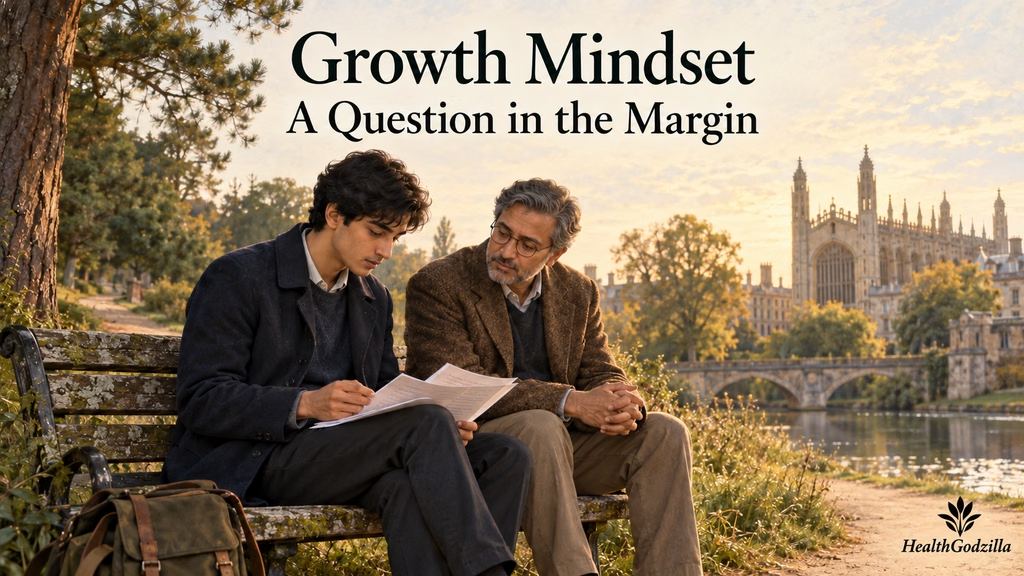
By the time he reached his grandfather’s bench, his father was already there. Pine needles lay along the empty half. His father brushed them aside, and Selene sat down with the bag between his feet.
“How did the essay go?”
“Back into my bag.”
His father smiled, then waited.
“The professor says I have an interesting question.”
“That sounds promising.”
“But he spent the next two pages explaining what I hadn’t answered.”
“May I see?”
Selene reached for the zipper but left it closed.
“I worked on it.”
“I know.”
“No, I mean I really worked on it. I read the things he suggested. Then I rewrote the introduction. I stayed up finishing it.”
His father looked down at the bag.
“Which comment troubles you most?”
Selene repeated the question about his paragraph.
“And what were you trying to connect?”
For a moment, Selene began to explain. Then he stopped.
“It sounds foolish when I say it.”
“We haven’t heard it yet.”
A cyclist passed along the path. Selene watched until the trees hid the bright rear light.
“I used to find this easier,” he said.
“The writing?”
“Knowing whether I was any good at it.”
His father leaned back. He had often called Selene a natural writer. The praise had come easily, especially when his son was younger and brought him something to read.
“Have you started the revision?”
“I’ve been thinking about choosing another topic.”
“Because another question interests you more?”
Selene bent down and opened the bag.
“I wouldn’t have to look at this one.”
He drew out the essay but kept it folded on his knee. His father waited beside him.
When a Result Becomes a Verdict
Selene unfolded the essay and passed it to his father.
“Second page.”
His father read the paragraph, then went back a few lines.
“What were you hoping this example would show?”
“That the character had changed.”
“And what does it show?”
“That he wanted to.”
They sat quietly for a moment.
“I suppose those are different,” Selene said.
“There may be something in that difference worth writing about.”
“I should have seen it.”
His father turned the page. There were comments beside several passages, a question near the conclusion, and a sentence underlined without explanation.
“Did you understand all of these?”
“Most of them.”
“This one?”
“I could ask.”
“Will you?”
Selene rubbed a crease in the paper.
“He’ll think I need everything explained.”
“Has he said that?”
“No.”
His father handed the essay back. Selene read the comment again. On the page, it asked how one thought followed another. But in his head, it had become a larger question.
Perhaps he had mistaken a love of writing for an ability to write.
“You always said I was good at this.”
“I did.”
“You sound less certain now.”
His father rested his hands on his knees.
“I’m thinking about how often I said it.”
Selene looked at him.
“You would bring me something, and I’d tell you that you had a gift. I enjoyed reading it. So I wanted you to know.”
“I liked hearing it.”
“I liked saying it.”
A breeze lifted the corner of the essay. Selene held it down with his thumb.
“When I started this one, I thought you’d want to read it.”
“I still do.”
“Even like this?”
His father glanced at the pages between them.
“Yes.”
Selene loosened his grip. He had expected to show his father the essay after the revision, when the awkward parts had disappeared and he could hand it over without explaining himself.
“I don’t mind changing a paragraph,” he said. “At least, I didn’t think I did.”
“What makes this one difficult?”
He looked at the sentence he had been so pleased to finish on Sunday.
“I thought I knew how to do this.”
His father waited.
“And now I have to find out how much I don’t know.”
What Are We Trying to Protect?
His father reached for the essay, then stopped.
“Were you going to correct it?” Selene asked.
“I nearly was.”
“You can.”
“I know. I’m rather comfortable correcting other people’s sentences.”
“And your own?”
His father laughed.
“I sometimes leave those in a drawer.”
Selene turned toward him.
“There’s a paper at home. A colleague sent it back with questions in June.”
“Have you answered them?”
“I’ve rearranged my desk instead.”
For the first time that afternoon, Selene smiled.
“It needed rearranging,” his father added.
“Of course.”
His father looked at the essay.
“She questioned a distinction I’ve been teaching for years. I began drafting a reply before I had properly considered whether she was right.”
“Was she?”
“About part of it, I think.”
“An inconvenient part?”
“Very.”
Selene laid the pages between them. Yet he had imagined that, somewhere along the way to becoming a professor, his father had finished feeling foolish.
“What made you read it again?”
“She asked whether I’d had time to think.”
“And had you?”
“I’d had time to be offended.”
A few needles fell onto the bench. His father picked one off the page.
“Carol Dweck writes about beliefs we hold concerning ability,” he said. “A fixed mindset treats it as something largely settled. In contrast, a growth mindset allows that it can develop.”
“So I have the first one.”
“I wouldn’t give you another label so quickly.”
“But I’m sitting here afraid to revise a paragraph.”
“Yes. And I have a paper in a drawer.”
Selene glanced at him.
“We can believe we’re capable of learning and still feel threatened when a particular piece of work matters to us,” his father continued. “Especially when we’ve become accustomed to doing it well.”
“I don’t feel like this about cooking.”
“I’ve eaten your cooking. You’re remarkably hopeful.”
“I know what went wrong with the rice.”
“What about the essay?”
“I thought I knew what I was doing.”
His father nodded.
“Then the question in the margin cost you more.”
Selene looked down. Before submitting the essay, he had considered taking it to his professor’s office hours. He had even checked the time. But he wanted the professor to encounter the finished argument, with every connection already in place.
“I could have asked him about this before,” he said.
“Why didn’t you?”
“I wanted him to see what I could do on my own.”
His father waited.
“Now I don’t want to ask because he’s seen it.”
He pulled the second page closer. The professor’s question still irritated him, but he could hear a question in it again.
“What would I even say when I went?”
His father leaned forward, then settled back.
“What would you like to find out?”
What Belief Can—and Cannot—Do
“Whether I can learn to make the argument properly,” Selene said.
“Then you’ll need to show him where you lose the connection.”
“And believing I can improve will help?”
“It might help you go through his door.”
“What happens once I’m inside?”
“You’ll still need something useful to happen there.”
Selene looked at his father.
“You’re making this growth mindset sound less convenient.”
“I may have introduced it too conveniently.”
His father drew his coat closer. Beyond the bench, someone called a dog that seemed to have other arrangements.
“There’s research behind the idea,” he said. “But there’s also disagreement about how much changing a belief changes the result.”
That disagreement deserves a little room here.
What the Research Shows
In their 2007 research, Lisa Blackwell and her colleagues followed students through the transition to junior high school. Specifically, they found that believing intelligence could develop predicted a more favorable trajectory in mathematics grades. However, that association alone could not establish cause. A separate, smaller intervention study offered encouraging evidence: students who received instruction about intelligence developing, alongside other learning material, showed a better grade trajectory than the comparison group. Even so, the study’s size and setting limited how far its findings could travel.
Later, a larger test followed. In 2019, David Yeager and his colleagues reported a national experiment involving more than 12,000 ninth graders in 65 U.S. public schools. Here, a brief growth mindset intervention produced a small improvement in grades among lower-achieving students. In addition, the findings pointed to the importance of school environments, including whether peers supported taking on challenges.
The two 2023 reviews, however, leave us with a disputed picture. In their published abstract, Macnamara and Burgoyne (2023) reported a very small overall academic effect that became statistically nonsignificant after correction for potential publication bias. Their highest-quality subset also showed no statistically significant benefit. In contrast, Burnette and colleagues (2023) reported a small academic benefit under conditions combining targeted student groups with interventions delivered closely according to their intended design, alongside substantial variation in expected effects.
However, those estimates address different selections and conditions. We therefore cannot settle their disagreement from the abstracts alone.
Back to the Unfinished Essay
Nor do these studies tell us precisely what will happen to a young writer sitting beside his father. They examine educational interventions and outcomes; Selene’s fear of disappointing someone belongs to the story through which we are considering them.
“So you can’t tell me this will make the next essay good,” Selene said.
“No.”
“Or that the professor will explain it well.”
“No. You may need to ask again, or find help elsewhere.”
Selene looked back at the paragraph. The missing connection had survived their conversation.
“I still like the question I started with,” he said.
His father glanced at the page.
“What made you ask it?”
Returning to the Work
“Everyone in the seminar thought he’d changed,” Selene said. “But I wasn’t sure. He spoke differently toward the end, but when someone needed him, he still found a reason to leave.”
His father looked at the essay.
“Is that in here?”
“Somewhere.”
Selene searched the pages. Eventually, he found a sentence near the bottom of the third.
“There.”
His father read it.
“You passed over that rather quickly.”
“I couldn’t make it fit.”
“Fit what?”
“The argument.”
Selene took the page back. He had spent an evening moving that sentence between paragraphs before leaving it where it caused the least disturbance.
“I think I made the character improve because I wanted the essay to come together.”
He reached into his bag for a pencil.
Above the paragraph, he wrote: What does he do differently?
Then, beneath it: What stays the same?
His father leaned closer.
“You could begin by—”
“Wait.”
The pencil hovered.
“I want to see where this goes.”
His father sat back.
Selene numbered two scenes in the margin. He remembered a third, though he would have to reread it. For several minutes, the only conversation came from farther along the path.
Then he crossed out the opening sentence.
“That was the one you liked,” his father said.
“I still like it.”
He read it once more.
“But I may have to keep it somewhere else.”
“Drawers are useful.”
“You’ve established that.”
Selene smiled, but the next sentence resisted him. He tried a few words, rubbed them out, and brushed the crumbs from the page.
“I can’t do the whole thing here.”
“Do you have the book?”
“At home. And I need to check what he actually says in the last scene.”
He turned the essay over and wrote himself a note. First, reread the two scenes. Then find the third. Compare what the character promises with what he does.
“And the professor?” his father asked.
“Office hours on Thursday. If there’s space.”
“What will you ask?”
Selene considered.
“Whether the scenes support this reading—and where I’m asking them to carry too much.”
He paused.
“Of course, I’ll need to show him a paragraph.”
It was less comfortable than arriving with a finished essay. He could already imagine stumbling through the explanation. Still, he wrote Thursday beneath the other notes.
His father reached for his phone.
“What are you doing?”
“Finding the email from my colleague.”
“About the paper?”
“Yes.”
Selene shifted the pages onto his own knee, making room on the bench.
The Next Attempt

On Thursday, Selene reached the professor’s office with a revised paragraph and the book.
Someone was already inside. So he waited beside a bulletin board, reading the same announcement twice.
The paragraph had seemed clearer at home. But standing in the corridor, he found a sentence he wanted to change. He took out his pencil, then heard a chair move.
“Come in.”
Selene sat down and placed the pages on the desk.
“I tried another approach.”
The professor began to read. Selene watched his pencil travel down the margin.
“This distinction is clearer,” the professor said. “But here—you say he understands the harm he’s done. What gives you that impression?”
Selene felt the familiar urge to explain how long he had spent on it.
Instead, he opened the book.
“This conversation.”
They read the passage.
“He knows the other person is angry,” the professor said. “Does that mean he understands why?”
“I thought so.”
“You may be right. Show me where.”
Selene searched farther down the page. The sentence he remembered was there, though it seemed less decisive with the rest of the conversation around it.
“I may have done it again.”
“What?”
“Given him more credit than the scene allows.”
“Try writing what you can support first. Then see how much of your larger claim remains.”
Selene wrote that down.
They worked through a few lines. Before he left, he asked the professor to explain one comment on the original essay that he still did not understand.
Outside, he put both versions into his bag. There was more to revise than he had hoped.
That evening, his father found him at the table with the book open.
“How did it go?”
“He asked me another question.”
“An inconvenient one?”
Selene moved a cup away from his notes.
“And your colleague?”
“We’re talking on Monday.”
Selene nodded and returned to the passage.
After a while, he crossed out understands.
He left a space for the word he had not found.
Frequently Asked Questions
In Carol Dweck’s framework, a growth mindset is the belief that abilities can develop. It leaves room for learning through practice, effective strategies, feedback, and support. However, it does not mean that everyone starts with the same opportunities or can achieve anything they wish.
Yes. For example, someone may believe they can improve at cooking while treating mathematical ability as something they either possess or lack. These beliefs can also shift with circumstances. Feeling defensive about a setback does not, by itself, define someone’s mindset. After all, the terms describe beliefs about ability, rather than two permanent kinds of people.
No. Repeating an ineffective approach can leave someone exhausted and no closer to understanding. Instead, learning may require a different method, clearer instruction, more time, or help identifying a mistake. In Selene’s story, for example, the next step is to examine what his evidence supports and ask a specific question about his argument.
The findings are mixed. Some studies report small academic benefits for particular students and settings. However, the two 2023 reviews discussed here reach different conclusions: Macnamara and Burgoyne question whether apparent benefits hold up under checks for study quality and bias; Burnette and colleagues report benefits under selected conditions involving targeted groups and strong implementation.
These findings therefore do not establish a dependable route to higher achievement. Our discussion of those two reviews draws only on their published abstracts.
Articles You May Like
If Selene’s unfinished essay has stayed with you, these articles continue through questions of learning, recognition, uncertainty, and what we ask of ourselves.
- Intellectual Growth and Vocation: Before the Mind Can Grow, It Must Answer a Call
To begin, another conversation between Selene and his father asks what learning is for—and how discipline, protected time, and a tender heart can give knowledge direction. - Meaning of Success: A Conversation Across Time
Beyond learning itself, this reflection considers the measures we inherit and the fear of falling short, asking how our understanding of success shapes the lives we try to build. - The Fragile Crown: The Burden of Being Number One
Similarly, this close companion to Selene’s difficulty explores what happens when self-worth depends on achievement, recognition, or remaining exceptional in other people’s eyes. - The Old Man and the Sea: Not Yet Doesn’t Mean Never
Here, too, effort meets uncertainty. A return to Santiago’s struggle considers disappointment and the uncomfortable distance between the work we give and the results we bring home. - In Praise of Night: The Call of Lullabies and Fairy Tales
Finally, a quieter journey through stories, memory, longing, and human presence explores what imagination allows us to hear when explanation alone cannot reach far enough.
Each article begins with a different difficulty. Together, however, they leave room to consider how we learn, what we value, and how much of a life remains beyond its visible results.
Principal Sources
The following sources provide the conceptual and research foundation for this article, covering beliefs about ability, responses to setbacks, learning, and the effectiveness and limitations of growth mindset interventions.
- Dweck, C. S. (2006). Mindset: The new psychology of success. Random House.
Chapters consulted include “Inside the Mindsets,” excerpts from “The Truth About Ability and Accomplishment,” and “Changing Mindsets.”
https://www.penguinrandomhouse.com/books/44330/mindset-by-carol-s-dweck-phd/ - Blackwell, L. S., Trzesniewski, K. H., & Dweck, C. S. (2007). Implicit theories of intelligence predict achievement across an adolescent transition: A longitudinal study and an intervention. Child Development, 78(1), 246–263.
https://doi.org/10.1111/j.1467-8624.2007.00995.x - Yeager, D. S., et al. (2019). A national experiment reveals where a growth mindset improves achievement. Nature, 573, 364–369.
https://doi.org/10.1038/s41586-019-1466-y - Macnamara, B. N., & Burgoyne, A. P. (2023). Do growth mindset interventions impact students’ academic achievement? A systematic review and meta-analysis with recommendations for best practices. Psychological Bulletin, 149(3–4), 133–173.
https://doi.org/10.1037/bul0000352 - Burnette, J. L., Billingsley, J., Banks, G. C., Knouse, L. E., Hoyt, C. L., Pollack, J. M., & Simon, S. (2023). A systematic review and meta-analysis of growth mindset interventions: For whom, how, and why might such interventions work? Psychological Bulletin, 149(3–4), 174–205.
https://doi.org/10.1037/bul0000368
For Macnamara and Burgoyne (2023) and Burnette et al. (2023), we consulted only the published abstracts. Accordingly, our discussion stays within the findings and qualifications those abstracts report.
HealthGodzilla draws on these sources to explore how beliefs about ability can shape the meaning we give to difficulty—and how strategies, support, and learning environments matter alongside those beliefs. The fictional dialogue also explores questions beyond those directly tested in the cited studies. This is not an exhaustive review, and growth mindset is not presented as a guarantee of achievement.
This article is also archived for open access at https://doi.org/10.5281/zenodo.23126094