

By Ansarul Karim Jamee
Originally published: February 10, 2025 | Substantially revised: November 1, 2026
Ansarul Karim Jamee holds master’s degrees in Environmental Science and Management, History, and Business Administration. For nearly three decades, he has worked across diverse industries, advancing sustainability, well-being, and systems awareness.
Author profiles: LinkedIn | Google Scholar | Academia.edu | ORCID
To learn more about the author and the HealthGodzilla project, visit the HealthGodzilla homepage.
What the Article Is About
Benzene exposure connects workplaces, homes, and the environment. A fuel tank, a refinery, a busy road, and a kitchen seem like separate places. This article follows benzene from its sources through air, soil, and water, examining where prevention can interrupt its journey.
Imagine Kimiya, our fictional observer, standing beside a refinery fence at dusk. A worker leaves through the gate. Beyond it, someone opens a window at home. The fence marks the property line; understanding what travels beyond it requires more than a boundary on a map.
Before the release
Benzene is a volatile, flammable liquid. It occurs naturally in crude oil and can form during events such as forest fires. Human activities also release it through fuel handling, industrial processes, and combustion. Industry uses benzene to manufacture other chemicals that help produce materials such as plastics, synthetic fibers, and rubber. [1] [4]
Its usefulness helps explain its industrial presence. Its hazardous properties explain why that presence requires care.
We should also distinguish a chemical used in manufacturing from the finished product. Knowing that benzene participates in a production chain does not, by itself, tell us whether a particular object releases benzene into someone’s surroundings. That requires evidence about the product and its conditions of use.
The same precision applies to related chemicals. Benzene, toluene, xylene, and ethylbenzene may appear together in discussions of fuels and solvents, but their health effects are not interchangeable. The International Labour Organization (ILO) treats these distinctions explicitly in its occupational-disease guidance. [1]
Where benzene enters shared surroundings
Benzene exposure can occur at work, in the wider environment, and at home. The World Health Organization identifies petroleum products, including motor fuels and solvents, as important sources, alongside tobacco smoke. Because benzene evaporates readily, inhalation is a major exposure route. [3]
Industrial releases deserve attention beyond the most visible chimney. In its refinery guidance, the U.S. Environmental Protection Agency (EPA) identifies storage tanks, loading operations, and wastewater operations among sources associated with elevated benzene measurements at facility boundaries. [7]
This widens the questions we ask. How does a facility transfer its materials? What happens during storage and maintenance? Where does its wastewater go? An environmental account must follow the ordinary movements of production as carefully as its dramatic failures.
Household sources also require specific evidence. A 2023 study of 87 homes in California and Colorado measured benzene emissions from natural gas and propane combustion in stoves. The findings establish a source worth understanding; they do not establish identical conditions or exposures in every kitchen. [6]
After release: air, soil, and water
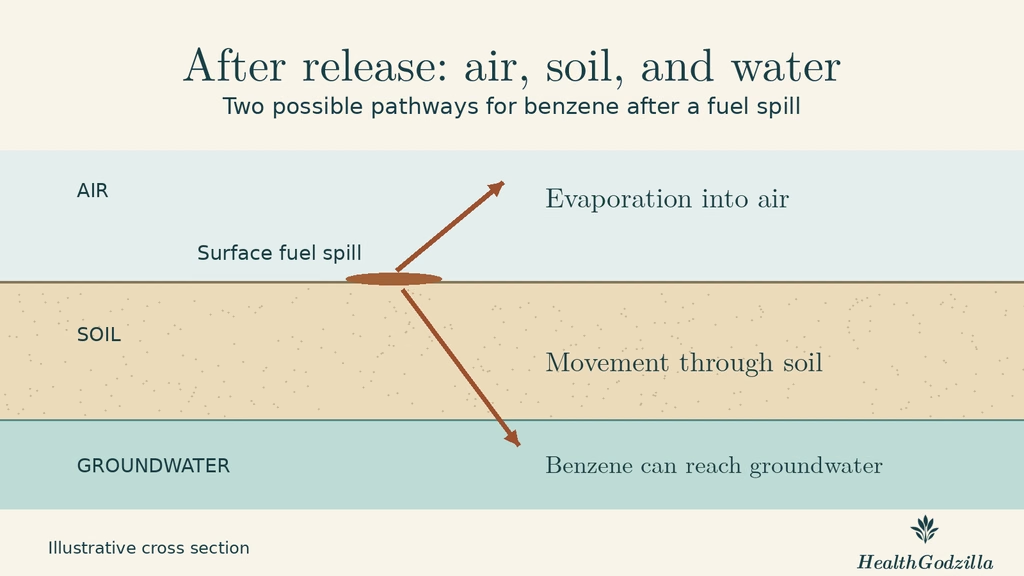
Benzene’s environmental journey changes with its surroundings.
In air, it undergoes chemical breakdown, generally within a few days. It can evaporate from surface water and soil, and it can move through soil into groundwater. The Agency for Toxic Substances and Disease Registry (ATSDR) does not expect it to accumulate substantially in plants or animals. These properties give us a more accurate picture than imagining a substance that remains forever and steadily builds up throughout the food chain. [4]
Groundwater presents different conditions. California’s State Water Resources Control Board explains that benzene biodegradation there can take days to years, depending on oxygen, temperature, and suitable bacteria. A timescale observed in the atmosphere therefore cannot tell us how quickly an underground contamination problem will resolve. [5]
There is another distinction worth holding onto: evaporation moves benzene into air; it does not destroy the chemical. Breakdown and movement are different processes.
Nor does eventual breakdown make continuing releases unimportant. A source may keep adding material while environmental processes remove some of it. The practical questions remain: how much enters, where it travels, and whether releases continue.
A patch of ground may look ordinary while an investigation tells a different story. Appearance gives us a beginning, not a measurement.
Where pathways meet people
Workers, nearby residents, and households may encounter different sources and exposure conditions. The ILO identifies occupations involving petroleum refining, fuel handling, chemical production, and other activities where benzene exposure can occur. That does not mean everyone working in those settings receives the same exposure. [1]
The reason for prevention is well established. The International Agency for Research on Cancer (IARC) classifies benzene as carcinogenic to humans, with sufficient evidence that it causes acute myeloid leukemia in adults. [2] Long-term exposure can also harm blood cells and bone marrow. [4]
These findings explain why preventing benzene exposure matters. They do not predict an individual person’s outcome from a location, an occupation, or a brief encounter. Understanding a particular exposure requires information about concentration, duration, frequency, and route.
A lesson from another chemical
My work in garment manufacturing left me with an experience that shapes how I think about prevention. It involved potassium permanganate—commonly called PP in garment processing—not benzene.
I learned that a senior garment quality assurance (QA) manager had fainted while observing PP work and discussing a fading-quality issue. During my investigation, I learned that someone had offered her a protective mask, but she continued wearing her regular fabric mask.
She received first aid and later went to a hospital. I was told that the hospital kept her under observation for four hours before discharge. She returned to work the next day, and no further complications were reported to me. I did not obtain the diagnosis, so I cannot establish why she fainted.
Management’s investigation found that some senior staff did not follow personal protective equipment (PPE) instructions. It arranged awareness training and tightened entry requirements. Management also reported inspecting the section with its chemical engineer, who recommended an exhaust fan, water backdrops behind the process, and a drainage connection to the effluent treatment plant.
At my last follow-up, preparations for the fan purchase and drainage route were underway. The factory subsequently ceased operations, ending our involvement before I could verify completion.
Those recommendations were specific to that factory; I cannot present them as a verified control system. What stayed with me was the unfinished work. An instruction had been issued, improvements had been proposed, and implementation still needed follow-through.
For me, the experience raises three questions: Do precautions apply equally to everyone? Where does material go when we draw it away or wash it into a drain? Who verifies that an improvement works?
Prevention begins at the source
For benzene, the ILO emphasizes substitution where feasible, closed processes, engineering and ventilation controls, monitoring, appropriate work practices, and personal protective equipment. These measures address different parts of the exposure problem. [1]
The environmental task extends from protecting a work area to understanding the destination of its emissions and waste. A control deserves scrutiny along its whole route: collection, handling, treatment, and final release.
Monitoring helps test whether intentions become results. Under the U.S. refinery framework described by EPA, an annual-average benzene concentration attributable to the facility above the regulatory action level requires investigation and corrective action. The approach connects monitoring with a responsibility to identify and address the cause of an exceedance. [7]
That is a useful principle beyond any single jurisdiction. A measurement should lead somewhere. So should an inspection finding, a repair request, and a problem reported by a worker.
For readers trying to understand a facility’s environmental performance, useful questions include:
- Which processes can release benzene?
- What prevents or captures those releases?
- What measurements show whether controls work?
- When a problem appears, who takes responsibility for correction?
- What evidence confirms completion?
A policy describes an intention. Maintenance records, measurements, and verified repairs help show what happens in practice.
Back at the fence
Return to our imagined evening. Kimiya remains beside the gate as the last workers leave.
A neighbor cannot judge a facility’s environmental performance from its lights, its silence, or the neatness of its fence. Much of the work happens behind the scenes: in equipment design, maintenance decisions, sampling records, and the patient follow-through after someone reports a fault.
The most meaningful ending may be modest—a leak located, a repair completed, and a measurement taken afterward.
Care becomes tangible when someone checks what changed.
A note from the author
Nearly three decades ago, I began my career at a dyeing and hosiery mill. I still remember its chemical-handling procedures. Since then, I have worked in sweater and garment manufacturing, particularly in washing operations, and later in a brand office, auditing sustainability practices in hundreds of factories.
Over those years, I witnessed improvements in health and safety practices, the use of personal protective equipment (PPE), and awareness among factory management and workers. I also saw changes in labor and environmental legislation, alongside evolving expectations of responsible manufacturing.
I hold a master’s degree in Environmental Science and Management from Jahangirnagar University. My training includes TÜV SÜD’s EHS lead auditor course, based on ISO 14001:2004 and BS OHSAS 18001:2007, and SAI’s SA8000 basic and advanced auditor courses, including both examinations. I am grateful to have witnessed this journey and feel responsible for sharing what I have learned along the way.
Frequently Asked Questions
Sources include petroleum refining, fuel storage and handling, vehicle emissions, tobacco smoke, and certain industrial processes. Research has also documented benzene emissions from gas and propane stove combustion. Exposure varies with the source, concentration, duration, and surrounding conditions.
Benzene can evaporate into air and move through soil toward groundwater. It also undergoes breakdown, with the rate depending on its surroundings. Evaporation transfers benzene into air, while breakdown changes the chemical itself.
Benzene can break down, but the time required varies. Conditions in groundwater can allow it to persist much longer than in air. Continuing releases can also replenish contamination while natural processes remove some of it.
A manufacturing connection alone cannot establish whether a finished product releases benzene. That requires evidence about the product’s composition, any remaining benzene, and its conditions of use.
Prevention can begin with substitution where feasible, enclosed processes, leak prevention, and controls that capture releases. Maintenance and monitoring help establish whether these measures work. Following emissions and waste through collection, treatment, and final release also helps identify where further controls are needed.
Articles You May Like
These stories continue our inquiry into how pollution travels through shared surroundings, what remains after a release, and where prevention can begin.
- Lead Pollution: From Earth to Industry to Human Life
Beginning at a former battery-recycling site in Bangladesh, this essay follows lead through industry, soil, dust, and homes. It asks why contamination can outlast the activity that created it—and how those pathways can be interrupted. - Impact of Air Pollution on Plants: Leaves Bear Scars of Our Progress
A leaf brings another part of the pollution story into view. This essay examines how airborne pollutants affect plants and how those effects extend through soil, water, and surrounding ecosystems.
Principal Sources
- International Labour Organization (2022). Diagnostic and Exposure Criteria for Occupational Diseases. Sections 1.1.12 and 3.1.8.
- International Agency for Research on Cancer (2018). Benzene. IARC Monographs on the Evaluation of Carcinogenic Risks to Humans, Volume 120.
- World Health Organization (2019). Exposure to Benzene: A Major Public Health Concern.
- Agency for Toxic Substances and Disease Registry. Benzene: ToxFAQs.
- California State Water Resources Control Board (2017). Groundwater Fact Sheet: Benzene.
- Kashtan, Y. S., et al. (2023). Gas and Propane Combustion from Stoves Emits Benzene and Increases Indoor Air Pollution. Environmental Science & Technology, 57(26), 9653–9663. https://doi.org/10.1021/acs.est.2c09289
- U.S. Environmental Protection Agency (2025). Enforcement Alert: Benzene Fenceline Monitoring at Petroleum Refineries.
Editorial note: Kimiya and the refinery scenes are fictional. The factory account describes the author’s investigation and subsequent reports received; it does not establish a medical cause or benzene exposure.
This article is also archived for open access at https://doi.org/10.5281/zenodo.24022517