
By Ansarul Karim Jamee
Published: August 1, 2026
Ansarul Karim Jamee holds master’s degrees in Environmental Science and Management, History, and Business Administration. For nearly three decades, he has worked across diverse industries, advancing sustainability, well-being, and systems awareness.
Author profiles: LinkedIn | Google Scholar | Academia.edu | ORCID
To learn more about the author and the HealthGodzilla project, visit the HealthGodzilla homepage.
Description
In Praise of Night: The Call of Lullabies and Fairy Tales accompanies a wanderer on a night journey around the world—across the earth and beneath it, through the sky, the topsoil, jungles, deserts, villages, and megacities that refuse to sleep and compete with the moon.
Along the way, moving through ancient, medieval, and modern times, the wanderer hears lullabies carried from cradle to cradle, enters fairy tales whispered beside fires and beneath trembling blankets, and encounters the hidden lives of the night: sleeping bodies, hunting animals, migrating birds, courting insects, decomposing matter, glowing windows, forgotten gods, restless machines, and dreams that belong to no single age or civilization.
Throughout this journey, science, philosophy, mythology, ecology, memory, and storytelling come together to ask what night has given humanity—and what continues to blossom within darkness, silence, lullabies, and wonder.
When Evening Loosens the World
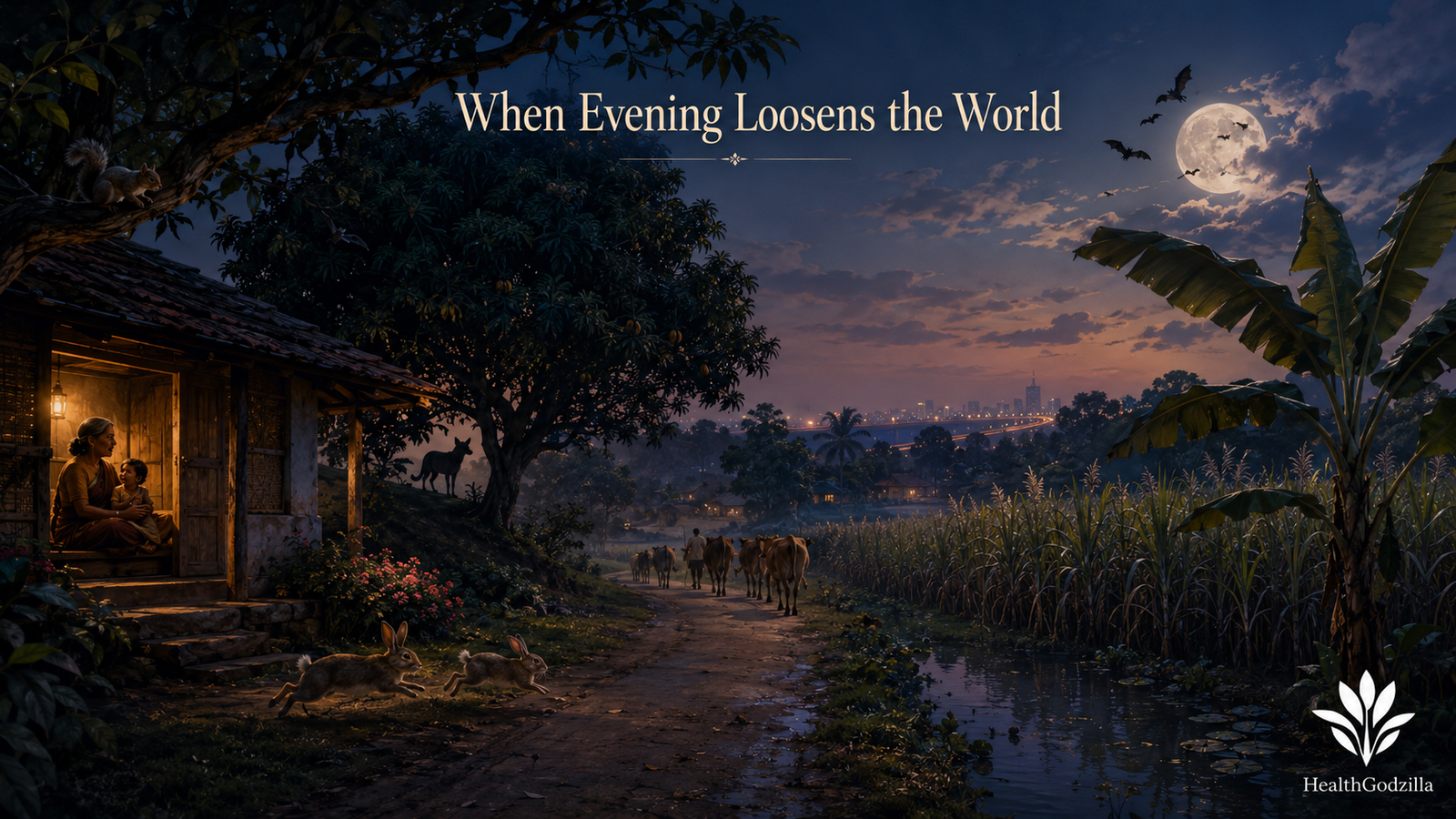
The wanderer arrived where the village road narrowed beside a sugarcane field.
Day had not ended entirely. It lingered on the leaves, on the pond, on the corrugated roofs, and on the backs of cattle returning home. Yet evening had begun loosening the world from its visible shape. As a result, the trees appeared larger. The paths seemed longer. Familiar places withdrew behind shadow, as if they had remembered older names.
Behind a mango tree, a jackal stood still.
The wanderer could see only its silhouette—the pointed ears, the lowered head, the patient body. It seemed neither frightened nor fierce. Instead, it was simply waiting for the human world to become quieter.
Nearby, two rabbits chased one another across the ground. Meanwhile, a squirrel ran along a branch, stopped, looked down, and vanished into the leaves. Another answered from somewhere deeper in the tree.
The village had not fallen asleep.
It was changing shifts.
When the Village Changed Shifts
Then, from a nearby house came the thin, tender sound of a traditional Bengali children’s rhyme, often sung as a lullaby:
আয় আয় চাঁদ মামা টিপ দিয়ে যা,
চাঁদের কপালে চাঁদ টিপ দিয়ে যা।
ধান ভানলে কুঁড়ো দেব,
মাছ কাটলে মুড়ো দেব।
কাল গাইয়ের দুধ দেব,
দুধ খাবার বাটি দেব।
চাঁদের কপালে চাঁদ টিপ দিয়ে যা।
Aay Aay Chand Mama Tip diye ja,
Chander kopale chand tip diye ja.
Dhan bhanle kunro debo,
Machh katle muro debo.
Kalo gaiyer dudh debo,
Dudh khabar bati debo.
Chander kopale chand tip diye ja.
Come, come, Moon-Uncle, place a bindi;
place a bindi on the forehead of my moon—my baby.
When the rice is husked, I will give you rice bran;
when the fish is cut, I will give you its head.
I will give you milk from the black cow
and a bowl from which to drink it.
O Moon-Uncle, place a bindi on the forehead of my moon—my baby.
(English rendering by the author.)
When the Moon Became Kin
The wanderer stopped.
The voice belonged to a woman, perhaps a mother, perhaps a grandmother. Inside the house, a child was being coaxed toward sleep through promises of rice bran, fish head, cow’s milk, and a bowl from which to drink it. In that moment, the moon was not a distant rock in the sky. It was kin. It could be invited, bribed, persuaded, and adorned.
That was how humanity had often dealt with the universe.
It made relatives of what it could not reach.
The moon became an uncle. The wind became a messenger. Rivers became mothers. Mountains became guardians. Forests became kingdoms. Even death itself became a traveler who might be delayed at the door.
The wanderer looked upward.
The moon had risen behind a pale cloud. Its light was modest, but it carried the strange authority of things that do not need to shout.
Far away, beyond the village, a highway carried buses, trucks, and motorcycles beneath electric lamps. Still farther, a city glowed against the horizon, refusing the darkness and competing with the moon.
But here, for a little while, the night remained sovereign.
When the Body Began Reading the Dark
The child inside the house did not know of circadian rhythm, melatonin, sleep cycles, memory consolidation, or the chemistry of repair. Nor did the child need to know. The body had already begun its own quiet preparation.
Light had faded.
The eyes had noticed.
The brain had begun reading the darkness.
Meanwhile, somewhere inside the skull, ancient signals moved without language. Hormones adjusted. Temperature shifted. Muscles softened. Attention loosened its grip. The body, which had spent the day facing outward, slowly turned inward.
The lullaby continued.
Its rhythm did not argue with the child. It did not explain sleep. Rather, it repeated, returned, circled, and softened. Rhythm was the seed from which logic grew. Breath was the ground on which philosophy stood. And long before words were shaped into symbols, humanity already knew that a single voice could guide another body into rest.
The wanderer listened until the final line faded.
Then he walked onward.
Behind him, the jackal moved from the mango tree toward the sugarcane field.
Above him, bats crossed the moon.
The Night Beneath His Feet
Beneath his feet, another night was beginning.
In the topsoil, insects stirred inside tunnels and chambers. Beetles pushed through fallen leaves. Ants carried fragments into hidden corridors. Larvae fed. Earthworms loosened the soil. Fungi spread their pale threads through the dark.
Some creatures searched for food.
Others searched for mates.
Still others decomposed what had died.
The soil was not sleeping.
It was digesting the day.
A fallen leaf, soft with decay, had already begun losing its old identity. Eventually, it would become food for microbes, passage for insects, nourishment for roots, and perhaps, one day, fruit on a branch.
The wanderer paused and pressed his foot lightly against the earth.
Human beings often looked toward the stars when they wished to feel wonder. Yet beneath the sole of his shoe, millions of lives were courting, feeding, breaking apart, rebuilding, and returning the dead to the living.
The night above glittered.
The night below labored.
And between them walked the wanderer, following a lullaby he could no longer hear, though its rhythm remained somewhere inside him.
Where the Ground Kept Its Secrets
The path narrowed after the sugarcane field.
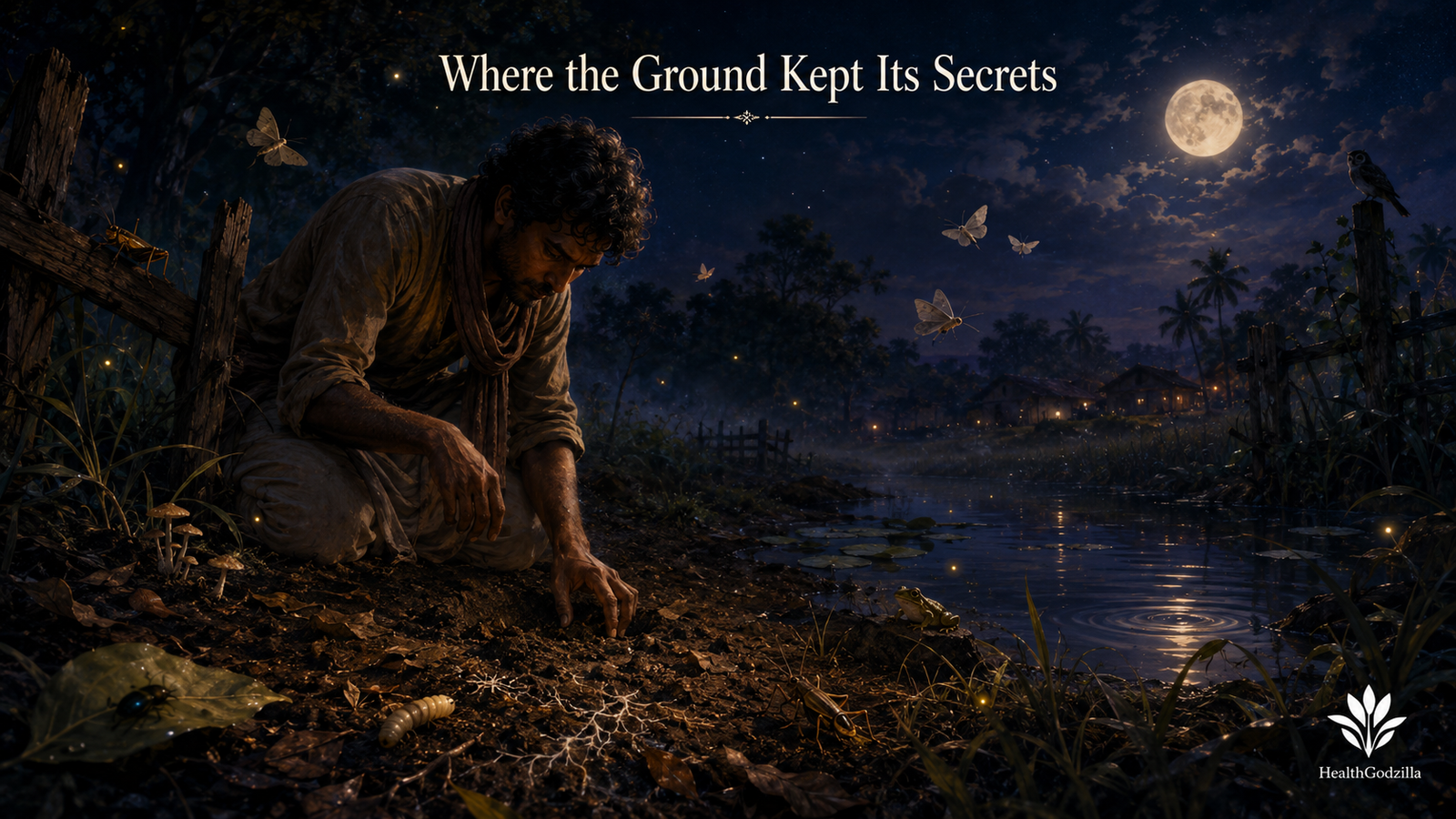
On one side stood a pond covered in shadow. On the other, banana leaves leaned over the road as though listening. The wanderer walked slowly, not because he feared the dark, but because the dark had begun to reveal how carelessly daylight passed over things.
Messages Without Light
A cricket called from beneath a broken fence.
Another answered from the grass.
Then another.
The sound traveled without haste, one small body speaking across a distance it could not see.
The wanderer stopped.
To human ears, it was only a familiar night sound. Yet somewhere among the roots and fallen leaves, the call was not music. Instead, it was invitation, announcement, rivalry, desire.
The night was full of courtship.
Meanwhile, moths released invisible messages into the air. Beetles searched through bark and soil. Fireflies raised and lowered their lamps, not for human wonder, but for one another. Frogs called from the pond with the seriousness of kings declaring territory. Wings trembled. Antennae received what eyes could not.
Even love had learned to survive without daylight.
The wanderer smiled.
Human beings wrote poems, purchased flowers, wore perfume, waited beside windows, and suffered entire evenings over unanswered messages. Insects had been negotiating the same difficulties for millions of years, though with fewer metaphors and perhaps better chemical accuracy.
A single firefly drifted beside the path. Soon, two others joined its glow. Before long, twenty lights shimmered together, rising among the bushes like fragments of a fallen constellation.
Where the Fallen Constellation Led
The wanderer followed them until the road softened into damp earth. There, he could smell water, mud, leaves, and something older—something between decay and birth.
He knelt.
The topsoil crumbled between his fingers.
It seemed simple: dark earth, fragments of leaves, grains of sand, a thin root. Yet the handful contained hunger, memory, death, digestion, reproduction, and preparation.
A beetle moved beneath a leaf.
A pale larva folded itself deeper into the soil.
Fungal threads spread through places no moonbeam entered.
Bacteria dismantled what larger creatures could no longer use.
Still, nothing there spoke of waste.
A fallen branch became shelter.
A dead insect became nourishment.
A rotting fruit became sugar for another mouth.
Thus, a body returned not as itself, but as possibility.
The Pond That Held the Moon
The wanderer looked toward the pond.
At its edge, a frog leapt.
Something beneath the water answered with a circle.
Above, a night bird passed without sound.
The movements seemed separate, but they were not. The insect fed the frog. The frog fed the snake. The snake fed another hunger. The fallen leaf fed the soil. The soil fed the root. The root held the bank. The bank held the pond. The pond held the moon.
In this way, the night tied them together without asking any creature to understand the whole.
Perhaps that was one of nature’s oldest mercies.
No single life had to comprehend the world in order to belong to it.
The wanderer rose and continued.
Before long, the air changed as the village thinned behind him.
Trees gathered closer. Their branches crossed overhead, breaking the moon into pieces. The path entered a grove where bamboo rubbed against bamboo, producing a dry whisper that resembled conversation.
Somewhere ahead, an animal moved through leaves.
The wanderer stopped again.
The sound stopped too.
He waited.
Nothing appeared.
Where Fear Found a Face
Daylight had trained him to trust what he could see. Night demanded another intelligence.
So he listened.
A branch cracked to his left.
Water moved somewhere to his right.
From far behind came the cry of the jackal, stretched thin across the fields.
The cry entered the grove and changed shape among the trees.
For a moment, the wanderer understood why humanity had filled darkness with spirits.
The night did not show enough to satisfy reason, but it revealed too much to permit indifference.
Shadows hinted at bodies.
Sounds carried intention.
Silence itself seemed to wait for an answer.
Long before written stories, perhaps this was how fairy tales began—not with imagination alone, but with incomplete information.
A child heard claws on a roof.
A traveler saw eyes beyond a fire.
A woman returning from a well noticed footsteps behind her.
A shepherd found one animal missing.
By morning, facts had already begun wearing costumes.
Consequently, the unknown became a witch, a demon, a talking wolf, a ghost, a guardian, a punishment, or a god.
Fear gave the darkness a face.
Story gave fear somewhere to live.
When the Owl Saw Him
The wanderer moved deeper into the grove.
Then, an owl called once.
The sound was low and round, as if the tree itself had spoken.
He looked upward but saw nothing.
Perhaps the owl saw him.
That possibility altered the night.
He was no longer only an observer. Instead, he was being observed by eyes adapted to a world in which his own vision had become clumsy.
Around him, flowers that had remained closed through the day began to open. Their pale petals caught what little light reached the ground. Meanwhile, scent thickened in the air.
Somewhere, a moth descended.
The flower had not waited for the sun.
Instead, it had prepared itself for another visitor.
The wanderer bent toward it and breathed carefully.
The scent was sweet, almost excessive.
Day flowers often advertised with color.
Night flowers had learned persuasion through fragrance.
He thought again of the lullaby behind him. Likewise, the mother’s voice had traveled through darkness toward a listener whose eyes were closing.
The flower and the lullaby shared an ancient knowledge:
When sight withdraws, something else must become tender enough to guide the way.
A Flame Across the Water
Eventually, the wanderer continued until the grove opened beside a river.
Moonlight lay across the water in a trembling path.
On the opposite bank, a small fire burned.
Figures sat around it.
One of them raised an arm.
Another leaned forward.
The wanderer could not hear their words, but he recognized the shape of storytelling.
A circle.
A flame.
Darkness beyond the flame.
Faces turned toward one voice.
Drawn toward them, he walked along the riverbank until he found a narrow wooden boat tied beneath a leaning tree. No boatman waited beside it. Only a pole rested across its middle, wet at one end, as though someone had crossed not long before.
The wanderer untied the rope.
The river received the boat without welcome or resistance.
He pushed away from the bank.
Water touched the wood with soft, hollow sounds. Meanwhile, the fire across the river trembled between the trees. For a moment, the figures disappeared behind mist, then returned as shadows around the flame.
Halfway across, the wanderer looked down.
The moon had broken beneath the boat.
Each movement of the pole shattered it, and each stillness allowed it to become whole again.
When the boat reached the opposite bank, one of the figures turned toward him.
No one asked where he had come from.
Instead, they moved slightly and made room beside the fire.
Somewhere between the trees and the river, the night had changed again.
The soil had shown him how life returned.
The insects had shown him how desire traveled unseen.
Now, the fire waited to show him how fear became a tale.
The Fire That Fed on Fear
The place beside the fire had been waiting for him.
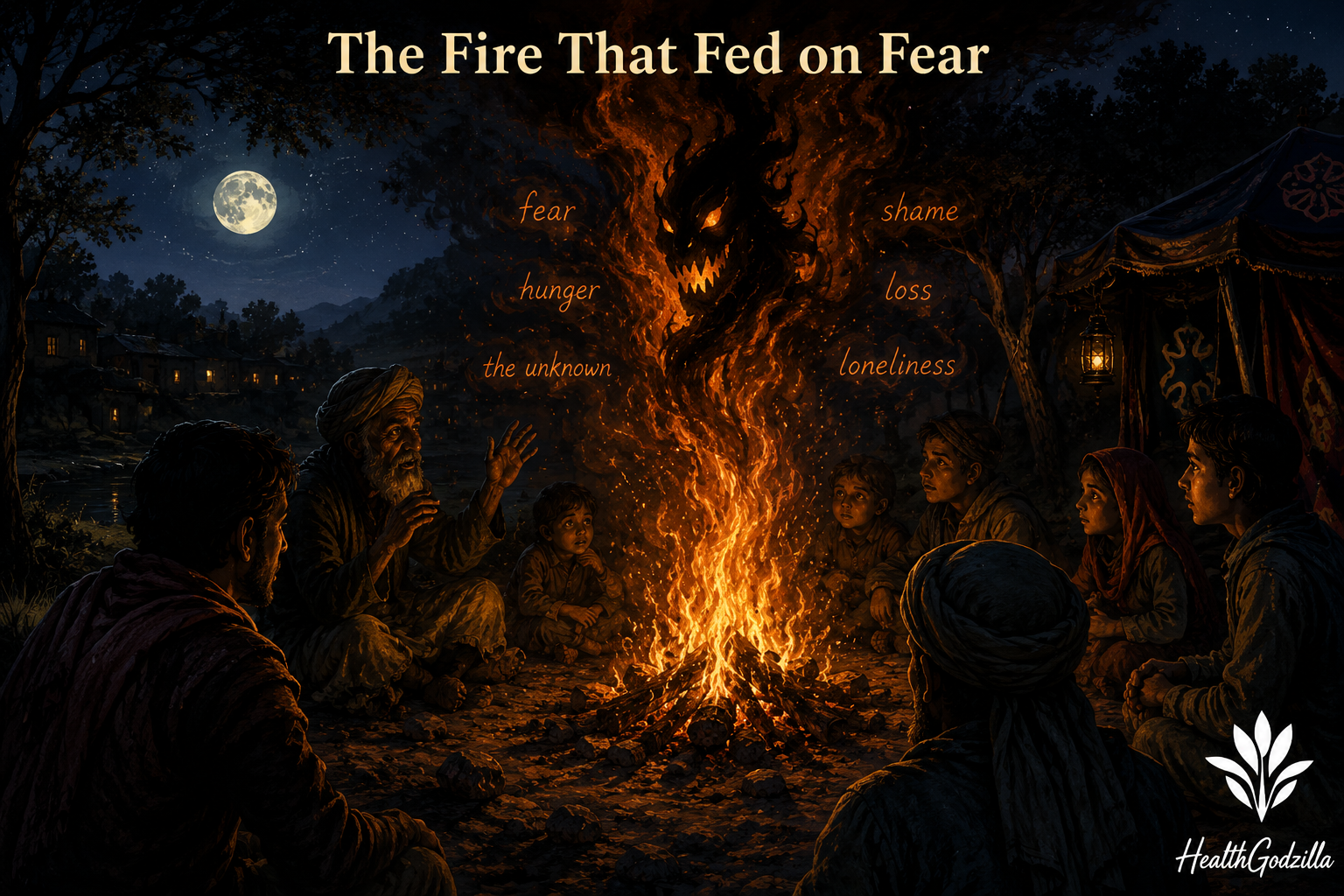
No one said so. Nevertheless, when the wanderer stepped from the riverbank, the circle opened without surprise. A man shifted onto one knee. A woman gathered the end of her shawl and moved closer to the child beside her. An old woman raised her eyes from the flame.
The wanderer sat.
Behind them, the river continued carrying pieces of moonlight downstream.
For a while, nobody spoke.
The fire settled. A branch collapsed inward, scattering sparks. One rose above the circle, shone briefly, and vanished into the dark.
Then the old woman began.
Her voice was low, almost conversational. She did not announce the beginning of the tale. Perhaps stories had not yet learned to knock before entering.
When the Forest Called Her Name
“There was once a girl,” she said, “who was warned never to answer when the forest called her by name.”
The child beside the woman leaned forward.
The wanderer did too.
The old woman spoke of a house at the edge of a forest, a sick mother, a missing goat, and a path that changed whenever the girl looked behind her. She spoke of a tree whose roots drank secrets, a bird that knew the language of the dead, and a creature that could borrow the voice of anyone the listener loved.
The creature never appeared completely.
First, it lingered as a shadow between the trees.
Later, footsteps followed behind the girl.
At last, it called in her mother’s voice.
The Waving Hand
At once, the wanderer remembered the hibiscus plant.
He had been a child then, awakened deep in the night by the urgent call of his bladder. He had opened the latches of the room and stepped onto the veranda.
Outside, the darkness had seemed complete.
The toilet stood across the courtyard, perhaps fifty feet away. When he looked toward it, someone was standing before the gate.
A silhouette.
It raised one hand and called him forward.
The child did not answer. Nor did he cross the courtyard. Necessity, however, demanded diplomacy. He relieved himself from the veranda, returned to the room, fastened the latches, and lay down without disturbing the night further.
By morning, he had gathered enough courage to inspect the place.
There was no stranger.
Only a hibiscus plant, its branches carrying red flowers, moving gently in the breeze.
Daylight explained the branches, the flowers, and the breeze.
It did not explain the waving hand.
When the Voice Followed Her Home
Meanwhile, the old woman continued her tale.
The girl in the forest heard her mother calling from behind the trees.
At first, she almost answered. Then she remembered that her mother was ill at home and could not have followed her so far.
Therefore, she kept walking.
The voice came again.
This time, it sounded like her dead brother.
The girl began to cry, but still she did not turn.
“What happened to the creature?” the child beside the fire asked.
The old woman looked at him.
“It followed her home.”
The child moved closer to his mother.
Someone across the fire laughed softly.
The old woman did not.
“It waited outside the house for three nights,” she said. “On the fourth night, it called from inside.”
The river seemed to grow quieter.
The wanderer looked beyond the fire. Darkness stood between the trees, patient and unoffended.
Instructions Hidden Inside Monsters
In that moment, he understood that fairy tales did not merely frighten children. They gave fear a body, a habit, a voice, and sometimes a weakness.
When the forest calls your name, do not answer.
Where the path continues, remain upon it.
Before the forbidden door, let your hand fall.
And when a stranger arrives with familiar eyes, remember that recognition is not always truth.
Carry bread.
Mark the road.
Remember who you are.
Long before safety manuals, maps, warning signs, psychology, and written law, stories had carried instructions inside monsters.
A child might forget advice.
A child rarely forgot the wolf.
Still, fairy tales did more than warn.
Instead, they allowed children to meet abandonment while sitting beside someone who loved them. They let hunger enter through a gingerbread house, death through an enchanted sleep, jealousy through a poisoned gift, and cruelty through a stepmother, king, demon, giant, witch, or beast.
The terror was real, yet the listener remained beside the fire.
That was the bargain.
The story could lead the child into the forest because a familiar voice promised to bring the child home.
The Fire That Carried the Story
The wanderer watched the old woman’s face. Firelight moved across her wrinkles, deepening and softening them by turns. Perhaps she had heard this story from another woman beside another fire. Perhaps that woman had inherited it from someone who had never seen a written page.
Stories traveled without passports.
They crossed wars, marriages, famines, migrations, and borders. They changed names, clothes, animals, forests, gods, and endings. Nevertheless, something inside them remained recognisable.
A child entered danger.
The world became strange.
Help arrived from an unlikely place.
A rule was broken.
A price was paid.
Someone returned changed.
When the old woman finished, no one applauded.
Instead, the child looked toward the trees.
His mother placed one hand on his head.
Across the river, a night bird called.
The wanderer wondered how many generations had sat this way—close enough to the flame for comfort, close enough to the darkness for imagination.
Perhaps civilization had begun not only when humans learned to make fire, but when they arranged themselves around it and gave the darkness a story.
The old woman reached for another piece of wood.
Before placing it on the flame, she looked at the wanderer.
“You crossed the river for a tale,” she said.
“I crossed because I saw the fire.”
She smiled.
“Those are often the same thing.”
The new wood caught slowly.
First came smoke.
Then a red line.
Then flame.
Beyond the circle, the forest remained immense. Yet, for the moment, every shadow had somewhere to belong.
This, too, was In Praise of Night: not a denial of fear, but the old human art of sitting beside it until it began to speak.
Where the Old Roads Remembered the Moon
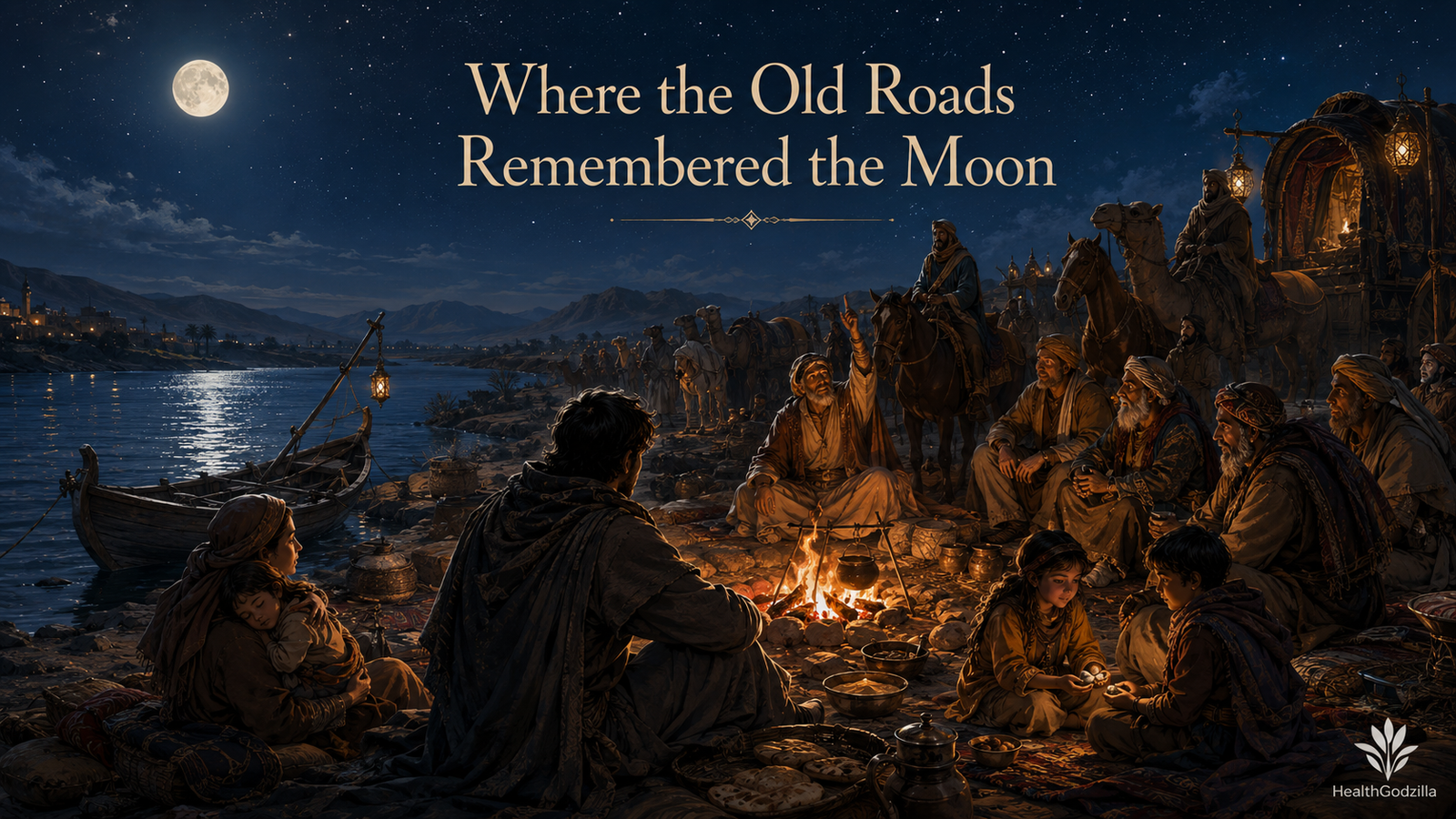
The old woman did not begin another tale.
Instead, she looked beyond the wanderer, toward the river, as though listening to something approaching from far away.
The others followed her gaze.
At first, there was only darkness.
Then came a sound.
A bell.
Faint.
Irregular.
Another answered.
The wanderer turned.
The Travelers Who Arrived with Bells
Across the water, lights moved between the trees.
Not village lamps.
Not fireflies.
They rose and fell with the rhythm of walking animals.
“A caravan,” said the man beside him.
The old woman nodded.
“They have been travelling longer than the road.”
The bells drew nearer.
Soon, shadows appeared on the opposite bank: camels, horses, men wrapped in cloth, women carrying bundles, a child asleep against someone’s shoulder. Their lamps swayed as they moved, each small flame surrounded by an empire of darkness.
The wanderer watched them search for a crossing.
A man at the front called across the river.
Someone beside the fire answered.
Words traveled over the water, broken by distance.
Then the wooden boat was pushed back toward the other bank.
The wanderer helped.
One crossing became three.
Then five.
Before long, the river carried people, sacks, jars, folded rugs, baskets, skins of water, and a cage containing two silent birds. Each arrival enlarged the circle. The fire was fed again. Bread appeared. Dates were passed from hand to hand. A pot was set near the coals.
No one asked who owned the night.
There was enough of it for everyone.
The travelers had come from the west, or perhaps from farther than the wanderer could imagine. Sand lay in the seams of their clothing. Dust covered their sandals. One man carried a map drawn on leather, though he trusted the sky more than the ink.
The Children Who Needed No Translation
Meanwhile, the child who had listened to the forest tale now sat beside a girl from the caravan.
Neither knew the other’s language.
Nevertheless, they began exchanging stones.
One was white.
One was black.
One carried a thin red line through its middle.
They placed them in rows, changed the rows, disagreed silently, and began again.
The wanderer smiled.
Children often reached peace before adults had finished translating the conditions.
The caravan leader sat near the fire. His beard was silver at the chin, and his face had been shaped by wind.
“You travel alone?” he asked.
“For now.”
“No one travels alone at night.”
The wanderer looked around.
The man continued, “The road remembers everyone.”
Then he pointed upward.
A Map Written in Stars
By then, the clouds had thinned.
Stars opened across the sky.
The caravan leader named them.
Not as a scholar might name them from a book, but as one names relatives whose habits are known.
That star rose before the cold.
That cluster leaned toward the southern route.
That bright one appeared above the wells.
That faint line warned of changing weather.
The sky was not decoration.
It was direction.
For travelers, sailors, shepherds, hunters, and migrating birds, darkness did not erase the world. Instead, it revealed another map.
The wanderer followed the man’s finger.
He could not see roads among the stars. Yet the caravan had crossed hundreds of miles by trusting them.
Perhaps knowledge did not always look like certainty.
Sometimes it looked like a man lifting his head.
The old woman listened.
Then she asked, “What stories travel with you?”
The caravan leader laughed.
“Too many. Some have become heavier than the goods.”
“Tell one.”
He considered this.
Then he looked toward the children.
The King Who Feared Darkness
“There was once a king,” he began, “who ordered every lamp in his city to remain lit through the night.”
The wanderer glanced toward the old woman.
She smiled slightly.
The caravan leader continued.
“The king feared darkness. He believed thieves lived in it, rebels hid in it, ghosts crossed it, and death entered through it. Therefore, he commanded that no street, courtyard, window, gate, stable, or rooftop should ever become dark.”
At first, the people praised him.
They said the city had conquered night.
Merchants remained open longer. Soldiers patrolled without torches. Noble houses shone like palaces. Even the poorest families were ordered to hang lamps outside their doors.
But soon, the birds stopped resting in the trees.
The moths gathered in such numbers that they fell dead beneath the lamps.
Children remained awake.
Dogs barked until morning.
The flowers that opened after sunset no longer knew when to release their scent.
The moon rose, yet no one noticed.
Still, the king demanded more light.
The city walls began to glow.
Along the river, lamps multiplied.
Even the graveyards lost their darkness.
Finally, he ordered flames to be hung from the branches of the oldest trees.
“Why?” asked the caravan girl.
“Because fear is rarely satisfied,” said the leader.
The fire cracked.
The travelers leaned closer.
The Bowl That Held the Night
“One night,” he continued, “an old woman came to the palace carrying an empty bowl.”
The guards tried to stop her.
She said, ‘I have brought the king what he lacks.’
They laughed.
The bowl held nothing.
Nevertheless, she was taken before the throne.
The king asked, ‘What is in the bowl?’
‘Night,’ she replied.
The king looked inside and saw only darkness.
He ordered her imprisoned.
But before the guards could seize her, she turned the bowl upside down.
At once, every lamp in the city went out.
The child beside the fire gasped.
The caravan leader lowered his voice.
“The king shouted for flames. None would burn. Oil became cold. Wicks refused fire. Sparks died before reaching wood.”
When the City Began to Listen
The city entered darkness for the first time in years.
At first came panic.
People screamed from their windows.
Soldiers lost their way.
Merchants guarded empty shops.
The king hid beneath his bed.
Then, slowly, other sounds returned.
An owl called from the wall.
Water moved in the river.
Leaves whispered.
Somewhere, a mother began singing.
Gradually, the city listened.
For the first time, the people heard how much noise their fear had made.
The next morning, the lamps burned again.
But the king ordered half of them removed.
“Only half?” asked the boy.
The caravan leader smiled.
“Kings often learn slowly.”
The circle laughed.
Even the old woman.
The wanderer looked beyond the fire.
The tale had crossed deserts, perhaps centuries. It might once have belonged to another king, another city, another fear. Still, it had arrived intact enough to ask its question.
How much darkness could humanity remove before it removed something necessary?
This was another form of In Praise of Night.
Not the worship of darkness.
Not the rejection of fire.
Rather, the recognition that light without limit could become another kind of blindness.
Afterward, the caravan leader opened the pot near the coals.
Steam rose.
Spices entered the air.
Bowls were filled.
The wanderer ate among strangers whose names he did not know.
Above them, the stars continued their silent migration.
Near the river, frogs called.
Behind the trees, something moved and did not reveal itself.
Meanwhile, the children became drowsy.
Two Lullabies Beside One Fire
The woman from the caravan took the girl into her lap and began a lullaby.
Its words belonged to another language, but the rhythm needed no translation.
The tune rose and fell like footsteps over sand.
The old woman listened.
Then, very softly, she joined it with a different melody.
For a while, the two lullabies traveled side by side.
They did not compete.
They carried the same child.
In that moment, the wanderer understood that humanity had often crossed distances this way—not only through trade, conquest, migration, or maps, but through songs sung softly enough to enter another person’s sleep.
The fire lowered.
The stars turned.
Far away, the road waited.
Before dawn, the caravan would continue toward the desert.
The wanderer knew he would follow.
Not because he had chosen the destination.
Because the lullaby had already begun walking ahead of him.
The Desert Where Songs Outlived Footprints

Before dawn, the camp began to disappear.
The fire was buried beneath sand. Bowls were wiped with cloth. Water skins were tied. Blankets became bundles. Children were lifted onto animals without fully waking.
The river remained behind them.
Ahead waited land that seemed to have forgotten water.
The wanderer joined the caravan.
Where Footprints Were Not Enough
At first, the earth was firm beneath his feet. Then the soil loosened, grasses thinned, and the path dissolved into sand. Soon, there was no road at all—only direction, memory, and the long patience of those who had traveled there before.
The caravan leader walked near the front.
“You said the road remembers everyone,” the wanderer told him.
“It does.”
“But the wind erases the footprints.”
The man looked toward the horizon.
“Footprints are not the only way a road remembers.”
The bells continued.
Step.
Bell.
Breath.
Step.
Bell.
Breath.
Gradually, the rhythm entered his body until walking no longer felt like movement, but agreement.
By day, the desert widened without mercy.
The sun flattened distance. The sky seemed too large for the earth beneath it. Sand entered shoes, clothes, food, conversation, and thought.
Yet when night returned, the desert changed its face.
Heat withdrew from the ground.
The air cooled.
The stars descended.
Without trees, towers, smoke, or electric light to interrupt them, they appeared in such numbers that the wanderer felt he had stepped beneath the exposed machinery of the universe.
Eventually, the caravan stopped beside a low ridge.
No one built a large fire. A few coals were enough.
The travelers gathered close.
Beyond them, darkness stretched without wall, roof, forest, or riverbank.
The wanderer looked upward.
In the village, the moon had been an uncle invited to place a mark on a child’s forehead.
Beside the river, it had broken beneath a wooden boat.
Here, it seemed distant again—cold, ancient, and unwilling to explain itself.
A Mother Who Asked the Moon to Follow
Still, someone began singing.
It was the woman whose daughter had exchanged stones with the village boy.
Her voice rose softly over the sand.
The wanderer could not understand the words, but the melody carried weariness without surrender. It did not ask the night to leave. Instead, it asked the night to hold them until morning.
The caravan leader translated only a little.
“She sings of a mother who waits beside a door,” he said. “Her son has crossed the desert. She tells the moon to follow him because she cannot.”
The wanderer listened.
The song moved through longing, distance, dust, and hope. Each line returned to the mother’s request:
Go with him.
Watch him.
Do not let the road keep him.
The desert offered no answer.
Perhaps that was why humans sang.
They had always placed their unanswered prayers inside rhythm, hoping music might travel where footsteps could not.
The Last Darkness
Meanwhile, near the edge of the camp lay an old man.
He had spoken little since the river. His breathing had become shallow. Two travelers sat beside him, one holding a cup he could no longer lift.
The woman’s lullaby changed.
Its rhythm slowed.
The girl stopped playing with stones.
Even the bells on the resting animals seemed to grow quieter.
The wanderer realized that the song was no longer being offered only to a child.
The old man opened his eyes.
“Home?” he whispered.
The caravan leader bent close.
“Soon.”
It was not clear whether he meant the next city, the man’s birthplace, or somewhere beyond both.
The woman continued singing.
The old man’s hand rested on the sand.
His fingers moved once, perhaps remembering grain, soil, cloth, or the hand of someone absent.
Then they became still.
No one cried out.
The song did not stop.
Until then, the wanderer had always thought lullabies belonged to beginnings—to cradles, milk, blankets, and children resisting sleep.
Yet here, beneath an immeasurable sky, the same tenderness accompanied a man toward the last darkness.
Perhaps humanity had invented lullabies because every great crossing frightened the traveler.
Birth.
Sleep.
Migration.
Death.
Each required someone to say:
You are not crossing alone.
The old man was buried before sunrise.
The grave was shallow because the ground beneath the sand resisted the tools. Stones were placed above him. No monument named him.
The caravan leader stood beside the grave.
“He traveled forty years,” he said.
“Where was his home?” asked the wanderer.
The leader looked across the desert.
“He gave a different answer every decade.”
Then the caravan moved on.
By noon, wind had begun smoothing the ground around the stones.
By evening, the grave could no longer be seen from a distance.
What the Desert Could Not Erase
Still, the woman remembered the song.
The girl remembered his hand.
The caravan leader remembered his stories.
The wanderer remembered the word home leaving his mouth like the final bird from an empty tree.
The desert erased the shape.
Humanity carried the trace.
That night, the wanderer walked apart from the others.
The moon was hidden.
Only stars remained.
Roads returned to him, then rivers, forests, and rooms locked against imagined hands. The child who had exchanged stones without language appeared beside the king who filled his city with lamps because fear was rarely satisfied.
Then a couplet by Mirza Ghalib rose in his memory:
مت پوچھ کہ کیا حال ہے میرا ترے پیچھے
تو دیکھ کہ کیا رنگ ہے تیرا مرے آگے
Mat pūchh ki kyā hāl hai merā tire pīchhe,
Tū dekh ki kyā rang hai terā mere āge.
Do not ask what condition I am in behind you;
look instead at the colors you reveal before me.
(English rendering by the author.)
The wanderer smiled into the dark.
Perhaps the night had changed him.
Perhaps he had also changed the night by carrying these stories through it.
For no darkness remained entirely empty after someone had named a star, buried a traveler, remembered a hand, or sung to the moon.
The Road Already Inside Them
Soon afterward, a flock of birds crossed the sky.
They traveled without lanterns.
The wanderer watched until they vanished.
“Where are they going?” he asked when the caravan leader approached.
“Somewhere they have never seen,” the man replied.
“Then how do they know the way?”
The leader looked upward.
“Perhaps the road is already inside them.”
The wanderer thought he was following the lullaby.
Perhaps the lullaby had been shaping the road beneath his feet.
At dawn, the caravan reached a line of stone towers rising from the desert.
Beyond them waited a city of gates, markets, minarets, bells, scribes, healers, thieves, princes, plague memories, and stories purchased by the hour.
The ancient road had brought him toward the medieval night.
Behind him, the desert kept no footprints.
Ahead, the city kept too many.
The City That Locked Its Gates Against the Night
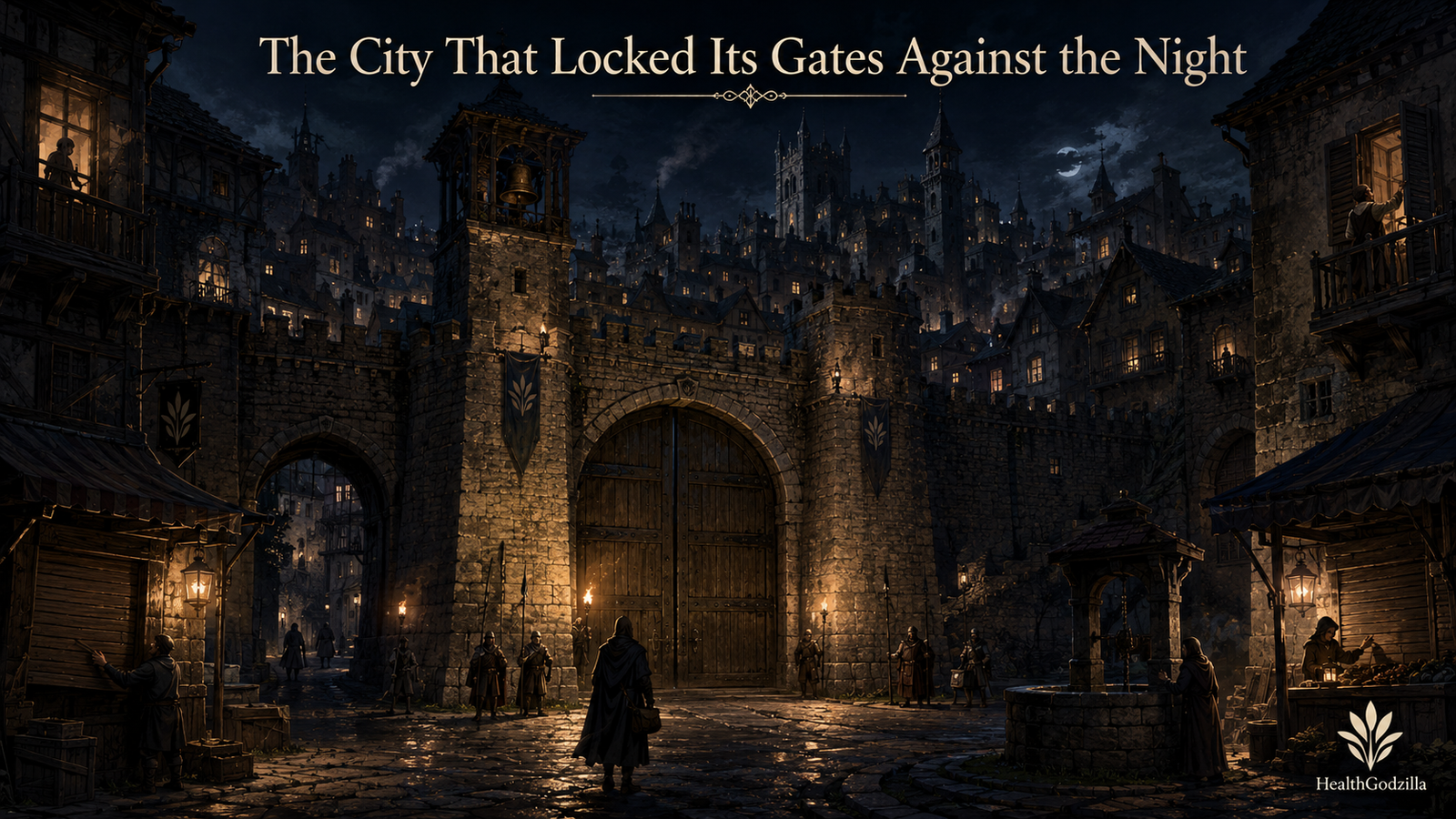
The gates opened at sunrise and closed before darkness could enter.
At least, that was what the people liked to believe.
By the time the wanderer reached the city, evening had already begun gathering beneath the walls. The final carts hurried through the entrance. Traders shouted at tired animals. Guards inspected bundles with the solemn suspicion of men who imagined danger always traveled inside somebody else’s luggage.
The caravan entered slowly.
A camel protested.
A wheel struck stone.
From above, a watchman leaned over the wall and called for haste.
The wanderer crossed beneath the gate just as its wooden doors began moving behind him.
Chains tightened.
Iron groaned.
The two halves met with a sound that traveled through the street.
The city had locked itself against the night.
The Night Was Already Inside
Yet the night was already inside.
It waited beneath balconies, inside wells, behind curtains, in cellars, stables, kitchens, bedrooms, and the narrow spaces between houses. Shadow carried it up the stone walls. Smoke holes welcomed it inward. Beneath tables, it gathered quietly. Even the sleeves of physicians, beggars, widows, princes, thieves, and children concealed a little darkness.
No gate had ever kept it out.
Soon afterward, the caravan dissolved into the city.
Some travelers turned toward an inn. Others followed porters into the market quarter. The girl who had exchanged stones with the village boy waved once before disappearing beside her mother.
The caravan leader remained near the wanderer.
“Here,” he said, “everyone sells something.”
“What do the storytellers sell?”
The man looked toward a crowded lane.
“An escape from what the others are selling.”
Then he left.
The wanderer stood alone beneath a sky reduced to a thin ribbon between rooftops.
The medieval night had begun.
When the Lamps Bargained with Darkness
Before long, oil lamps appeared one by one.
A boy carried a flame from shop to shop, lighting wicks in exchange for coins, bread, or curses. The lamps did not conquer darkness. Instead, they merely persuaded it to retreat a few steps.
Beyond each circle of light, the street remained uncertain.
Merchants lowered shutters.
Bakers prepared tomorrow’s bread.
A butcher washed blood from stone.
A woman leaned from an upper window and emptied a bowl into the gutter after warning those below only half a breath beforehand.
The wanderer stepped aside.
The contents struck the street where he had been standing.
A cat approached, considered them, and withdrew with dignity.
From a tower came the evening bell.
Elsewhere, another answered.
Then another.
The city measured darkness through sound.
Bells announced prayers, curfews, fires, danger, death, and the passing hours. Those who owned clocks were few. Everyone else lived by bells, stomachs, shadows, roosters, and the moods of employers.
The Watchman Who Lowered the Meaning of Good News
Meanwhile, a watchman entered the lane carrying a lantern and a staff.
“All is well,” he called.
The wanderer watched him disappear around a corner.
A window opened above.
“Liar,” someone whispered.
The window closed.
The wanderer smiled.
Perhaps the watchman did not mean that all was truly well. Perhaps he meant only that the city had not yet burned, the plague bell had not rung, and no army had appeared beyond the wall.
Civilizations often survived by lowering the definition of good news.
He continued through the lane.
At one corner, a physician’s apprentice crushed herbs beneath a lamp. Bundles of dried leaves hung from the ceiling. Jars contained powders, roots, oils, teeth, bones, and objects that might have been remedies, relics, or excellent excuses for charging more.
A woman waited outside with a feverish child.
The apprentice placed two fingers against the child’s wrist.
“What does the pulse say?” the mother asked.
“That he is ill.”
“I already know that.”
“Then the pulse agrees with you.”
The wanderer moved on before medicine and motherhood began a war.
Farther ahead, a crowd had gathered beneath the sign of an inn.
Steam rose from bowls.
Travelers sat on benches with their backs against the wall. Sailors argued over a map. Two men played dice beneath a lamp. A scribe wrote a letter for someone who could not write, pausing whenever the customer changed his mind about how much affection to send home.
Near the door sat a storyteller.
He wore no crown, carried no instrument, and owned nothing that announced his profession. Still, the listeners leaned toward him as plants lean toward light.
A wooden bowl rested at his feet.
A few coins lay inside.
The wanderer joined the crowd.
Sleep Arrived Carrying Dreams
The storyteller was speaking of a city visited by Sleep.
Not sleep as a condition.
Sleep as a woman.
She arrived barefoot, dressed in blue, carrying a basket of dreams.
At every house, she offered one.
For the hungry, tables overflowed.
Before prisoners, gates opened.
Around sailors, the water grew calm.
To widows came familiar voices.
Beneath children, flying horses stirred.
But before kings, her basket remained closed.
“Why?” someone asked.
The storyteller lifted one finger.
“Because kings already dream while awake.”
The crowd laughed.
A richly dressed man near the inn door did not.
Nevertheless, the storyteller continued.
In the tale, the king ordered Sleep arrested for neglecting him. Soldiers searched the city, but each time they approached her, they became drowsy. One sat upon a step and dreamed of becoming a baker. Another lay beneath a tree and dreamed he was a bird. The captain reached Sleep’s door, raised his sword, and forgot why he had come.
Finally, the king went himself.
He found Sleep beside a cradle.
“Give me a dream,” he demanded.
“You have too many,” she replied.
“I command armies.”
“In your dreams.”
“I own the city.”
“In your dreams.”
“I shall live forever.”
Sleep looked at him kindly.
“In your dreams.”
The listeners grew quiet.
The storyteller lowered his voice.
The King Who Burned His Beds
The king returned to his palace and ordered every bed destroyed.
He believed sleep entered through mattresses.
Therefore, the servants burned the royal beds, pillows, curtains, and blankets. Yet that night, the king fell asleep upon his throne.
In his dream, he was not a king.
He was a child standing outside a locked gate.
The guards looked through him as though he were no one.
Behind the gate, the servants remained silent.
His crown had vanished from his head.
Only Sleep stood beside him.
“Now,” she said, “you may enter.”
“Enter where?”
She opened the gate.
The storyteller stopped.
A listener groaned.
“What was behind it?”
The storyteller pointed toward the bowl at his feet.
The crowd laughed and reached for coins.
Even mystery had expenses.
The wanderer placed a coin in the bowl.
“What was behind the gate?” he asked.
The storyteller studied him.
“What do you fear losing?”
“That is not an answer.”
“It is the only door I have.”
The Only Door He Had
Afterward, the wanderer sat beside him when the crowd dispersed.
Inside the inn, bowls struck tables. Dice rolled. Someone began singing badly and with confidence.
Outside, the lamps trembled.
“You came with the caravan,” the storyteller said.
“Yes.”
“From where?”
“A village, a forest, a river, and a desert.”
“Those are places.”
“They are also answers.”
The storyteller smiled.
“You have been travelling with old people.”
“And children.”
“Better. Old people remember the beginning. Children remember that the world is strange.”
Then, a bell rang from somewhere deeper in the city.
Not the hour bell.
This sound was slower.
Heavier.
The inn became quiet.
Another bell answered from a distant quarter.
A woman crossed herself.
A man covered his bowl.
The storyteller looked toward the darkness.
“What does that bell mean?” asked the wanderer.
“Someone has died.”
“Only one?”
“The bell never says.”
A door closed across the street.
Then another.
When Fear Traveled Faster Than Disease
At once, the city altered around them.
People stepped away from strangers. Scarves rose over mouths. Mothers called children indoors. A cart carrying covered bundles moved quickly toward an alley.
“Plague?” the wanderer asked.
“Memory of plague,” said the storyteller. “Sometimes that is enough.”
Fear passed through the street faster than any disease.
It entered houses through rumour.
It multiplied in whispers.
By midnight, one death could become twenty. By dawn, twenty could become punishment from heaven, poison in the wells, foreign sorcery, corrupted air, or the revenge of the dead.
When knowledge failed, imagination did not remain idle.
The wanderer remembered the forest creature borrowing familiar voices.
He remembered the king who ordered lamps throughout his city.
He remembered his childhood silhouette beside the hibiscus plant.
Again and again, humanity encountered what it could not fully see and completed the shape.
One uncertainty became a god.
Another grew teeth and became a monster.
A third was given a name so blame would know where to land.
The storyteller picked up his wooden bowl.
“Come,” he said. “The street will soon belong to watchmen, rats, lovers, and men who insist they are none of these.”
“Where are we going?”
“To the house of a woman who tells stories without charging.”
“That sounds generous.”
“She charges in other ways.”
The House with the Blue Door
Soon, they entered a narrower lane.
Above them, houses leaned so close that neighbours could quarrel without raising their voices. Laundry hung like tired flags between windows. The gutter carried water, refuse, and secrets downhill.
The watchman’s cry returned:
“All is well.”
This time, no one answered.
At the end of the lane stood a small house with a blue door.
The storyteller knocked three times.
No response came.
He knocked twice more.
A voice inside said, “You are late.”
“You always say that.”
“One day it will be true.”
The door opened.
An older woman stood before them holding a candle.
Her hair fell in a long silver braid over one shoulder.
The wanderer stopped.
For a moment, the city disappeared.
He remembered another night, far from these walls—the warmth of a bed, his mother beside him, and his fingers holding her braid. As a baby, he had learned to stroke and scratch it until sleep came. The habit had outlived infancy. Even years later, the braid remained a small rope leading back toward safety.
The old woman noticed his gaze.
“You have seen this hair before?” she asked.
“Not yours.”
“But someone’s.”
“My mother’s.”
“Then enter before the memory becomes cold.”
The Library Before Books
Inside, a child lay beneath a blanket.
The room smelled of wax, herbs, and rain trapped in old wood. Shelves covered one wall. Yet instead of books, they held folded cloths, shells, toys, locks of hair, wooden animals, dried flowers, and tiny shoes.
“What is this place?” asked the wanderer.
The old woman closed the door.
“A library.”
He looked again.
“There are no books.”
“Books arrived late.”
Then, she sat beside the child and lifted her silver braid onto the blanket.
Small fingers found it at once.
The child’s eyes began closing.
The old woman stroked the child’s forehead and began to sing.
The language was unfamiliar.
The gesture was not.
The wanderer stood silently.
He had crossed a river for a tale, followed a lullaby through the desert, and entered a city that locked its gates against the night.
Yet here, inside one small room, he found the oldest road again:
a child,
a familiar hand,
a braid held between sleepy fingers,
and a voice promising that darkness could be entered without being abandoned.
This, too, was In Praise of Night.
For before humanity built libraries of paper, it stored tenderness in repetition.
A song remembered a mother.
A gesture remembered a child.
A braid remembered the hand that once refused to let it go.
The Library That Had No Books

The old woman placed the candle on a narrow table.
Its flame leaned toward the shelves.
The wanderer looked again at the objects arranged along the wall: a cracked wooden horse, a brass bell, a folded shawl, a child’s shoe, a shell, a lock of hair tied with thread, a clay bird with one broken wing, a rusted key, and several small cloth bundles whose contents remained hidden.
“You call this a library,” he said.
“It remembers,” the old woman replied.
“So do graves.”
“Yes.”
The child beneath the blanket had fallen asleep with one hand still holding the silver braid.
The old woman lowered her voice.
“Books remember words. These remember touch.”
Then, she took the wooden horse from the shelf.
Its paint had almost disappeared. One wheel was missing.
“This belonged to a boy who feared thunder,” she said. “Whenever the sky broke open, his father rolled the horse across the floor and told him the clouds were only moving furniture.”
The wanderer smiled.
“Did the boy believe him?”
“Children often believe kindness before they believe facts.”
She returned the horse and lifted the brass bell.
“This was tied beside a cradle.”
“For calling the mother?”
“For proving the child was still moving.”
The bell gave a faint sound in her hand.
It was too small to command a room. Yet the wanderer imagined a mother waking in darkness, hearing the bell, and allowing herself one more breath.
When Each Object Opened a Life
Afterward, the old woman moved along the shelves.
Each object opened a life.
The shell had been held to the ear of a girl who had never seen the sea.
The shawl had wrapped three generations of infants and one dying grandmother.
The clay bird belonged to a child who believed broken wings could still remember flying.
The shoe had been found beside a road after a family fled during war.
“Where is the child?” asked the wanderer.
The old woman looked at the shoe.
“That is why it remains here.”
Silence entered the room.
Outside, the city continued making its night noises: a cart wheel, a distant bell, footsteps, the brief quarrel of cats, someone coughing behind a wall.
Then, the old woman untied one cloth bundle.
Inside lay a strip of embroidered fabric.
Red thread formed a crooked moon.
“A mother stitched this while waiting for her daughter to return.”
“Did she return?”
“The cloth did.”
The wanderer did not ask again.
Gradually, he began to understand that this library did not preserve complete stories. It preserved what stories had failed to carry away.
A shoe without its foot.
A song without its singer.
A key without its door.
A braid without the hand that once held it.
The old woman watched him.
“You look disappointed.”
“I expected answers.”
“Then you came to the wrong library.”
A Key Without a Door
She took the rusted key from the shelf and placed it in his palm.
It was cold.
“What does it open?”
“Nothing now.”
“Then why keep it?”
“Because once, someone believed a door would open.”
The wanderer turned the key between his fingers.
Humanity had always preserved useless things for reasons no merchant could understand.
Letters from the dead.
Clothes too small to wear.
Broken toys.
Empty perfume bottles.
Locks of hair.
Tickets from vanished journeys.
Objects survived because love disliked admitting that time had completed its work.
What the Fingers Remembered
Meanwhile, the old woman sat beside the sleeping child.
“People think memory lives in the mind,” she said. “It also lives in the fingers.”
She gently loosened the child’s grip from her braid.
The small hand closed again upon emptiness.
For a moment, the wanderer remembered his mother.
As a baby, he had held her braid and scratched it while drifting into sleep. The habit remained long after he had outgrown the bed, the room, perhaps even the version of himself who first learned it.
He wondered whether his fingers remembered more faithfully than he did.
The old woman noticed his silence.
“Your mother is alive?”
“Yes.”
“Then do not turn her into memory too early.”
The sentence entered him without permission.
He looked toward the candle.
Its wax had begun gathering at the base.
Every Child Inherits a Fear and a Song
After a while, the old woman lifted the broken clay bird.
“Every child receives two inheritances,” she said.
“What are they?”
“A fear and a song.”
The wanderer waited.
“The fear teaches the child where danger may live. The song teaches the child that danger is not the whole world.”
She turned the bird in her hand.
“Fairy tales say: the forest is dark.”
She placed it beside the candle.
“Lullabies say: someone will remain awake while you sleep.”
The wanderer looked at the child.
Outside, a watchman called again:
“All is well.”
This time, no one whispered “Liar.”
The city may have grown tired.
Perhaps trouble had fallen asleep.
Or the windows had finally learned the wisdom of caution.
Into that unchallenged silence, the old woman began another song.
It was not the same lullaby as before.
This one had no words.
Only a low humming that rose, paused, and returned.
The melody seemed unfinished.
“Whose song is that?” asked the wanderer.
“No one knows.”
“How can a song survive without a name?”
“More easily than a person.”
The old woman explained that the melody had traveled through wars, border crossings, marriages, famines, and ships. Along the way, different mothers had sewn their own words into it. One promised milk beneath the moon. Another offered stars. From some lips came the sweetness of imagined treats; from others, tender warnings of wolves, spirits, soldiers, and strangers.
Yet beneath the words, the same rhythm endured.
When the Lullaby Entered the Body
The wanderer listened carefully.
The melody moved like walking.
Not hurried.
Not certain.
One step.
Then another.
A pause.
Then return.
He had heard that rhythm before.
The caravan bells had carried it.
Across the desert, a mother had given it voice.
The wooden boat had tapped it softly against the river.
A child’s fingers had traced it through a braid.
Perhaps lullabies survived because they resembled the body before they resembled language.
Heartbeat.
Breath.
Rocking.
Footsteps.
Eventually, the old woman stopped humming.
The room felt suddenly larger.
“Why did you stop?” asked the wanderer.
“To let the child continue it.”
The wanderer looked toward the bed.
The child’s breathing had taken the rhythm.
Inhale.
Pause.
Exhale.
The lullaby had entered the body and disappeared from sound.
For a while, they listened.
Then the old woman rose and handed the wanderer the rusted key.
“You should take this.”
“But you said it opens nothing.”
“Not every traveler needs a key that works.”
He closed his fingers around it.
The city bell marked another hour.
“Where should I go next?”
The old woman looked toward the shuttered window.
“Toward the place where people have forgotten how to sleep.”
“The palace?”
She laughed softly.
“Farther than that.”
A Light Without Warmth
At last, she opened the blue door.
The lane outside remained dark, but beyond the rooftops, something strange glowed against the horizon.
Not dawn.
Not fire.
A light without warmth.
The wanderer stepped into the street.
Behind him, the old woman spoke once more.
“Remember: when a city fears darkness, it burns lamps.”
He turned.
“And when it fears silence?”
She closed the door.
From behind it came her answer:
“It invents noise.”
The wanderer stood alone beneath the medieval sky.
Yet far beyond the walls, another city was already shining—one that would not wait for morning, one that would sell wakefulness by the hour, one that would compete not only with the moon, but with sleep itself.
He placed the useless key in his pocket.
Then he began walking toward the future.
The City That Sold Wakefulness

The wanderer slept beneath the medieval wall.
He did not remember closing his eyes.
One moment, the city bells were fading across tiled roofs. The next, another sound entered his sleep—sharp, metallic, impatient.
A bell.
No.
An alarm.
Then another.
Then many.
He opened his eyes.
The wall was gone.
Above him rose towers of glass, their windows burning long after midnight. Roads crossed one another in ribbons of light. Vehicles moved without pause. Screens climbed buildings. A woman twenty storeys high smiled down from an advertisement, holding a cup of coffee beneath words that promised energy, ambition, and a better morning.
Yet morning was nowhere near.
The wanderer stood.
The rusted key remained in his pocket.
Around him, the city had replaced darkness without learning rest.
A train passed overhead, carrying faces illuminated by phones. Films flickered before some eyes; messages occupied others, while several passengers stared into the luminous vacancy beyond their screens. One man slept sitting upright, his head falling repeatedly toward the shoulder of a stranger who shifted away each time.
Below the station, a bakery had already begun preparing bread.
Across the road, a pharmacy remained open.
A hospital entrance swallowed an ambulance and returned two nurses into the night.
Farther ahead, food riders waited beneath a digital billboard that changed color every few seconds. Their motorcycles stood in a row like tired animals. One rider leaned against his seat and watched a video on his phone.
The Father Inside the Phone
A child appeared on the screen.
“Baba,” the child said, “sing the moon song.”
The rider looked around, embarrassed.
The other men were busy with their own phones, their cigarettes, their silence.
So he began softly.
His voice was not trained. It cracked on the higher notes. Still, the child listened with solemn devotion.
The wanderer could not understand every word, but he recognized the bargain.
Sleep, and I will remain near you.
The rider’s face glowed inside the phone. The child’s face glowed back from another room, perhaps another district, perhaps a village where the night still reached the ground.
Behind the child, an older woman adjusted the blanket.
The mother or grandmother, thought the wanderer.
Then he noticed her braid.
For one moment, the blue door returned.
The silver hair.
The sleeping child’s fingers.
His own mother’s room.
His own photograph on the wall.
The rider finished the song.
“Again,” said the child.
“I have an order.”
“After the order?”
“After the order.”
“Promise?”
The rider looked toward the restaurant door, where a screen had begun blinking his number.
“I promise.”
The call ended.
He placed the phone inside his jacket and lifted a paper bag filled with food for someone awake beyond midnight.
The wanderer watched him leave.
The city sold meals to those who would not sleep and sleep promises to those whose fathers could not come home.
Above them, the billboard changed.
A new face appeared.
This one promised productivity.
Another promised beauty after eight hours of rest.
The wanderer laughed once, though nothing was funny.
The city had learned to sell both exhaustion and its cure.
Where Sleeplessness Kept Watch
Afterward, he walked toward the hospital.
Inside, the air smelled of antiseptic, metal, and sleeplessness. Machines blinked beside beds. Elevators opened and closed. Shoes crossed polished floors. Somewhere, a newborn cried with the authority of one who had recently entered existence and already found fault with it.
The wanderer followed the sound.
Through a glass wall, he saw rows of small beds beneath warm light. Some infants slept. Others moved their hands through the air as though searching for something remembered from before birth.
The Vigil Beside the Glass
Beside one incubator stood a father.
He had placed both hands against the glass.
A nurse adjusted a tube and spoke to him gently.
“Talk to her,” she said.
“She cannot understand me.”
“She knows your voice.”
The father looked uncertain.
Then he bent close.
“My little moon,” he whispered.
The child moved.
He smiled.
The nurse moved away.
The father continued speaking, though the words became difficult to hear through the glass. He told the baby about a room waiting at home, a grandmother who had already bought too many clothes, and a mother sleeping upstairs after surgery.
Then he began singing.
Badly.
Tenderly.
The wanderer thought of the old woman’s library.
A bell beside a cradle had once assured a mother that her child still moved.
Here, machines performed the same vigil with lights, numbers, alarms, and wires.
Technology had changed the instruments.
Fear had not changed.
Nor had love.
The father sang until the baby’s hand opened.
Perhaps it meant nothing.
Perhaps it meant everything.
The wanderer left before the song ended.
Someone’s Daughter Beneath Fluorescent Light
Meanwhile, outside the ward, a cleaner pushed a cart slowly down the corridor. Her eyes were red. A phone rested between her shoulder and ear.
“Yes, Ma,” she said. “I have eaten.”
She had not.
The untouched food container on her cart testified without mercy.
“No, no, the shift is easy.”
It was not.
The corridor stretched ahead of her like another night.
“Yes, I will come soon.”
She stopped speaking.
The person on the other end continued.
The cleaner leaned against the wall.
Her face changed.
For a moment, she was no longer an employee beneath fluorescent lights. She was someone’s daughter.
“I know,” she said quietly. “I miss you too.”
The wanderer looked away.
Some griefs deserved privacy even when walls did not provide it.
The Night Shift
Then, he continued deeper into the city.
At a factory gate, workers entered beneath bright lamps while others came out. Their bodies crossed without meeting. One shift surrendered the night to another.
A guard inspected identity cards.
A woman yawned and covered her mouth.
The guard said, “Long night?”
She answered, “They are all long.”
Inside her bag lay a small packet of biscuits, a folded scarf, and a drawing made with crayons.
A house.
A tree.
Three people holding hands beneath an oversized moon.
The wanderer saw it only because the bag remained open for a moment.
Then the woman disappeared through the gate.
By then, the wanderer understood that the city did not sleep because sleep had been divided by income, duty, distance, illness, and necessity.
Some remained awake by choice.
Others because of hunger.
Still others because another life depended on them.
One remained awake for the small advantage of night-shift pay.
Another listened beside a feverish child.
Somewhere else, loneliness grew louder after midnight.
And in countless hands, a glowing screen had learned the intimate art of calling people back.
The City That Sold Both Exhaustion and Its Cure
Before long, the wanderer entered a crowded avenue.
Restaurants shone.
Music escaped from closed doors.
Cars waited in lines.
A young man photographed his food before eating it.
A woman laughed into a camera, then stopped laughing when the recording ended.
Two lovers sat across from one another, each speaking to someone elsewhere through a screen.
Above them, the moon had risen.
No one looked.
The wanderer remembered the king who filled his city with lamps.
The old tale had warned that flowers would forget when to release their scent, moths would fall beneath the lights, and children would remain awake.
The king had learned slowly.
The megacity had learned to call the same mistake progress.
Yet the wanderer could not condemn it entirely.
Here, surgeons worked while villages slept.
Firefighters waited.
Pilots crossed oceans.
Bakers prepared bread.
Women gave birth.
Strangers donated blood.
A nurse held the hand of a dying man whose family had not arrived in time.
A driver carried someone home.
The city’s sleeplessness wounded.
It also rescued.
That was the difficulty.
Humanity rarely built monsters without placing something useful inside them.
The Old Man Who Preferred the Noise
Near dawn, the wanderer reached a small public park trapped between towers.
Most benches were empty.
One held an old man feeding crumbs to birds that had arrived too early.
“Do they always come before sunrise?” asked the wanderer.
“They come when the lights confuse them.”
The old man scattered another handful.
“Why are you awake?”
“My wife died.”
The answer arrived without ornament.
The wanderer sat beside him.
“How long ago?”
“Eight years.”
“And you still cannot sleep?”
“I can sleep.”
The old man watched the birds.
“I do not always want to.”
They sat quietly.
Behind them, the city continued buying, delivering, healing, guarding, cleaning, waiting, and pretending that morning had already begun.
The old man reached into his coat and removed a photograph.
A woman stood beneath a tree, holding a baby.
“My wife sang every night,” he said. “After she died, the house became too quiet.”
“So you come here?”
“The city makes enough noise to keep memory from speaking clearly.”
The wanderer looked at the photograph.
“Does it work?”
“No.”
The old man smiled.
“But some failures become habits.”
A bird landed near his shoe.
He lowered a crumb.
What the Noise Could Not Silence
The wanderer remembered the old woman behind the blue door.
When a city fears darkness, it burns lamps.
When it fears silence, it invents noise.
Yet no lamp had erased the old man’s night.
No noise had silenced the song he remembered.
The wanderer reached into his pocket and touched the rusted key.
For the first time, he wondered whether it had never belonged to a door.
Perhaps it belonged to a memory that refused to remain closed.
Above the towers, the sky had begun to pale.
The megacity dimmed reluctantly.
Screens continued glowing.
Street lamps remained awake.
The moon faded, not defeated, merely ignored.
The wanderer rose.
“Where are you going?” asked the old man.
“I do not know.”
“That is not always a weakness.”
Return
The wanderer looked toward the east.
Somewhere beyond the towers, a child was waking.
Somewhere else, a mother had waited beside a phone.
He thought of his own mother beneath the largest photograph in her room.
Civilization had given him roads, work, urgency, distance, and reasons.
Love had given him a simpler instruction.
Return.
The word did not sound like command.
Instead, it sounded like a lullaby remembered too late.
This was also In Praise of Night:
the hour when noise began to weaken,
duty loosened its grip,
and memory, after waiting all day, finally spoke loudly enough to be heard.
The wanderer had entered the megacity fearing that its lights would erase the moon.
Instead, he discovered that even here, beneath glass, wires, alarms, and sleepless trade, humanity continued hiding small darknesses where tenderness could survive.
A father sang beside an incubator.
A rider promised another song.
A daughter lied gently to her mother about having eaten.
An old man fed confused birds because silence still carried his wife’s voice.
The city had not destroyed the lullaby.
It had made the lullaby travel farther to reach the child.
The Kingdom Behind Closed Eyes
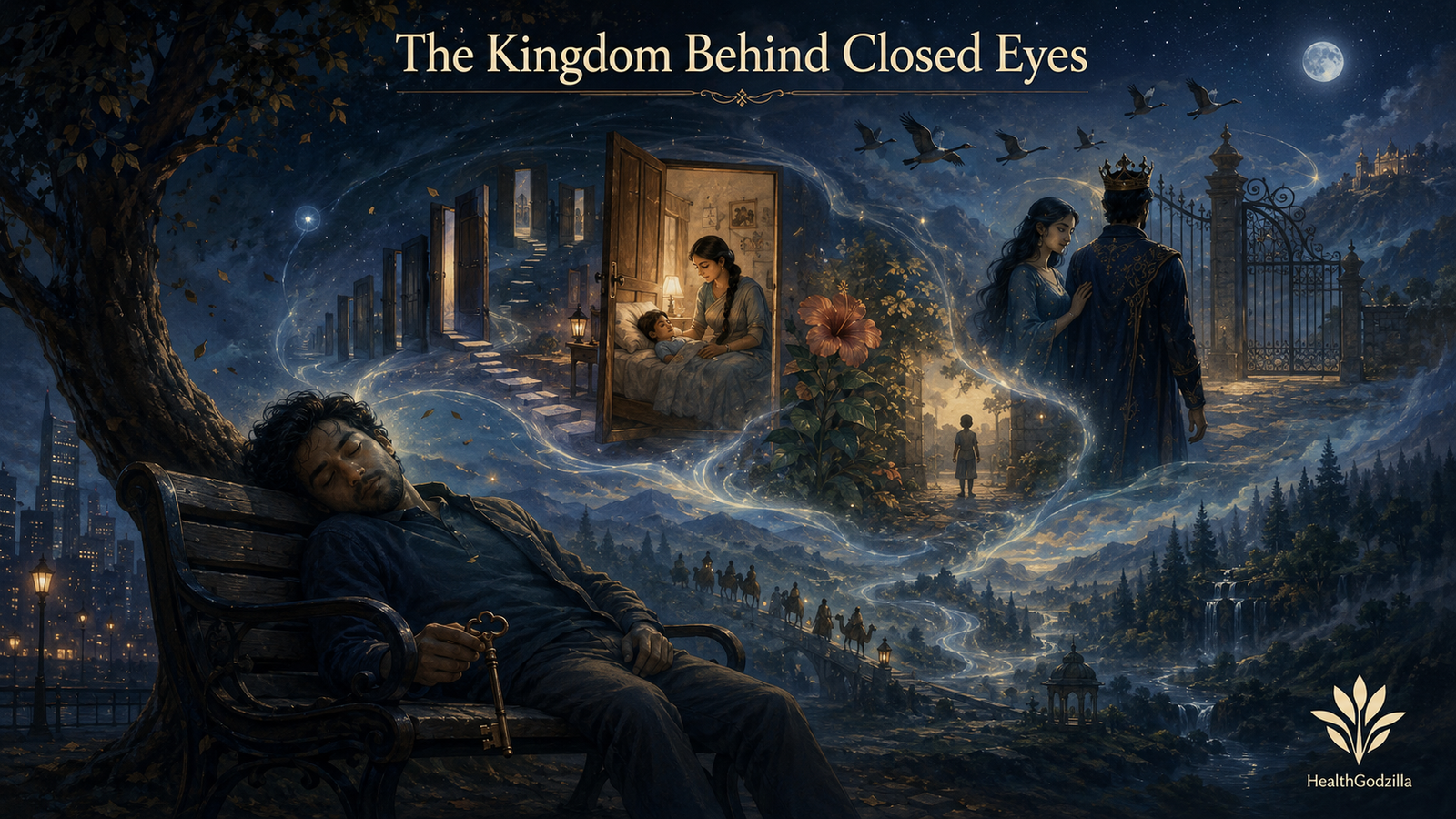
The wanderer left the old man before sunrise.
The park emptied slowly.
Birds lifted from the pavement. Meanwhile, street cleaners gathered bottles, wrappers, leaves, and the small remains of other people’s nights. Office towers began filling with workers who called the hour morning, though the sky still carried traces of darkness.
The wanderer walked without direction.
He had crossed villages, forests, rivers, deserts, centuries, and cities. Yet fatigue had been following him more faithfully than any road.
At last, he found a bench beneath a tree whose leaves had turned grey with dust.
He sat.
The rusted key remained in his pocket.
The city continued around him—sirens, brakes, footsteps, doors, horns, announcements—but the sounds began moving farther away.
Gradually, his eyelids lowered.
For the first time since the journey began, the wanderer stopped watching the night.
The night began watching him.
He slept.
When the Body Opened Its Workshops
At once, the body opened its workshops.
The heart continued without applause.
The lungs kept their quiet bargain with the air.
The liver sorted, stored, released, and repaired.
Cells replaced what daylight had worn down.
Hormones changed shifts.
Temperature fell.
Muscles loosened.
The immune system moved through its invisible patrol.
Even the brain, which had spent the day naming the world, turned inward and began rearranging it.
The sleeping body was not idle.
Instead, it was a city working after the gates had closed.
The wanderer knew none of this.
The Door That Opened by Itself
Meanwhile, he had entered a corridor with no walls.
On either side stood doors.
One carried the smell of wet soil.
Another held the sound of caravan bells.
A third glowed with hospital light.
From behind one door came his mother’s voice.
He stopped.
The voice did not call his name.
It hummed.
The same low rhythm as the old woman’s song.
The same rise and return.
He reached for the handle.
The rusted key in his pocket grew warm.
He removed it.
The key did not fit the lock.
He tried again.
Still, it would not turn.
Then he heard the old woman:
Not every traveler needs a key that works.
The door opened by itself.
Inside stood his childhood room.
The bed was lower than he remembered.
The walls were softer.
The night outside the window was complete.
His mother sat beside him, her braid falling over one shoulder.
The child he had once been held it between his fingers.
The wanderer remained near the door.
He did not want to disturb them.
His mother looked up.
Not at the child.
At him.
“You came late,” she said.
“I know.”
“You always say that.”
“One day it will be true.”
The words belonged to the old woman behind the blue door, yet his mother spoke them without surprise.
The wanderer stepped forward.
“I called you.”
“You did.”
“Four or five evenings a week.”
“You did.”
“Was it not enough?”
The Photograph That Kept His Place
His mother looked toward the wall.
There hung the largest photograph in the room.
His photograph.
“It was enough for the telephone,” she said.
The wanderer lowered his eyes.
The child beside her continued scratching the braid.
The gesture was small, almost careless.
Yet it contained more presence than every apology he had prepared.
He moved closer.
“Why is that photograph so large?”
“So the room does not forget your face.”
The answer did not accuse him.
That made it heavier.
The wanderer sat beside the bed.
His mother reached toward him.
For a moment, he thought she would touch his head.
Instead, she placed the braid in his hand.
The hair felt exactly as memory had preserved it.
Soft.
Familiar.
Impossible.
He held it carefully.
Then, the child beside her disappeared.
The room changed.
Now his mother was older.
The photograph remained.
Outside, the city glowed beyond the village fields, brighter than any city had a right to be.
“What happened to the dark?” he asked.
“You became busy,” she replied.
The wanderer looked toward the window.
The Silhouette in the Courtyard
The hibiscus plant moved in the wind.
Someone stood beside it.
A silhouette.
The figure lifted one hand.
This time, the wanderer did not retreat.
Instead, he stepped into the courtyard.
The toilet gate stood fifty feet away.
The plant trembled.
Red flowers moved like small signals in the dark.
“Who are you?” he asked.
The silhouette did not answer.
He walked closer.
With each step, it changed.
First, it wore the face of the old woman with the silver braid.
Then came the caravan leader, followed by the dying traveler.
It passed into the hospital cleaner, the rider singing through his phone, and the old man feeding birds before dawn.
Finally, every borrowed face dissolved, and the wanderer saw himself.
Older.
Tired.
Holding a key that opened nothing.
“What do you want?” asked the wanderer.
The older version of himself raised one hand.
Return.
The word passed through the courtyard without sound.
Return.
The hibiscus flowers moved.
Return.
The photograph watched from the room.
Return.
The wanderer reached toward the figure.
Before their hands met, the courtyard vanished.
He fell through darkness.
Not downward.
Inward.
How Sleep Filed Memory
Then, memories opened beneath him.
A river.
A flame.
A child exchanging stones.
A mother stitching a crooked moon.
A bell beside a cradle.
A king beneath his bed.
A city burning lamps.
A bird with a broken wing.
A phone glowing beside a sleeping child.
None appeared in order.
Sleep did not file life by date.
Instead, it gathered by feeling.
Fear found fear.
Tenderness found tenderness.
Loss found whatever still carried its shape.
The brain was not preserving the world exactly as it had been.
Rather, it was asking which parts mattered enough to remain.
A face blurred.
A voice sharpened.
A road shortened.
A hand became larger than a room.
The wanderer saw how memory worked.
It did not keep everything.
It kept what continued asking to be understood.
Then came dreams.
The forest opened its mouth.
The moon entered the river.
The river rose into the sky.
Birds swam through stars.
The old woman’s library grew roots.
Each object on the shelf became a door.
The wooden horse galloped across thunder.
The child’s shoe filled with sand.
The clay bird opened its broken wing and flew.
The rusted key turned inside the chest of the sleeping wanderer.
Behind it waited no room.
Only light.
He entered.
A World That Did Not Require a King
There stood the king who had burned all the beds.
Sleep waited beside him.
“Now,” she said, “you may enter.”
“Enter where?” asked the king.
This time, the storyteller did not stop.
Instead, Sleep opened the gate.
Beyond it lay a city with no crowns.
No head bowed at his arrival.
Fear did not recognise him.
His name passed through the streets without an echo.
Children ran past carrying stones.
Mothers sang without asking permission.
Workers slept without punishment.
Old men remembered without shame.
The king touched his bare head.
“What is this place?”
“A world that does not require you to be important.”
The king began to tremble.
At last, the wanderer understood why the tale had ended at the gate.
Some truths frightened rulers more than death.
The Body Was the Journey
The dream changed again.
Now he stood beneath the stars with the caravan leader.
Birds crossed overhead.
“Where are they going?” he asked.
“Somewhere they have never seen.”
“Then how do they know the way?”
The leader placed one hand against the wanderer’s chest.
“The road is already inside them.”
The wanderer looked down.
Beneath his skin, veins branched like rivers.
His lungs opened like forests.
The gut moved like soil.
The heart kept time like caravan bells.
The brain flashed like a city at night.
The body was not separate from the journey.
It had carried jungles, deserts, migrations, tides, hunger, fear, and ancient clocks within it all along.
Sleep did not remove him from nature.
Instead, it returned him to its rhythm.
The city outside continued shining.
Yet within the sleeping wanderer, darkness performed its oldest labor.
It repaired what daylight had strained.
Memory entered its hidden rooms and began sorting.
What could no longer serve the body was quietly released.
Fear was invited to rehearse, but not permitted to rule.
Grief sat beside memory until neither needed to speak so loudly.
The scattered fragments of the day were carried into deeper chambers, where night asked which of them deserved tomorrow.
This was In Praise of Night:
not darkness as absence,
but darkness as workshop,
not sleep as surrender,
but sleep as restoration,
not dreams as nonsense,
but the mind speaking in images when language had become too narrow.
When Kindness Passed Without Waking Him
The wanderer slept through the changing light.
Around him, the city grew louder.
People passed without noticing him.
Yet one woman slowed, saw his tired face, and placed a bottle of water beside the bench.
A child asked why he was sleeping outside.
The woman replied, “Perhaps he has traveled far.”
The child looked at the rusted key visible in his hand.
“What does it open?”
The woman smiled.
“Maybe he is dreaming of the door.”
What Had He Given Back?
By noon, the wanderer awoke.
The water bottle stood beside him.
The key remained in his palm.
For a moment, he did not know which city surrounded him.
Then the memory returned.
The hospital.
The rider.
The old man.
His mother.
The largest photograph.
Return.
He stood.
The journey had not ended.
But something had changed.
Until then, he had traveled around the world asking what night had given humanity.
Now the question had turned toward him.
What had he given back?
The Roads Written Inside Wings
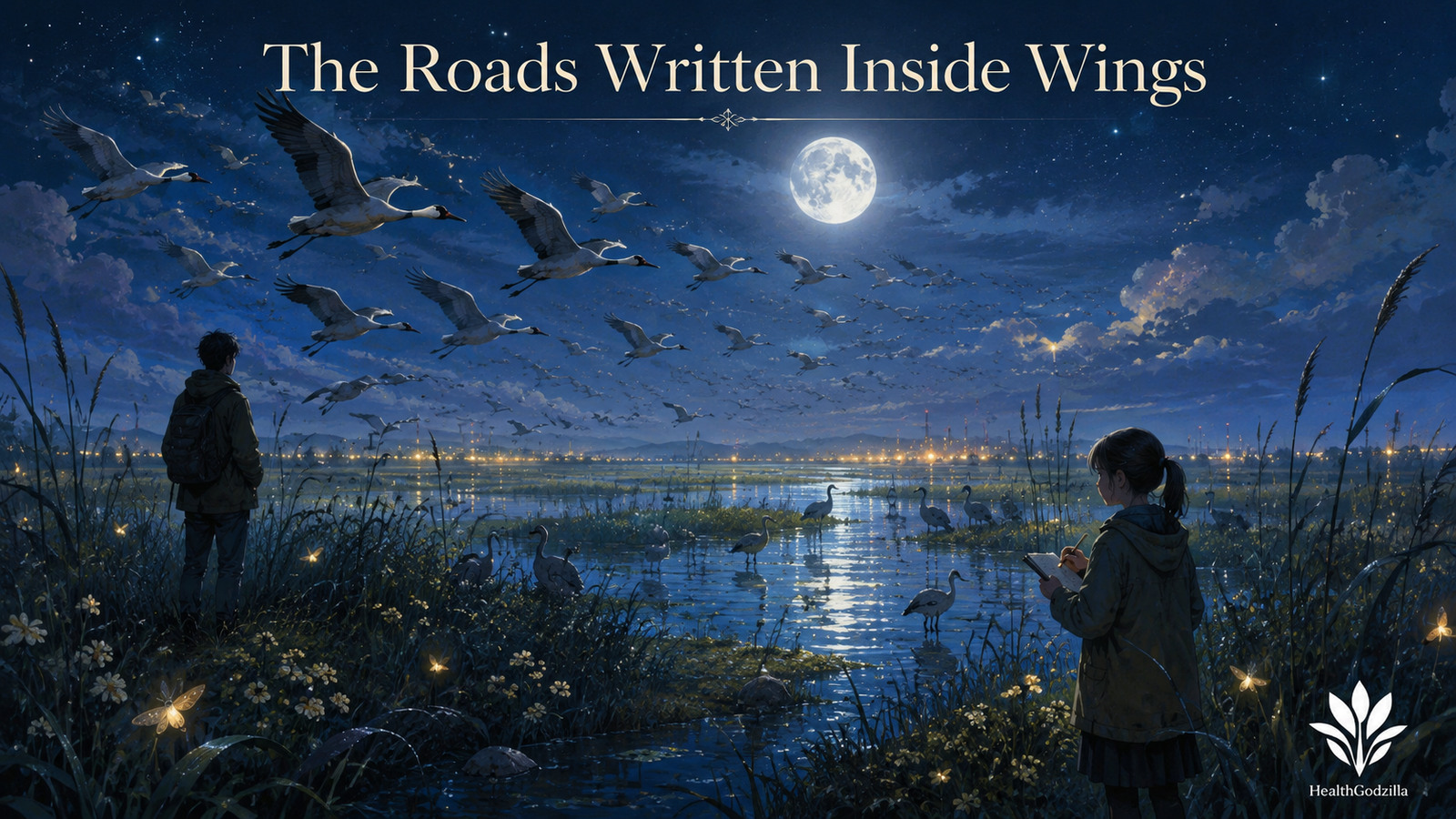
The wanderer left the bench after noon.
By evening, the city had begun loosening around him. Towers thinned. Roads widened. Warehouses replaced shops. Then came fields, canals, power lines, and stretches of land where human light no longer ruled every shadow.
He walked until night returned.
This time, he did not fear it.
The Travelers Without Signboards
Above him, birds were moving.
At first, he saw only a few shapes crossing the moon. Then more appeared—small, dark bodies flying in loose formation, each one carrying a destination it had never visited.
The wanderer stood beneath them.
No signboard instructed the sky.
Borders could not question their wings.
Beside the young birds, no mother flew whispering where to turn.
Still, they continued.
North.
South.
Seas passed beneath their wings.
Deserts opened and closed below them.
They crossed countries that had divided the earth without consulting the sky.
The wanderer remembered the caravan leader.
Perhaps the road is already inside them.
Soon afterward, a bird descended toward a wetland beyond the fields.
Then another.
Soon, reeds trembled with arrivals.
The wanderer followed.
The wetland received the night differently from the city. Water held the moon in pieces. Frogs called from mud. Insects moved above the surface. Tall grasses bent under the weight of resting wings.
The birds had crossed hundreds, perhaps thousands, of miles.
Now they fed.
A beak entered water.
Another searched mud.
One bird stood on a single leg, eyes half closed, while its body remained alert to danger.
The wanderer watched them.
Migration appeared heroic from below.
Up close, it was hunger, fatigue, weather, instinct, and the constant risk of not finding what had once been there.
A shrinking wetland could erase a destination.
A glass tower could become a wall in the sky.
A city’s light could pull travelers away from ancient routes.
A storm could scatter families.
Still, they flew.
The night did not promise safety.
Instead, it offered direction.
Tomorrow Between Flower and Moth
Nearby, moths gathered around pale flowers.
Their wings carried patterns no human hand had designed. Some were soft as ash. Others flashed colors hidden until movement revealed them.
The flowers had opened after sunset.
Scent traveled where color could not.
One moth entered, vanished briefly among petals, then emerged carrying pollen.
The wanderer leaned closer.
No one applauded.
No market announced the exchange.
Yet between flower and moth, tomorrow was being prepared.
He thought again of the underground insects, the roots, the fungi, the pond, and the moon.
The soil fed the root.
The root held the bank.
The bank held the pond.
The pond held the moon.
Now the flower fed the moth.
The moth carried the flower.
The flower became fruit.
The fruit fed another traveler.
Life did not move in straight lines.
Instead, it moved through gifts no giver controlled completely.
A butterfly rested on a branch nearby.
Its wings were closed.
The wanderer wondered whether it had crossed great distances or only the field. Either way, the body carried maps too delicate to see.
The stars shifted overhead.
He followed their movement.
Humans had once trusted them as travelers still did in deserts and oceans. Sailors read them. Shepherds waited for them. Farmers tied seasons to them. Lovers gave them names. Children counted them and failed.
Now many cities had erased them.
The stars remained.
Only the witnesses had disappeared.
The Girl Who Recorded Arrivals
Eventually, the wanderer walked deeper into the wetland.
There, beside a low tree, he found a girl holding a notebook.
She looked no older than twelve.
“What are you writing?” he asked.
“Arrivals.”
“Of whom?”
She pointed toward the birds.
Each line in the notebook held a date, a number, a direction, and sometimes a small drawing.
“Do you know all their names?”
“No.”
“Then how do you record them?”
“I write what I see.”
“That may not be enough.”
“It is more than forgetting.”
The wanderer sat beside her.
“Why do you come at night?”
“My grandfather used to.”
“Where is he now?”
She looked toward the reeds.
“He migrated.”
The wanderer waited.
The girl smiled faintly.
“That is what my grandmother says when she does not want to say he died.”
The wanderer looked at the notebook again.
“Did he teach you this?”
“He taught me to look up.”
The answer stayed with him.
Many inheritances were smaller than land, money, or titles.
A habit.
A song.
A braid.
A way of looking.
A refusal to pass beneath wings without noticing them.
Suddenly, the girl pointed.
“Listen.”
At first, the wanderer heard only water.
Then came thin calls from above.
Birds approached through darkness, announcing themselves to companions they could not see.
“Why do they call?” he asked.
“So they do not lose one another.”
The girl continued writing.
The wanderer looked up.
Perhaps lullabies began before humans.
Perhaps every species had its own way of saying:
I am here.
Keep near.
Do not disappear.
The calls passed overhead.
When Our Lights Became Louder Than the Stars
Farther away, a line of electric towers crossed the wetland. Red warning lights blinked against the sky.
The girl frowned.
“They follow the wrong lights sometimes.”
“Why?”
“Because we made our lights louder than the stars.”
The wanderer remembered the king who ordered every lamp to burn.
He remembered the megacity that sold wakefulness.
Humanity had always feared darkness.
Now other creatures were paying for that fear.
Then, a flock circled unexpectedly.
Once.
Twice.
Then again.
The birds seemed uncertain.
The girl stood.
“They should not be turning there.”
Lights from a distant industrial zone glowed beyond the reeds.
The flock shifted toward them.
For several moments, the girl watched helplessly.
Then the birds corrected their course and moved away.
She exhaled.
The wanderer had not realized she had been holding her breath.
A Home That Must Remain
“Will they return next year?” he asked.
“If the wetland remains.”
“And if it does not?”
She closed the notebook.
“Then the road inside them will lead to a place that no longer exists.”
The sentence struck him.
He thought of migrants returning to houses that no longer stood.
Rivers had altered their courses.
Cities had swallowed villages.
Beside certain doors, mothers still waited.
And with each passing decade, old men gave the word home a different address.
Home was not only where memory pointed.
It also had to remain somewhere in the world.
Rest Your Wings
The moon rose higher.
Afterward, the girl opened a small cloth bag and scattered grain near the reeds.
“Is that enough?” asked the wanderer.
“No.”
“Then why do it?”
“Because not enough is not the same as nothing.”
The wanderer smiled.
Children, he thought, often reached wisdom before adults had finished preparing speeches.
They sat together until the air grew colder.
Then, the girl began humming.
It was not a lullaby he knew.
“Who taught you that?”
“My grandmother.”
“What does it mean?”
“She says it tells birds to rest their wings.”
The wanderer listened.
The melody rose lightly, then settled.
Not a command.
An invitation.
For a moment, the wetland seemed to lean toward it.
Birds shifted among the reeds.
Moths continued their quiet bargains with flowers.
Frogs answered from the mud.
Stars remained above the electric haze.
The girl sang to creatures that did not know her language.
Still, perhaps they recognized the intention.
Rest.
You have traveled far.
Rest.
Morning will ask for your wings again.
What Allowed the Journey to Continue
The wanderer thought of the dying man beneath the desert sky.
He thought of the child behind the phone.
He thought of himself upon the park bench.
Every traveler, whether bird, child, laborer, king, mother, or old man, eventually reached the same border.
No body could journey forever without surrender.
Rest was not the opposite of movement.
Rather, it was what allowed movement to continue.
This, too, was In Praise of Night:
the pause between two distances,
the reed beneath a tired wing,
the song offered without certainty that anyone understood,
the darkness that hid the road but awakened the compass within.
The girl closed her notebook.
“My grandmother will worry.”
“Do you live far?”
“Far enough for her to imagine monsters.”
The wanderer laughed.
“Are there monsters?”
She looked toward the industrial lights.
“Yes.”
Then she smiled.
“But not always where grandmothers place them.”
Before long, they walked together until the path divided.
The girl turned toward a cluster of village lights.
The wanderer continued beside the water.
Behind him, she called:
“Do you know where you are going?”
“No.”
“Then watch the birds.”
He looked up.
The last flock crossed the moon.
Their bodies disappeared into darkness, yet their calls remained for several moments after they were gone.
The wanderer followed the sound.
When the Unseen Became a Compass
Gradually, he began to understand that night did not remove the world from sight.
Instead, it taught the world to travel by memory, scent, sound, rhythm, magnetism, stars, and trust.
Daylight showed the road.
Night revealed what carried the traveler when the road could no longer be seen.
Ahead, the wetland narrowed into a river.
On its far bank stood a village under moonlight.
From one house came a lullaby.
From another came crying.
Between them, beneath a banyan tree, people were gathering around a body covered in white cloth.
The wanderer slowed.
The night was preparing to show him another crossing.
The Night That Sat Beside the Dead
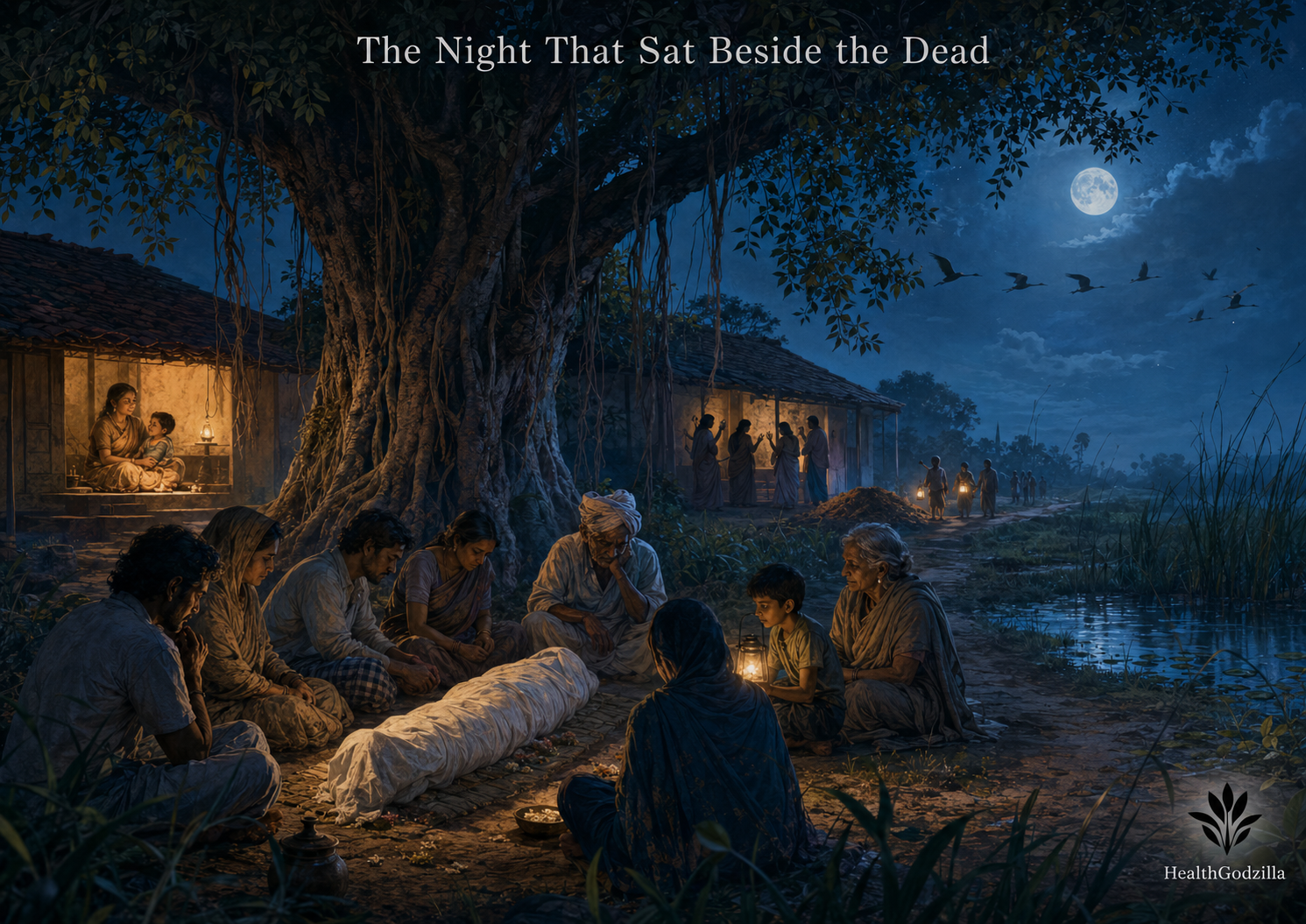
The body lay beneath the banyan tree.
White cloth covered it from head to foot.
Around it, men sat in a loose circle. Some spoke quietly. Others stared at the ground. One man recited verses beneath his breath, pausing whenever grief tightened his voice.
The wanderer stopped at the edge of the gathering.
No one asked his name.
Death often made strangers temporarily acceptable.
A boy carried a lantern from one side of the courtyard to the other. Its flame trembled each time the night wind passed beneath the banyan leaves.
One Voice Called Back, Another Guided Away
From a nearby house came crying.
Not loud.
Not continuous.
Grief rose, broke, lowered, then returned.
From another house came a lullaby.
The two sounds crossed the courtyard without quarrelling.
One voice called someone back.
The other guided someone away.
The wanderer stood between them.
A man beside the body looked up.
“You knew him?”
“No.”
“Then sit.”
The wanderer sat.
The dead man had been a farmer.
He had planted rice, repaired nets, argued over land boundaries, carried grandchildren on his shoulders, and complained every winter that the cold had become worse than the year before.
“He said that every year,” someone remarked.
A few men smiled.
Grief allowed humour only in small amounts, but it did allow it.
The wanderer looked toward the white cloth.
The farmer’s hands were hidden.
He wondered what they had last held.
A cup.
A gate.
A child’s shoulder.
A handful of soil.
Perhaps nothing.
Nearby, the boy with the lantern returned and sat beside an older woman near the courtyard wall.
“Why is he covered?” the boy asked.
“So he may rest,” she replied.
“Can he hear us?”
“No.”
The boy considered this.
“Then why are we speaking softly?”
The woman looked toward the body.
“Because we can hear ourselves.”
The wanderer lowered his eyes.
The night had gathered everyone into a gentler version of speech.
No one shouted instructions.
No one hurried the dead.
Even the village dogs kept their distance, as though they too understood that one body had crossed beyond ordinary disturbance.
When the Cloth Moved
Then, a breeze moved through the banyan tree.
Leaves whispered.
The white cloth stirred slightly near the feet.
The boy froze.
“He moved.”
“No,” said the woman. “The wind moved the cloth.”
The wanderer remembered the hibiscus plant.
Daylight explained branches, flowers, and breeze.
Night had once offered him a hand.
Here again, movement and meaning stood close together.
The cloth had moved.
The dead had not.
Yet for one second, the child had seen possibility.
Perhaps grief began there—in the body’s refusal to accept absence as quickly as the mind announced it.
Love After Usefulness
Soon afterward, a man arrived carrying a clay cup of water.
He placed it near the body.
“He cannot drink,” said the boy.
“I know.”
“Then why bring it?”
The man sat down.
“Because all his life, someone brought him water.”
No one spoke after that.
The wanderer looked at the cup.
Love often continued its duties after usefulness had ended.
It folded clothes for someone who would not wear them.
Prepared food for someone who would not return.
Kept rooms unchanged.
Charged phones that would never ring.
Placed water beside the dead.
From the nearby house, the lullaby continued.
The wanderer recognized none of the words.
Still, the melody carried something familiar.
It rose as though remembering.
Paused as though listening.
Then returned as though it had never truly left.
A woman beside him whispered, “His granddaughter cannot sleep.”
“Does she know?”
“She knows everyone is crying.”
“Does she understand why?”
The woman looked toward the singing house.
“Children understand absence before they understand death.”
The wanderer listened.
The lullaby did not deny what had happened beneath the banyan tree.
It did not tell the child that no one had gone.
Instead, it offered something smaller and more honest.
Tonight, someone remains beside you.
That had always been the lullaby’s promise.
Not immortality.
Presence.
The Weight Shared Among Many Hands
Before long, the men began preparing for the final journey.
The body was lifted carefully.
Hands reached forward.
Each person held only a small part of the weight.
The wanderer watched.
Perhaps this was how communities carried what no individual could bear alone.
One shoulder received the head.
Another, the middle.
Another, the feet.
The dead man’s weight had not increased.
Yet grief made every step heavier.
The procession began.
No music followed.
Only footsteps.
The wanderer joined.
They walked beyond the village, past the wetland, along a narrow path where grass brushed their ankles.
Above them, migratory birds continued crossing.
The dead traveled below.
The living traveled beside him.
The birds traveled above.
Each followed a road visible only in part.
When the Earth Received Him
At last, the grave appeared near a field the farmer had once cultivated.
The soil was dark and cool.
Men lowered the body.
The wanderer thought of the world beneath the topsoil—worms, roots, beetles, fungi, microbes, the ancient workers of return.
Once, the farmer had fed the earth with seed.
Now the earth received him.
The thought was not cruel.
Instead, it was complete.
A man lifted the first handful of soil.
For a moment, he could not release it.
Then his fingers opened.
The soil fell softly upon the white cloth.
One handful.
Then another.
Then many.
The sound was small.
Yet every person heard it.
The wanderer remembered the desert grave.
The old traveler buried beneath stones.
The woman who had continued singing.
Here, too, the night did not stop for death.
Frogs called from the wetland.
Insects moved through grass.
Roots waited beneath the field.
A bird landed briefly upon a branch, then flew.
Life did not insult the dead by continuing.
Rather, it honoured the law that had carried every body this far.
When the grave was closed, the men stood around it.
No monument had yet been placed.
Only a mound of earth.
The Whistle for the Road
The boy with the lantern came forward.
He placed something upon the soil.
A small wooden whistle.
“Why?” asked the older woman.
“He made it for me.”
“You should keep it.”
The boy shook his head.
“He will need it if he gets lost.”
No one corrected him.
The wanderer looked toward the sky.
Perhaps every burial contained one object that reason would not approve.
A cup.
A flower.
A letter.
A toy.
A whistle.
Humanity disliked sending anyone into darkness empty-handed.
When Absence Walked Back with Them
Afterward, the procession returned more slowly.
The body was gone, yet the group still walked around an absence shaped like a person.
Near the banyan tree, the clay cup remained.
The lantern burned lower.
From the house, the lullaby had stopped.
The child was asleep.
The wanderer stood alone beneath the branches.
He thought of birth, sleep, migration, and death.
Every crossing asked for surrender.
At every threshold, fear waited.
Yet nearby there was always a hand, a song, a road, or someone refusing to let the traveler cross alone.
Perhaps lullabies had never belonged only to children.
Perhaps they were humanity’s oldest answer to every threshold:
You may not know where you are going.
You may not return unchanged.
Still, you will not cross without tenderness.
The wind moved through the banyan leaves again.
This time, the wanderer did not mistake the sound for a voice.
Yet neither did he dismiss it as only wind.
The dead man had become silence.
The village had answered with memory.
The child had answered with a whistle.
The mother had answered with a lullaby.
The soil would answer in roots.
This, too, was In Praise of Night:
the hour when grief lowered its voice,
when many hands divided one final weight,
when the living left small gifts beside the road they could not follow,
and darkness received death and tenderness as though they had always belonged together.
Some Doors Opened Inward
The wanderer reached into his pocket.
The rusted key was still there.
He held it beneath the banyan tree.
For the first time, he understood that some doors did not open forward.
Instead, they opened inward—
into the chambers of memory,
along the hidden road of return,
and toward those still alive, still waiting.
Far beyond the village, morning had not yet begun.
The night remained.
So did the road.
The Road That Returned Him Home
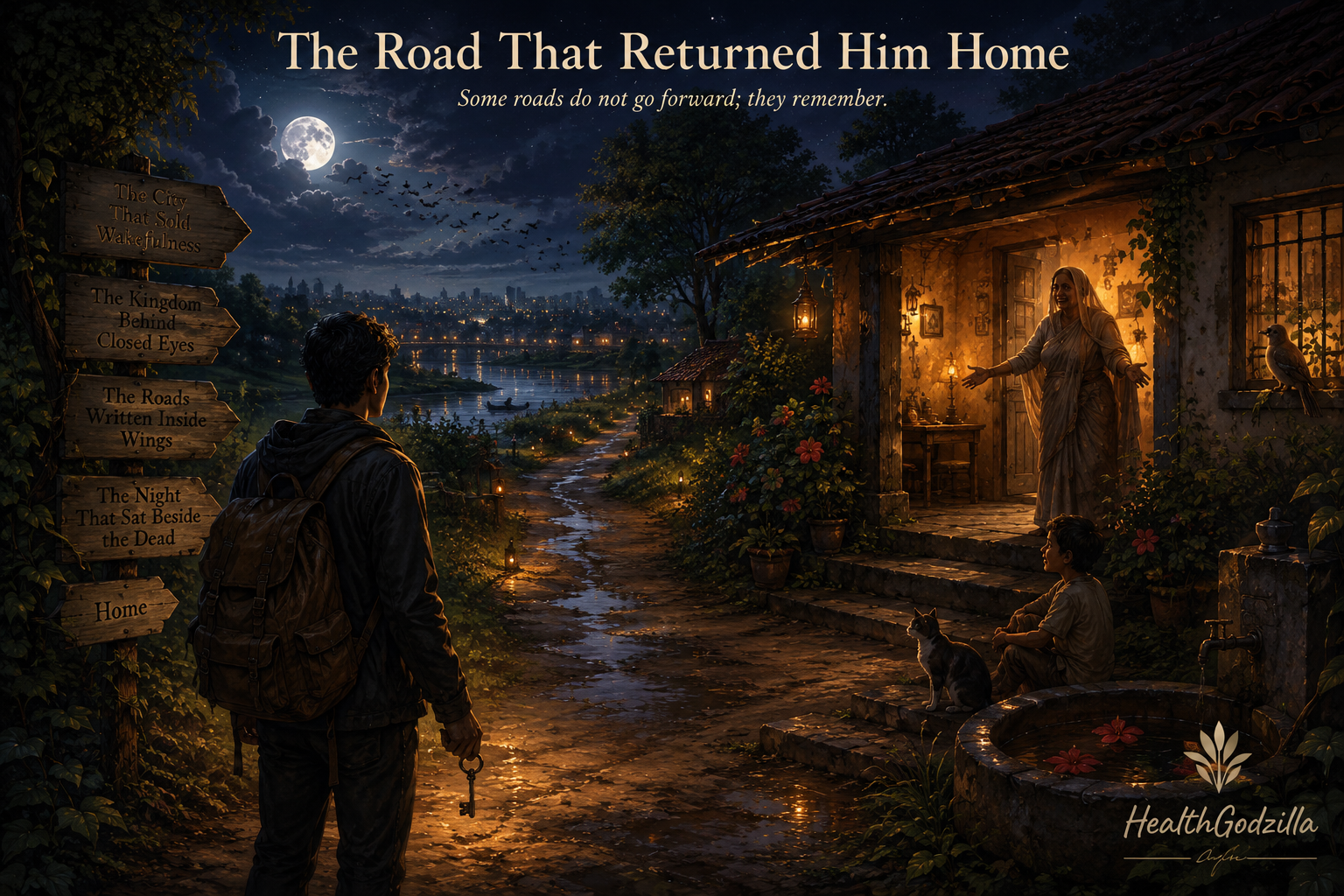
The wanderer left the banyan tree before dawn.
No one saw him go.
Behind him, the village remained gathered around its absence. The clay cup waited beneath the tree. The lantern weakened. Somewhere inside the house, the child slept after hearing a lullaby that had carried her across the first night of grief.
Ahead, the road divided.
One path followed the river.
Another entered the fields.
A third disappeared beneath trees.
The wanderer stood between them.
When Uncertainty Became Delay
For most of the journey, uncertainty had felt like freedom. He had followed fires, songs, birds, caravans, bells, and strangers. He had allowed each night to choose the next landscape.
Now uncertainty felt like delay.
He reached into his pocket.
The rusted key rested against his palm.
It still opened no visible door.
Nevertheless, when he closed his fingers around it, he saw the largest photograph hanging in his mother’s room.
He saw her waiting beside the telephone in the evening.
He heard the old woman behind the blue door:
Your mother is alive?
Yes.
Then do not turn her into memory too early.
At last, the wanderer chose the road through the fields.
When the Road Began to Remember
At first, he walked quickly.
Then the soil softened beneath his feet, and the road began returning forgotten details.
A pond where boys once learned to swim by swallowing more water than pride permitted.
A bamboo bridge that had always seemed dangerous, though goats crossed it without philosophy.
A tamarind tree beneath which travelers rested.
A narrow canal where moonlight once appeared brighter than the water.
The closer he came to home, the less impressive distance became.
Civilization had taught him to measure journeys in miles, hours, tickets, deadlines, and missed calls.
Memory measured differently.
One bend in the road could contain twenty years.
A smell could shorten a continent.
The sound of a hand pump could return a childhood before the mind had prepared a chair for it.
The sky remained dark.
Yet the eastern edge had begun loosening.
Birds stirred inside trees.
A rooster called too early, received no reply, and tried again with greater conviction.
The wanderer passed sleeping houses.
Some doors stood open behind bamboo fences. Some courtyards held cattle breathing slowly. In one veranda, an old man slept beneath a mosquito net while a radio murmured beside him to no listener.
Nearby, a dog rose near the roadside.
It barked once.
Then it looked at him carefully.
The wanderer stopped.
The dog approached, smelled his trousers, and wagged its tail with uncertainty.
Perhaps it recognized something.
Perhaps it was merely generous.
The wanderer continued.
The House Beyond the Sugarcane
Soon, the sugarcane field appeared.
The stalks moved beneath the breeze.
Beyond them stood the mango tree.
He slowed.
The first night returned to him whole.
The jackal’s silhouette.
The rabbits chasing one another.
The squirrels in the branches.
The lullaby inviting the moon to place a mark upon a child’s forehead.
For a moment, he expected the jackal to step from behind the tree.
Nothing moved there.
Still, the darkness did not feel empty.
He understood now that absence was not the same as nothingness.
The soil worked beneath him.
Insects called from grass.
A moth visited a flower he could not see.
Somewhere above, birds crossed toward a wetland that might or might not remain.
The world continued carrying its hidden obligations.
The wanderer walked on.
Before long, he saw the house.
The roof had changed.
One wall carried newer paint.
A tree had grown where no tree stood in his memory.
Yet the veranda remained.
So did the courtyard.
And beyond it, near the toilet gate, the hibiscus plant moved in the breeze.
He stopped at the edge of the road.
The branches lifted and lowered.
Red flowers stirred like small hands in the dark.
No silhouette stood there.
Or perhaps one did.
The wanderer no longer needed to decide.
He entered the courtyard.
This time, he crossed all fifty feet.
He stood before the hibiscus plant and touched one branch.
The leaves trembled against his fingers.
Daylight had once explained the branches, the flowers, and the breeze.
Night had preserved the waving hand.
Both had been telling the truth in different languages.
The Door That Frightened Him Most
Then, he turned toward the house.
The door was closed.
A faint light came from inside.
The wanderer raised his hand to knock.
Then he stopped.
He had crossed forests, rivers, deserts, centuries, cities, sleep, migration, and death.
Yet this door frightened him.
Beyond it waited no monster.
No king.
No plague bell.
Only the person whose love had survived without requiring his presence to prove itself.
The rusted key became heavy in his pocket.
He removed it and looked at it once.
Then he placed it beside the door.
Not every traveler needed a key that worked.
He knocked.
No answer came.
He waited.
Then he knocked again.
Footsteps moved inside.
Slowly.
A latch lifted.
Then another.
The door opened.
When the Years Stood in the Doorway
His mother stood before him.
For a moment, neither spoke.
She had grown older.
He knew this. He had seen her through video calls and photographs. Yet screens had flattened the years. Here, in the doorway, time stood upon her face without disguise.
Silver had found its way into her hair.
The years had drawn her shoulders inward.
Only her eyes had refused to grow unfamiliar.
The wanderer tried to speak.
Every explanation he had carried failed at once.
Work.
Distance.
Responsibilities.
Circumstances.
The civilization that had filled his hands until he no longer noticed what they had released.
All of it waited behind his teeth.
His mother looked at him.
“You came,” she said.
“Yes.”
That was all.
Then, she stepped aside.
He entered.
The room smelled of familiar wood, stored clothes, coconut oil, and the faint dust that gathers where photographs remain longer than visitors.
His photograph hung upon the wall.
The largest one.
He looked at it.
The man in the frame was younger. His face carried the calm confidence of someone who did not yet know how quickly years could become reasons.
His mother followed his gaze.
“You kept it,” he said.
“Where would it go?”
He wanted to ask why it was so large.
He already knew.
The room had needed help remembering his presence.
His mother sat upon the bed.
The Question That Survived the Years
“You have eaten?”
The wanderer almost laughed.
Across deserts, hospitals, factories, graves, and glowing cities, mothers continued asking the same question.
“Yes,” he said.
Then he paused.
“No.”
His mother looked at him with mild disappointment, as though his long absence were one matter but arriving hungry were a more immediate offence.
“There is rice.”
“Later.”
“There is fish.”
“Later.”
“You always say later.”
The old woman’s warning moved through him again.
One day it will be true.
“Now,” he said.
His mother rose.
He stopped her gently.
“Sit.”
She sat again.
For a while, they said nothing.
The house held their silence without discomfort.
Outside, the hibiscus branches moved.
A bird called from the mango tree.
Somewhere beyond the field, a child began crying.
Then came a woman’s voice.
Soft.
Sleepy.
A lullaby.
আয় আয় চাঁদ মামা টিপ দিয়ে যা…
The wanderer closed his eyes.
The song had returned before he had.
Or perhaps it had never left.
The Hand That Remembered
His mother shifted upon the bed. Her braid had loosened over one shoulder.
It was thinner now.
Silver ran through the dark hair.
The wanderer looked at it.
His mother noticed.
Without a word, she placed the braid in his hand.
The gesture required no explanation.
His fingers closed around it.
At once, the distance became impossible to measure.
He was the traveler who had crossed the world.
He was the child who had crossed only the bed.
His fingers remembered the small scratching movement.
Once.
Then again.
His mother leaned back against the pillow.
“You still do that?” she asked.
The wanderer smiled.
“My hand does.”
She closed her eyes.
Perhaps she was tired.
Perhaps she trusted the moment too completely to keep watching it.
The wanderer continued moving his fingers gently through the braid.
An apology rose within him.
Explanations crowded behind it.
Beyond them waited a promise—that never again would he allow work, distance, duty, or civilization to build such a quiet wall.
But promises often found their bravest voices before time had tested them.
So he said nothing.
Presence was the only language the room required.
Where the Night Gathered Every Road
The lullaby continued from the neighbouring house.
Outside, the night moved through the village.
It crossed the pond and entered the sugarcane field.
Beneath the mango tree, the place where the jackal had once waited remembered its touch.
The wetland received it under the folded wings of migratory birds.
Far away, darkness traveled across the desert where an old wanderer rested beneath stones.
In hospitals, fathers sang beside glass while the night kept watch.
It moved on through factories, airports, kitchens, guard posts, graves, forests, and cities still competing with the moon.
Beneath the soil, roots received what had fallen.
Above the earth, stars continued offering maps to anyone still able to see them.
Night did not belong to darkness alone.
It belonged to repair.
To fear, it gave a story.
Beside grief, it placed company.
Into tired bodies, it returned rhythm.
At doorways, mothers continued waiting.
In small hands, braids became anchors.
And for travelers, the longest road sometimes ended in the smallest gesture.
This was In Praise of Night:
not because night concealed the world,
but because it revealed what daylight allowed urgency to overlook.
What Lost Time Could Not Take
The wanderer looked again at the photograph.
Nothing could recover the years he had not returned.
No journey could reverse them.
No apology could reopen the evenings when his mother had waited beside the telephone or looked toward the door.
Lost time remained lost.
Yet the hand holding her braid was not a photograph.
The mother beside him was not a memory.
The room was not empty.
That, for one night, was enough.
Gradually, his mother’s breathing deepened.
The wanderer continued the old movement until his own eyes grew heavy.
Just before sleep, he heard her whisper:
“You came late.”
“I know.”
She opened her eyes slightly.
“But you came.”
Then she slept.
The wanderer lay beside her, still holding the braid.
Outside, the first bird announced morning.
Another answered.
The sky began changing behind the hibiscus flowers.
Night loosened its hold upon the village, but it did not disappear. Instead, it entered the soil, the sleeping body, the fading moon, the remembered song, and the road waiting for another traveler.
Morning came.
The lullaby remained.
Author’s Reflection
I began this journey with night in my imagination.
Moonlight entered first. Lullabies followed, then fairy tales, migrating birds, insects beneath the soil, flowers opening after sunset, sleeping bodies, deserts, villages, and cities that had forgotten how to become dark.
I wanted to ask what night had given humanity.
When the Journey Turned Toward Me
However, somewhere along the road, the question turned toward me.
The wanderer entered places I had intended to describe, but he also entered memories I had not planned to revisit. He returned me to a childhood veranda, where I once stood in complete darkness and saw a silhouette waving near the toilet gate. By morning, daylight offered a hibiscus plant, red flowers, moving branches, and a gentle breeze. Yet night had already given the child another truth.
The Braid My Fingers Remembered
Later, the journey reached my mother’s braid.
As a baby, I learned to hold and gently scratch her braid while falling asleep. The habit remained with me long after infancy. In writing this story, I realized that the body sometimes remembers tenderness more faithfully than the mind remembers time.
I speak with my mother several evenings each week. Somewhere beyond the call, she waits, and the largest photograph in her room still carries my face. Yet, for many reasons, I have not returned to my village home for years. Until this journey, I had not fully understood how civilization can fill a life with work, urgency, duty, distance, and reasonable explanations—until absence begins to disguise itself as something ordinary.
The Reader Sees Ink
Then, while writing this work, I cried.
I have cried while singing before, though rarely. But crying while writing was new to me. Perhaps many writers experience this, while readers see only the finished ink. The reader sees ink; the writer remembers the wound.
Still, this story is not an accusation against civilization, cities, technology, responsibility, or distance. The megacity in these pages wounds, but it also heals. Hospitals stay awake to protect life. Workers labor while others sleep. A father sings beside an incubator. A delivery rider carries a lullaby through a phone. A daughter hides her hunger so her mother will not worry.
Humanity often survives through such small acts.
Gradually, that became the centre of this journey.
Fairy tales gave fear a shape. Lullabies gave fear company. Night gave the body time to repair, the soil time to return the dead to life, birds a road through darkness, memory a room, grief a quieter voice, and love a chance to speak without spectacle.
Why the Wanderer Had to Return
The wanderer returned home because I could not allow him to die upon the road. Somewhere within the story, a promise had already been made, and I felt bound to keep it. His mother had to see him standing at the door. The room beneath his largest photograph had to receive him. And once more, the braid had to rest in his hand.
Yet return does not recover lost time.
That remains the unfinished question.
Can a person truly return to the home once left?
Could one evening mend years of absence?
Might a familiar gesture open the door to the life adulthood concealed?
I do not know.
Perhaps return does not defeat time.
Perhaps it simply refuses to surrender what remains.
What Morning Must Not Take Away
In the end, this story did not teach me to praise darkness because it hides the world. It taught me to praise night because it reveals what daylight, hurry, and habit allow us to overlook.
A mother waiting beside a telephone.
A child placing a whistle on a grave.
A bird carrying a vanished wetland inside its body.
A worker telling her mother that she has eaten.
A flower persuading through fragrance.
A hand remembering a braid.
And somewhere, even now, a lullaby travelling farther than footsteps can go.
I began by asking what night had given humanity.
By the end, I found myself asking what humanity must remember before morning takes everything back into motion.
Articles You May Like
If this journey through darkness, memory, tenderness, and return has stayed with you, the following articles may open a few neighbouring doors.
1. Humanity and Morality: Is There a Borderline Between Them?
Where does humanity end and morality begin—or are they inseparable? This article explores compassion, conscience, cruelty, responsibility, and the difficult border between being human and behaving humanely.
2. Meaning of Success: A Conversation Across Time
Success often arrives wearing the language of achievement, position, urgency, and recognition. Yet across generations, philosophers, workers, dreamers, and ordinary lives have asked whether a successful life is measured by what we gain—or by what we remember not to lose.
3. The Old Man and the Sea: Not Yet Doesn’t Mean Never
Through endurance, solitude, dignity, and the quiet courage to continue, this reflection revisits Hemingway’s old fisherman and the stubborn hope carried inside the words not yet.
4. My Planet Home—Earth: The Future of Humanity and It
Home is not only a room, a village, or a country. It is also the soil beneath us, the air around us, the water that remembers our footprints, and the living planet whose future cannot be separated from our own.
Principal Sources
Literary and Intellectual Influences
The following works were not directly quoted or consulted as sources for individual passages. However, they have profoundly influenced my understanding of journeys, homecoming, morality, human endurance, and the living Earth, and therefore helped shape the imaginative ground from which this work emerged.
- Hemingway, E. (1952). The old man and the sea. Charles Scribner’s Sons.
https://www.simonandschuster.com/books/Old-Man-and-the-Sea/Ernest-Hemingway/9780684801223 - Homer. (2006). The Odyssey (R. Fagles, Trans.; B. Knox, Intro. & Notes). Penguin Classics. (Original work composed circa the eighth century BCE).
https://www.penguin.co.uk/books/62460/the-odyssey-by-homer-trans-robert-fagles/9780143039952 - Kant, I. (1997). Lectures on ethics (P. Heath, Ed. & Trans.; J. B. Schneewind, Ed.). Cambridge University Press.
https://www.cambridge.org/core/books/lectures-on-ethics/3165BCC1A91F68ADADBFEC2F4DA4A58E - Lovelock, J. (2016). Gaia: A new look at life on Earth. Oxford University Press.
https://books.google.com.bd/books?id=w-MmEAAAQBAJ&printsec=frontcover&source=gbs_ge_summary_r&cad=0#v=onepage&q&f=false - Ghalib, Longing, and the Mirror of Separation
Ghalib, M. A. K. (2007). Dīwān-e-Ghālib (3rd ed.). Ghalib Academy.
Selected Scientific Sources
The works shaped understanding of sleep, circadian rhythms, immunity, memory, nocturnal pollination, soil decomposition, migration, artificial light, wetlands, and migratory habitat.
- Sleep, Melatonin, and Circadian Rhythms
Zisapel, N. (2018). New perspectives on the role of melatonin in human sleep, circadian rhythms and their regulation. British Journal of Pharmacology, 175(16), 3190–3199. https://doi.org/10.1111/bph.14116 - Sleep and Immune Function
Besedovsky, L., Lange, T., & Born, J. (2012). Sleep and immune function. Pflügers Archiv—European Journal of Physiology, 463(1), 121–137. https://doi.org/10.1007/s00424-011-1044-0 - Sleep and Memory Consolidation
Rasch, B., & Born, J. (2013). About sleep’s role in memory. Physiological Reviews, 93(2), 681–766. https://doi.org/10.1152/physrev.00032.2012 - Nocturnal Pollination and Night-Time Plant–Insect Communication
Macgregor, C. J., & Scott-Brown, A. S. (2020). Nocturnal pollination: An overlooked ecosystem service vulnerable to environmental change. Emerging Topics in Life Sciences, 4(1), 19–32. https://doi.org/10.1042/ETLS20190134 - Decomposition and Soil Ecology
Neher, D. A., Barbercheck, M. E., El-Allaf, S. M., & Anas, O. (2003). Effects of disturbance and ecosystem on decomposition. Applied Soil Ecology, 23(2), 165–179. https://doi.org/10.1016/S0929-1393(03)00043-X - Migratory Navigation
Merlin, C., Heinze, S., & Reppert, S. M. (2012). Unraveling navigational strategies in migratory insects. Current Opinion in Neurobiology, 22(2), 353–361. https://doi.org/10.1016/j.conb.2011.11.009 - Artificial Light at Night
Bará, S., & Falchi, F. (2023). Artificial light at night: A global disruptor of the night-time environment. Philosophical Transactions of the Royal Society B: Biological Sciences, 378(1892), 20220352. https://doi.org/10.1098/rstb.2022.0352 - Wetlands and Migratory Habitat
Haig, S. M., Murphy, S. P., Matthews, J. H., Arismendi, I., & Safeeq, M. (2019). Climate-altered wetlands challenge waterbird use and migratory connectivity in arid landscapes. Scientific Reports, 9, 4666. https://doi.org/10.1038/s41598-019-41135-y
These sources inform HealthGodzilla’s narrative and systems lens. Rather than an exhaustive review, the article draws on research exploring how darkness influences biological rhythms, sleep, memory, immunity, nocturnal ecology, migration, and night-active species’ habitats.
This article is also archived for open access on https://doi.org/10.5281/zenodo.21762613