
By Ansarul Karim Jamee
Published: June 23, 2026
Ansarul Karim Jamee holds master’s degrees in Environmental Science and Management, History, and Business Administration. For nearly three decades, he has worked across diverse industries, advancing sustainability, well-being, and systems awareness.
Author profiles: LinkedIn | Google Scholar | Academia.edu | ORCID
To learn more about the author and the HealthGodzilla project, visit the HealthGodzilla homepage.
Before the Article Begins
Clear Description of the Article
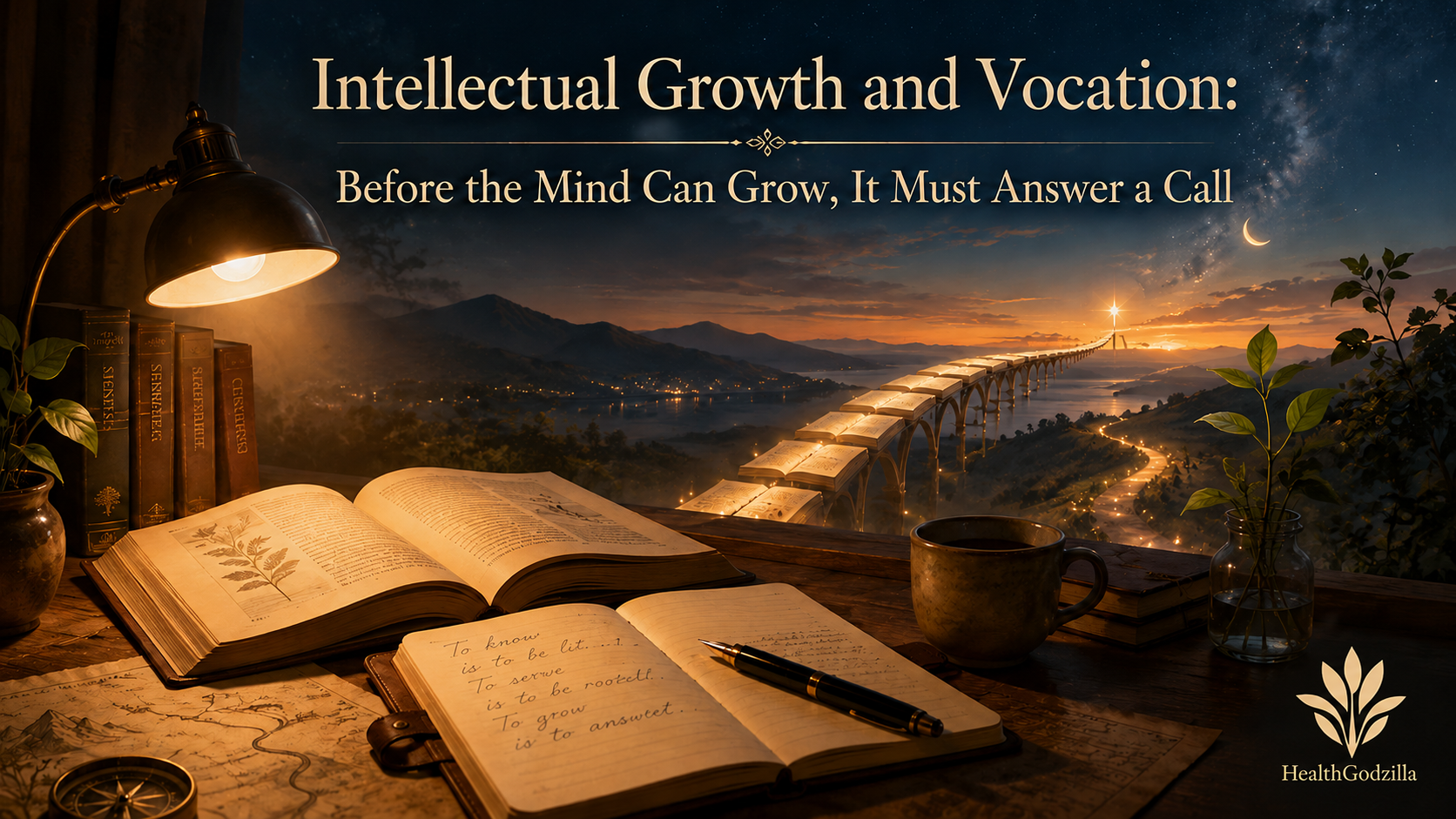
Intellectual Growth and Vocation explores what happens when the mind becomes tired of growth as command, measurement, visibility, and endless improvement. It asks a deeper question: before the mind grows stronger, sharper, or more successful, should it first ask what its growth is for?
Drawing from Carol Dweck’s idea of growth mindset and A. G. Sertillanges’ vision of intellectual vocation, this article follows Selene and his Professor father through a quiet conversation about learning, discipline, service, history, science, solitude, and a tender heart. Dweck teaches that ability can grow. Sertillanges asks whether that growth has answered a call. HealthGodzilla asks whether knowledge can truly grow without tenderness.
Through this journey, Intellectual Growth and Vocation becomes more than a topic. It becomes a meeting place between modern anxiety and older wisdom, between information and direction, between achievement and meaning. The article suggests that the mind should not grow only to become more capable. It should grow toward truth, life, service, and the age in which it stands.
What Is Intellectual Growth and Vocation?
Intellectual growth and vocation mean more than becoming informed, skilled, clever, productive, or successful. Their deeper connotation lies in the relationship between growth and calling. Intellectual growth is the deepening of the mind through learning, reflection, discipline, correction, imagination, and return. Vocation gives that growth direction. It asks why the mind is growing, whom it may serve, what truth it must honor, and what wound of the age it may help to clarify.
A mind may grow in many ways. It may collect facts, pass examinations, publish articles, win recognition, build influence, or become more visible. Yet growth alone does not guarantee wisdom. A sharper mind may still become vain. A faster mind may still become careless. A more informed mind may still become cold. Even persistence, discipline, and intelligence may become dangerous if they are not joined by humility and tenderness.
Therefore, intellectual vocation asks the mind to grow with responsibility. It does not reject curiosity, ambition, achievement, or skill. Instead, it places them under a larger and more demanding question: what is this growth for?
In this sense, Intellectual Growth and Vocation is not only about personal improvement. It is about the direction of the growing mind. It asks whether knowledge will become a badge, a weapon, a performance, or a lamp held toward life.
Why Must Intellectual Growth Answer a Call?
The mind must answer a call because growth without direction can become noise, vanity, hunger, or mere performance. A person may improve endlessly and still feel inwardly lost. He may become more capable without becoming more humane. He may learn more, produce more, and become more visible, yet never ask whether his growth is serving truth or only feeding the restless machinery of self-improvement.
Intellectual growth and vocation become meaningful when learning serves something beyond private expansion. A call gives the growing mind a center. It turns scattered curiosity into disciplined attention, private learning into service, and knowledge into a lamp held toward life.
This does not mean every person must become a scholar, philosopher, or public thinker. Rather, it means that serious learning should not remain a decoration of the self. A mind that grows should also ask whom it may help, what confusion it may clarify, what darkness it may soften, and what dignity it may restore. This question also connects with the purpose of education: whether learning should produce only capable students, or more humane people.
For Selene, this question begins as discomfort. Growth has surrounded him as command: become more visible, more productive, more optimized, more successful. Yet through his father’s questions, growth slowly changes shape. It no longer feels only like a whip. It begins to feel like a question.
For now, this answer is only one current in the river. Tomorrow, the flow may reveal another bend. Yet at this point in the journey, one thing seems clear: before the mind can grow wisely, it must begin to hear what it is growing for.
Here, the Article Begins
Selene and the Anxiety of Growing
Selene was tired of growth.
Not of learning. Becoming itself had not exhausted him. What tired him was not the difficult joy of understanding something that yesterday had seemed closed, but the way the world had turned growth into a command. He was tired of the word itself—growth as command, growth as advertisement, growth as measurement, growth as a polite whip in the hands of the modern world.
Develop your skills. Increase your income. Build a network. Become more visible. Find an audience. Expand your influence until even silence begins to look unemployed.
He was not tired of learning.
He was tired of being improved by everyone.
Algorithms wanted him optimized. Institutions wanted him measurable. Books wanted him disciplined. Success wanted him visible. Even failure had become a motivational quote.
That evening, he found his father in the study, seated beside a lamp whose yellow light fell gently over an old book. Outside, the city hummed with its usual metallic impatience. Somewhere beyond the window, cars moved like thoughts that had forgotten where they were going.
“What are you reading?” Selene asked.
His father looked up, smiled faintly, and turned the book so Selene could see the page.
“A book about the intellectual life,” he said.
Selene leaned against the doorframe. “That sounds dangerous.”
“It is,” his father replied. “If read honestly.”
Selene laughed. “I thought intellectual life meant reading, thinking, writing, maybe teaching.”
“It can mean those things,” his father said. “But those are only the outer movements. The deeper question is different.”
“What question?”
His father touched the page lightly, as if the sentence there were not ink but a small flame.
“Growth toward what?”
The question did not sound academic. It sounded like rescue.
Dweck Opens the Door: Ability Can Grow
Selene did not hate the idea of growth.
That was the first thing his father seemed to understand without asking. Selene had not come to the study as a lazy mind trying to escape effort. He knew the dignity of practice. He knew the quiet miracle of returning to something difficult and finding, after days or months, that the wall had begun to loosen.
There was beauty in that.
A sentence once impossible becomes readable. A problem once frightening becomes approachable. A failure once humiliating becomes information. The mind, when treated with patience, sometimes answers back with a new strength.
“That part is true,” Selene said. “People can grow.”
His father nodded. “Carol Dweck helped many people remember that.”
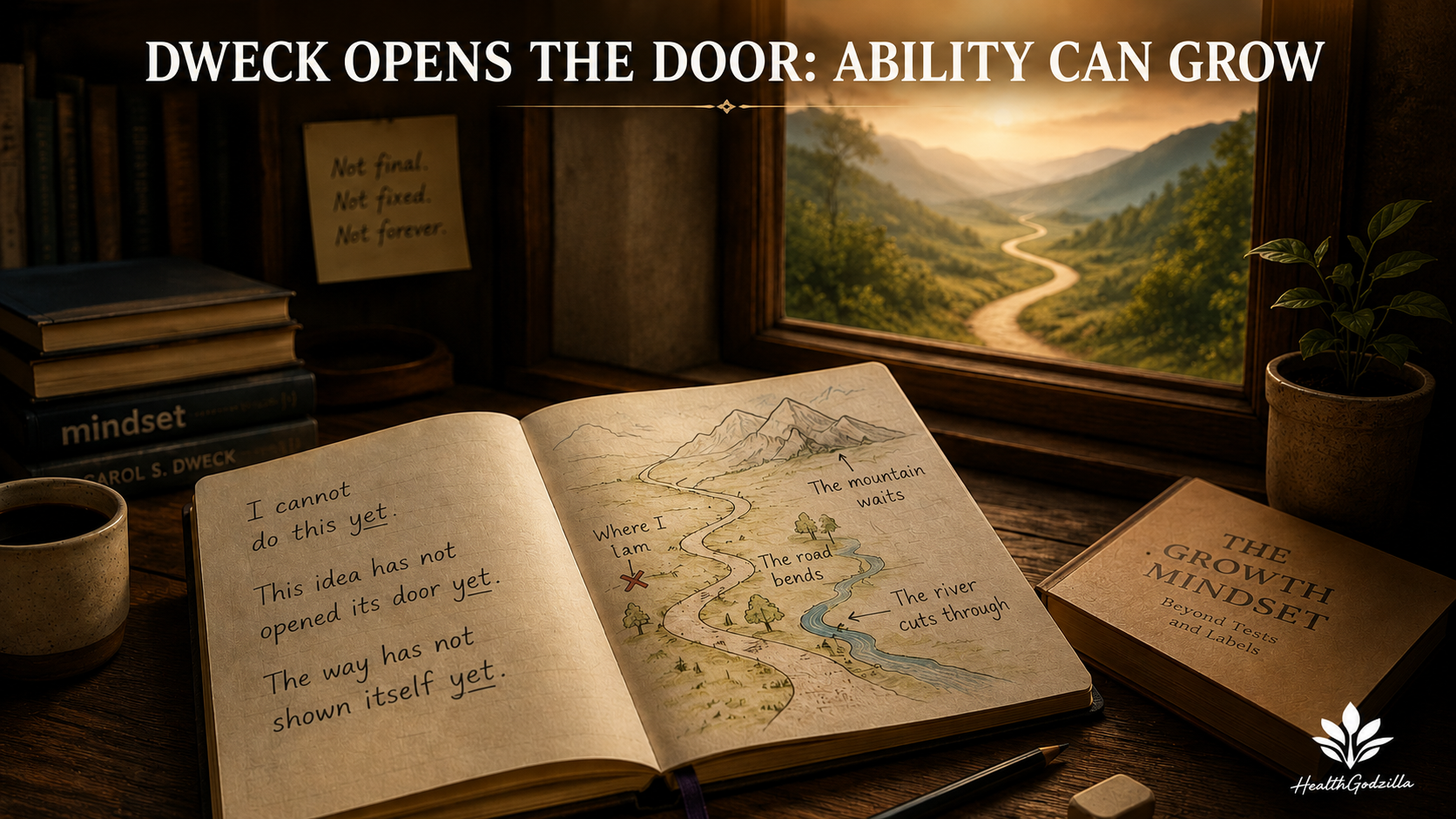
Dweck’s idea of growth mindset challenged the belief that intelligence, talent, and ability arrive in fixed quantities. A person is not sealed forever inside an early measurement. Through effort, strategy, correction, persistence, and support, abilities may develop. Failure need not become a permanent name. It may become part of the map. For a fuller HealthGodzilla reflection on growth mindset beyond tests and labels, see my earlier article on deconceptualizing growth mindset.
The Little Word Yet
Selene liked that word: map.
A map did not insult the traveler for being far from the destination. It simply showed where he stood, where the road bent, where the river cut through, where the mountain waited.
“That is why the word yet matters,” his father said. I cannot do this yet. This idea has not opened its door yet. The way has not shown itself yet.
Selene looked toward the window. The city outside was restless with lights.
“Yes,” he said. “But the world has taken that little word and made it work overtime.”
His father smiled. “How so?”
“Everything is now a yet. Not successful yet. Still not visible enough. Optimization remains unfinished. Wealth waits farther ahead. Productivity demands another ladder. Even healing had become a performance target. Even rest is treated like a technique for future performance.”
His father did not answer immediately.
That silence helped.
For a moment, the room became different from the world outside it. No notification entered. The metrics stopped blinking. For once, the invisible audience outside his mind demanded nothing.
Why Intellectual Growth Needs Direction
Growth mindset can free a learner from the prison of fixed ability. But growth culture can build another prison and decorate its walls with motivational quotes.
This is where Selene’s discomfort began.
A fixed mindset says, “You cannot grow.”
Growth culture says, “You must grow endlessly.”
Neither one asks whether the growing person is becoming whole.
The first imprisons ability. The second exhausts the soul.
Dweck opens an important door. She tells the learner that present ability is not always final ability. This is necessary, humane, and often liberating. Without that door, many people stop too early. They mistake difficulty for destiny. They turn temporary struggle into permanent identity.
But once the door opens, another question stands outside.
Where should the learner go?
When Growth Needs a Road
Persistence can strengthen a mind, but persistence alone does not choose the road. Consistency can carry a person far, but consistency alone does not ask whether the destination deserves the journey. Resilience can help someone rise again, but even resilience may return a person to the wrong battlefield.
Selene leaned forward.
“So growth itself is not innocent.”
“No,” his father said. “Growth needs direction.”
A person may grow more intelligent and become more honest. Another may grow more intelligent and become more skillful at hiding the truth. One may develop language to awaken people. Another may develop language to manipulate them. Knowledge may expand while tenderness disappears quietly from the room.
This does not weaken Dweck’s insight. It protects it.
Growth mindset needs rescue from the marketplace of endless improvement. It should not become a whip. It should remain a window.
Dweck teaches the learner not to surrender to the first limit. Sertillanges asks the next question: once the limit begins to move, what will the learner serve?
Selene sat quietly with that.
Ability could grow. Yes.
But perhaps the real danger was not failure. Perhaps the danger was growing without knowing what kind of person that growth was building.
Bridge-Stone
Growth mindset opens the window; vocation asks what kind of sky the learner is trying to see.
Sertillanges and Intellectual Vocation: Growth Toward What?
His father opened the old book again.
“Now,” he said, “we are ready for vocation.”
Selene did not answer quickly. The word felt older than the room. It did not sound like a career plan, a skill path, or a personal brand. It sounded like something that could not be downloaded, optimized, or displayed in a profile headline.
“Vocation,” Selene said at last. “That sounds heavier than growth.”
“It is heavier,” his father replied. “Growth asks, ‘Can I become more?’ Vocation asks, ‘What am I becoming more for?’”
The question stayed in the room.
Outside, the city continued its restless business. Someone was probably preparing for an exam. Elsewhere, a resume was being updated. On another screen, discipline was being polished into a post. In some quiet corner, failure was being renamed as strategy. Somewhere, another young mind was being told to grow without being asked what kind of life that growth was building.
Sertillanges does not treat intellectual life as vague admiration for books, scattered reading, or occasional writing. For him, intellectual vocation requires penetration, continuity, and methodical effort. A mind must not merely collect ideas like bright stones from the shore. It must enter them, test them, live with them, and return to them when the first excitement has already gone home.
Selene looked at the shelves around him.
“So liking ideas is not enough.”
“No,” his father said. “Liking ideas may begin the road. It cannot finish it.”
Intellectual Growth and Vocation Need More Than Interest
Interest is often beautiful. It visits suddenly, opens a window, and lets fresh air enter the mind. Without interest, many journeys would never begin.
However, interest is not yet vocation.
Interest says, “This attracts me.”
Vocation says, “This asks something of me.”
Interest enjoys the flame. Vocation arranges life so the flame can keep burning.
That difference matters because modern life is full of intellectual fragrance. Quotes travel faster than reflection. Books are displayed before they are digested. Ideas become captions. Even wisdom is often packaged like a product: brief, polished, shareable, and safe from the inconvenience of transformation.
Yet Sertillanges asks for something more dangerous. He asks whether the mind is willing to be shaped by truth, not merely decorated by it.
Selene felt that sentence before he understood it.
“So the question is not whether I enjoy thinking,” he said.
“No,” his father answered. “The question is whether thinking has begun to claim you.”
Truth Does Not Serve Vanity
Sertillanges uses a severe line: truth serves only its “slaves.”
Selene frowned.
“That word is troubling.”
“It should trouble us,” his father said. “But we must hear what he means before we reject the whole sentence.”
In modern ears, the word sounds harsh, even dangerous. Yet Sertillanges is not praising social slavery. He is describing inward surrender. Truth does not become a servant of ego. It does not arrive merely to make a person admired, clever, quotable, or victorious in argument.
Instead, the seeker must become available to truth.
That availability requires humility. It means accepting correction, resisting publicity as the main motive, and learning from those who walked before us without turning them into statues. It also means understanding that knowledge has causes.
Books matter. Silence matters. Method matters. Discipline matters. Friendship with better minds matters. So does the protected hour, the honest notebook, the difficult return, and the willingness to begin again after confusion.
One should not wait until the roof is needed to start digging the foundation.
Selene smiled. “That sounds like advice given after somebody has already tried to build the roof.”
“Most wisdom is,” his father replied.
When Growth Becomes a Call
For this reason, intellectual growth and vocation cannot remain only a private improvement project. If growth becomes only self-expansion, it may sharpen the mind while narrowing the soul. If vocation enters, growth begins to ask whom it may serve.
This is where Sertillanges changes the atmosphere.
He does not ask the learner only to become capable, but responsible. The mind is not asked merely to become stronger, but faithful. Knowledge is not asked simply to increase; it is asked whether it can become life-giving.
Selene looked again at the book.
“So vocation is not against growth.”
“No,” his father said. “It rescues growth from emptiness.”
The answer was simple, but it did not feel small.
Growth without vocation could become endless climbing. Vocation did not remove the mountain. Instead, it asked whether the mountain was worth climbing, and whether anyone might need the view from its height.
Selene sat quietly.
For the first time that evening, growth did not feel like a whip.
It felt like a question.
Bridge-Stone
Interest admires the flame; vocation arranges life so the flame can keep burning.
Intellectual Growth Is Not Vague Reading
Selene remained quiet for a while.
The room had become too honest for easy answers. A few minutes earlier, growth had seemed like a public word, something shouted from screens, classrooms, offices, and self-improvement shelves. Now it felt private again, almost dangerous. If growth was a question, then reading was no longer innocent either.
He looked at the books around him.
“So if vocation begins to claim someone,” he asked, “does that mean reading more?”
His father laughed softly.
“Sometimes. But not always.”
That answer surprised him.
“Not always?”
“No. Some people read more because they are hungry. Others read more because they are avoiding digestion.”
Selene smiled. “That sounds like an accusation.”
“It is a diagnosis.”
His father leaned back in his chair. Behind him, the shelves rose quietly, like a forest that had learned to stand indoors.
“Books can become companions,” he said. “They can also become hiding places. A person may pass from one author to another, one idea to another, one quotation to another, and still never let any truth enter deeply enough to disturb him.”
When Reading Becomes Decoration
Intellectual growth and vocation cannot depend on vague reading alone.
A mind may collect beautiful sentences and remain unchanged. It may underline half a library and still not know what question it is serving. It may admire difficult books, quote serious thinkers, and decorate itself with intellectual fragrance, yet avoid the harder labor of penetration.
Penetration is different from exposure.
Exposure says, “I have encountered this idea.”
Penetration says, “This idea has entered me, resisted me, corrected me, and left me unable to think exactly as before.”
That is why vague reading can become dangerous. It gives the sensation of movement without requiring transformation. The reader travels across many pages, but the inner life remains in the same room.
Selene looked down at his hands.
“I know that feeling,” he said. “Finishing pages but not being changed by them.”
His father nodded. “Many intelligent people know it. The danger is not ignorance only. Sometimes the danger is undigested knowledge.”
The Difference Between Collecting and Returning
A poor reader only collects.
A living reader returns.
He returns to the sentence that would not leave him alone. In the margin, a question keeps calling him back. Even the paragraph that annoyed him deserves another visit, because annoyance sometimes guards an unfinished lesson. Then an idea first mistaken for simplicity begins to reveal a staircase.
Therefore, the intellectual life is not built by the number of books touched, but by the depth of contact established. One necessary book may do more than twenty admired books. One honest notebook may do more than a hundred saved quotations. One hour of real attention may do more than an entire day of distracted accumulation.
Selene remembered the way people photographed books beside coffee cups, arranged them beside windows, posted them beside captions about discipline. He had done it too, though not always dishonestly. Sometimes beauty helped him begin. Still, he now understood the danger.
A book could become a door.
It could also become a mirror in which the reader admired himself for standing near the door.
“So how does one read for vocation?” he asked.
“By asking what the book is asking of you,” his father said.
“Not only what I can take from it?”
“No. Also what it can demand from you.”
Organized Patience and the Honest Notebook
This is where discipline enters quietly.
Not as punishment. Not through stiffness. And certainly not as the proud cruelty of a person who wants to appear serious. Discipline enters as hospitality for truth. It prepares the room so that an idea may arrive, sit down, and stay long enough to speak.
The honest notebook helps. So does the protected hour. The refusal to chase every new intellectual sparkle also matters. Above all, there is the humility to admit, “I have read this, but I have not yet understood it.”
At the same time, organized patience is not laziness wearing a robe. It has movement. Questions begin to arrange themselves. Causes are followed. Ideas meet and test one another. Memory becomes seed, not storage. Finally, the mind asks whether a thought has roots, whether those roots touch life, and whether life may be served by what grows from them.
Selene looked again at the old book.
“So reading is not just gathering water.”
“No,” his father said. “It is learning which spring to return to.”
“And then?”
His father smiled.
“Then, if the water is clean, you pour.”
Bridge-Stone
The reader who only collects ideas builds a shelf; the reader who returns to them begins to build a life.
Intellectual Vocation Needs Protected Time
Selene was still thinking about the spring.
A strange thing had happened. Reading no longer looked like a race to finish pages. It looked like a return to water. Yet the thought also made him uneasy, because return required time, and time was the one thing everyone claimed to lack.
He looked at his father.
“What if someone has the call,” he asked, “but not the life for it?”
His father did not laugh this time.
“That is the usual condition,” he said.
Selene waited.
“Almost nobody begins with the perfect life. Work interrupts. Family calls. Fatigue arrives before philosophy. Bills are not impressed by vocation. The body asks for sleep even when the mind wants a kingdom.”
Selene smiled faintly. “That sounds familiar.”
“It should. Intellectual vocation is not always given to people with empty days. Sometimes it is given to people with crowded days and one honest hour.”
Two Protected Hours Can Become a Small Monastery

Sertillanges asks a sharp and merciful question: have you two hours a day?
He does not ask whether you own a library, live near a university, possess perfect leisure, or have been freed from ordinary duty. He asks whether a portion of the day can be protected with jealousy and used with ardor.
Two hours may sound small to ambition. Yet to vocation, a protected hour is not small. It is a room with a door.
Inside that room, the world does not disappear, but it stops governing everything. The learner returns to the book, the notebook, the problem, the unfinished idea. Slowly, the hour becomes recognizable. The mind begins to trust it. Thought learns where to find its chair.
Selene imagined such an hour.
No applause. Nothing announced itself. No heroic transformation entered the room. Only return.
“That sounds less dramatic than I expected,” he said.
“Most real things are,” his father replied.
A Guarded Hour May Gather the Mind
The modern world praises freedom but often gives distraction. A completely empty day may scatter the mind into many attractive fragments. However, a guarded hour can gather it.
This is why limitation is not always an enemy. A river without banks spreads into swamp. A river with banks gathers force. In the same way, obligation may sometimes train attention. Work, duty, and limited time can teach the mind to stop wasting the little space it has been given.
Of course, exhaustion is real. No romantic sentence should insult the tired body. A person who works all day cannot be commanded into greatness by slogans. Yet the question remains gentle and dangerous: is there a small protected space where the inner life may breathe?
If the answer is yes, then vocation has a place to stand.
Selene looked at the lamp. Its light did not fill the whole room. It did not need to. It only made one circle of visibility, and inside that circle, the book was enough.
“So the task is not to conquer the whole day,” he said.
“No,” his father answered. “Begin by rescuing one faithful part of it.”
The Sacred Corner in a Crowded Life
A protected intellectual hour is not only a scheduling trick. The mind will not live only on leftovers. Thought deserves more than accidental attention. And even a quiet call deserves to be treated as real.
For this reason, intellectual growth and vocation must eventually become practical. A person may love truth in the evening and betray it by morning if no habit protects the love. The call must enter the calendar, the desk, the notebook, the repeated return.
Selene understood now why his father had not begun with productivity.
Productivity asks how much can be produced. Vocation asks what must be faithfully protected. Productivity counts output. Vocation guards the source.
Perhaps two hours were not merely two hours. Perhaps they were proof that the inner flame had been given shelter.
His father closed the book for a moment.
“Remember,” he said, “a crowded life does not cancel vocation. But vocation must find one place in that crowd where it is not constantly interrupted.”
Selene nodded.
For the first time, time did not feel only like something stolen from him.
It felt like something that could be defended.
Bridge-Stone
A protected hour is not an escape from life; it is the small room where life learns what it must become.
Intellectual Growth Needs Solitude Without Isolation
Selene understood the need for a protected hour. Yet another worry entered him almost immediately.
“If I protect time,” he said, “does that mean I must withdraw from people?”
His father looked at him carefully.
“Withdraw from noise, yes. From life, no.”
The answer was simple, but it divided the road.
Selene had seen both dangers. Some people were swallowed by the crowd until they could no longer hear themselves think. Others escaped the crowd so completely that they began to love ideas more than living beings. One kind of person lost silence. The other lost tenderness.
Neither seemed whole.
“Solitude is not the same as isolation,” his father said.
Selene waited.
“Solitude gives the mind room to breathe. Isolation teaches the mind to breathe only itself.”
Solitude Gives the Mind a Room
Intellectual growth and vocation need solitude because the mind cannot deepen while constantly performing. A serious thought often arrives quietly. It does not always compete well with noise, speed, display, and interruption.
Therefore, solitude becomes necessary.
In solitude, the learner can return to the difficult sentence. The notebook can remain open without apology. The half-formed idea can walk slowly across the mind without being pushed into a conclusion too soon. A question can ripen before it is announced.
Selene liked that: a question ripening.
The world usually wanted answers before the fruit had formed.
“So solitude protects the unfinished thought,” he said.
“Yes,” his father replied. “And many of the best thoughts are unfinished for a long time before they become useful.”
This kind of solitude is not emptiness. It is hospitality. It prepares a small inward room where truth may enter without being immediately photographed, judged, sold, or defended.
Isolation Can Make the Mind Inhuman
Yet solitude has a shadow.
If the thinker withdraws too far, he may begin to mistake distance for depth. He may become proud of not needing anyone. Humanity may stay in his vocabulary while actual human beings vanish from his patience. Truth may still be loved in abstraction, while the trembling, inconvenient lives for which truth should matter begin to irritate him.
That is when solitude hardens into isolation.
Isolation does not merely separate a person from noise. It separates the mind from sympathy. Cleverness may remain, but wisdom begins to thin. Judgment may sharpen, while mercy quietly withdraws. A thinker may even learn to define suffering beautifully while failing to hear the person suffering beside him.
Selene looked toward the window.
“So the danger is not only distraction,” he said. “The danger is also coldness.”
His father nodded.
“Exactly. A mind can become too crowded. It can also become too empty of others.”
The Tender Heart Keeps Solitude Human
This is where the tender heart becomes necessary.
A tender heart does not weaken intellectual life. Instead, it keeps intellectual life from becoming cruel, vain, or sealed inside itself. It reminds the thinker that knowledge is not a jewel to hide in the mind, but a lamp entrusted to the hand.
For this reason, solitude must eventually return to life.
The protected hour should help the thinker listen more deeply, not withdraw permanently into self-admiration. The honest notebook should make the mind more available to truth, not more superior to people. The old book should not become a wall against the present world. It should become a window through which the present world can be seen more clearly.
Selene remembered his father’s earlier question.
Who may need this?
Whose darkness may this little lamp reduce?
What confusion may this clarify?
What human dignity may this restore?
Those questions now sounded less like writing prompts and more like safeguards. They protected intellectual growth from becoming lonely brilliance.
“So the mind goes into solitude,” Selene said, “but it must come back carrying something.”
His father smiled.
“Yes. Otherwise, it has only visited itself.”
Bridge-Stone
Solitude deepens the mind; tenderness returns it to the human world.
History as a Bridge, Not a Coffin

The old book remained open between them.
Selene had begun to feel that the room was becoming crowded, though no one else had entered. Dweck was there, with her door of possibility. Sertillanges was there, asking whether growth had found its call. The dead were there too—not as ghosts, but as presences waiting to be understood without being embalmed.
His father noticed him looking at the shelves.
“You are thinking about the past,” he said.
Selene smiled. “How did you know?”
“You looked at the books as if they were watching us.”
“Maybe they are.”
“In a way,” his father said, “they are.”
The thought did not frighten Selene. It steadied him. A book was not only paper. It was a mind that had crossed time and arrived with dust on its shoulders, asking whether anyone in the present still knew how to listen.
Yet listening to the past was not simple. Some people worshipped it. Others dismissed it. Some carried it like a corpse. Others threw it away like a burden. Neither gesture seemed wise.
“So what should we do with the past?” Selene asked.
His father closed his eyes for a moment, as if the question deserved a quieter room.
“Do not bury it twice,” he said.
When the Past Becomes a Coffin
The past becomes a coffin when we love it without letting it live.
This can happen in scholarship, religion, culture, family memory, and even personal identity. A person may admire old thinkers so much that admiration becomes paralysis. He may repeat their sentences without asking what wound those sentences were trying to heal. He may guard inherited words like museum objects while the living world stands outside, waiting for bread, light, and interpretation.
Sertillanges warns against this tendency. He does not reject the past. Instead, he rejects a dead relationship with it. He does not want the intellectual worker to become a pallbearer at the funeral of memory.
Selene sat with that image.
“A pallbearer of memory,” he said. “That is terrible.”
“And common,” his father replied.
The danger is subtle because it often wears noble clothes. Respect for tradition may hide fear of the present. Love of ancient wisdom may become an excuse for avoiding modern suffering. Even intellectual seriousness may become archaeological pride if it spends all its strength polishing bones instead of asking what old truth can do for living people.
The past deserves better than that.
It does not want to be flattered. It wants to be understood deeply enough to become useful again.
History Becomes a Bridge When It Meets the Present
History becomes a bridge when the past and present are allowed to question each other.
The past asks the present, “What have you forgotten?”
The present asks the past, “What can still live?”
Between them, understanding begins to move.
This is where historiography matters. History is not only a storehouse of dates, kings, wars, documents, and vanished customs. It is also a way of asking how meaning travels through time. It studies how facts are selected, interpreted, arranged, remembered, forgotten, and revived.
Therefore, the intellectual worker should not use history as decoration. He should use it as a method of awakening.
A past idea must be tested in the weather of the present. If it breaks, we learn something. When it survives, we learn something greater. And if it changes shape without losing its soul, then perhaps it was never merely old. Perhaps it was waiting for another age to recognize it.
Selene leaned forward.
“So old truth is not old because it came before us.”
“No,” his father said. “Sometimes it is old because it has survived many mornings.”
That sentence pleased Selene.
He thought of virtues that had been buried too quickly: patience, silence, humility, discipline, courage, mercy, reverence, intellectual honesty. None of them belonged only to the past. Yet none of them could be carried into the present without translation.
A virtue repeated without life becomes a slogan.
A virtue translated with care becomes seed.
Intellectual Growth and Vocation Need Living Memory
For this reason, intellectual growth and vocation need living memory.
A mind without memory becomes fashionable too easily. It mistakes novelty for truth and speed for depth. Yet a mind trapped in memory becomes rigid. It mistakes age for wisdom and repetition for fidelity.
The intellectual vocation must walk between these dangers.
It must receive the inheritance of the dead without becoming their prisoner. Older wisdom should be heard without turning older voices into statues. At the same time, the present must be faced without becoming drunk on its own noise.
Selene remembered the phrase his father had used earlier: growth toward what?
Now another version appeared:
History toward what?
If history only produced nostalgia, it became a coffin. When it produced only argument, it became a battlefield. But when it gave birth to humility, perspective, courage, and renewed responsibility, it became a bridge.
“Then the past is not behind us only,” Selene said.
“No,” his father answered. “Sometimes it is beneath us, like a foundation. Sometimes it is ahead of us, like an unfinished promise.”
The study became quiet again.
Outside, the city kept moving. Screens glowed. Engines turned. Messages traveled. Somewhere, people were chasing the newest thing because the newest thing looked alive. Somewhere else, people were worshipping the oldest thing because the oldest thing looked safe.
Between those two errors, Selene saw a narrower road.
Carry the past like seed.
Not like a corpse.
Bridge-Stone
History is not a coffin for memory; it is a bridge where old truth learns today’s weather.
What Does Our Age Lack in the Age of Information?
Selene did not speak for a while.
The past had entered the room, but it had not made the present disappear. In fact, the present now seemed louder. The city outside the window glowed with screens, engines, advertisements, updates, ambitions, and unfinished messages. Every second, something was being posted, measured, corrected, ranked, bought, sold, optimized, forgotten.
The present did not look empty.
It looked overcrowded.
“What does our age lack?” Selene asked.
His father turned the question over slowly.
“That is the question every intellectual worker must ask.”
Selene looked at him. “Not what do I like to study?”
“That too,” his father said. “But not first. First, ask what wound has been placed near you.”
The sentence landed heavily.
What wound has been placed near you?
It did not sound like a productivity question. Career language felt too small for it. This was the kind of question one could spend years answering honestly.
The World Is Not Poor in Data
The modern world does not suffer from a shortage of information.
It suffers from a crisis of orientation.
Facts multiply. Notifications arrive. Reports are published. Opinions move faster than reflection. Artificial intelligence can generate answers before the soul has learned how to ask a question. Dashboards glow. Metrics update. Feeds refresh. Yet beneath this bright abundance, many people remain directionless, exhausted, and strangely unfed.
Therefore, the problem is not only ignorance.
Sometimes the problem is undigested knowledge. At other times, scattered attention becomes the wound. Deeper still, the age may suffer from the absence of life-giving maxims—those deep sentences, principles, and living ideas that help a person decide how to stand, what to serve, and when to refuse the crowd.
Selene remembered his own tiredness with growth.
Grow more. Know more. Produce more. Become more.
But toward what?
The world had given him many commands. It had not given him enough direction.
“So our age has information,” he said, “but not necessarily wisdom.”
His father nodded. “And not every answer is guidance.”
When Speed Loses Its Sun
Sertillanges wrote of a train rushing forward at full speed without visible signals. In the algorithmic age, the image has not weakened. It has multiplied.
Now the train has dashboards. It has sensors, predictions, models, and automated announcements. Speed is calculated beautifully. Even the efficiency of every wheel glows on the dashboard. Yet the deeper question remains: where is it going?
A civilization may become powerful without becoming wise. It may become connected without becoming centered. Speech may multiply while deep listening quietly disappears. Its tools may improve while its purposes grow poorer.
Selene felt the weight of that.
“So the danger is not only that we are lost,” he said. “The danger is that we may be lost efficiently.”
His father smiled sadly.
“Yes. Efficiency can move a person quickly toward the wrong horizon.”
That was why intellectual growth and vocation could not remain private. A mind that grows only for itself may become another instrument of the age’s confusion. But a mind that grows toward service may help restore signals where speed has erased them.
Not grandly. Not by saving the whole century.
Perhaps only by clarifying one question. Healing one confusion. Returning one forgotten virtue to use. Lighting one small lamp in a corridor where many people have been walking too quickly in the dark.
Four Questions for the Present Age
Selene took his notebook from the table.
“What should I write down?” he asked.
His father looked pleased.
“Write questions, not slogans.”
Then he spoke slowly, giving each question enough space to breathe.
What does my age lack?
Which wound has been placed near me?
What old truth may grow new leaves now?
Which field of study has my life quietly prepared me to serve?
Selene wrote them down.
The questions did not flatter him. They did not promise success, visibility, or comfort. Instead, they gave shape to responsibility. They made intellectual vocation less abstract and more dangerous.
Because once a person asks what his age lacks, he can no longer hide completely inside private curiosity.
Once he asks what wound is near him, he can no longer pretend that every subject is equally his.
Once he asks what truth from the past can grow new leaves now, he must stop treating history as a museum.
And once he asks what kind of study his life has prepared him to serve, he must begin listening to his own experience, not as vanity, but as evidence.
Selene looked at the four questions.
“They are not easy.”
“No,” his father said. “They are not meant to be easy. They are meant to keep the mind honest.”
From Information to Life-Giving Thought
This is where the intellectual worker’s duty becomes clearer.
He does not need to answer every crisis. He is not required to become an expert in every field. Nor must he compete with the noise by becoming louder than the noise.
Instead, he must find the place where his attention can become faithful.
For one person, that place may be ecology. For someone else, education may become the field of service. Another life may be called toward grief, language, memory, justice, faith, technology, health, or the inner life of the learner. The field may differ, but the responsibility remains: thought should not become decoration while the age is panting.
Intellectual growth and vocation ask the mind to become useful without becoming cheap, disciplined without becoming cold, and relevant without becoming shallow.
Selene closed the notebook.
Outside, the city was still moving.
But now the movement looked different. It was not only noise. It was also need. Beneath the signals, there were human beings. Under the speed, questions remained. And below the exhaustion, an age waited for thought—not cleverness only, not content only, but thought with a pulse.
“What if I cannot give the age its sun?” Selene asked.
His father looked toward the lamp.
“Then begin with a lamp,” he said.
Bridge-Stone
The world is not poor in information; it is poor in lamps that know where to shine.
The Tender Heart of Intellectual Growth
The lamp on the desk had begun to look smaller, or perhaps the room had become larger.
Selene had written down the four questions. They looked simple on the page, but they did not behave like simple questions. Inside him, they kept moving. The comfortable parts of ambition began to stir uneasily. Growth no longer felt like a staircase only; it began to feel like a responsibility.
Still, one worry remained.
“What if someone answers the call,” Selene said, “but becomes hard?”
His father looked at him.
“Hard in what way?”
“Disciplined, intelligent, focused, productive, even useful—but cold.”
His father did not answer at once.
Outside, the city moved as before. However, the study seemed to pause around the question. Perhaps every serious intellectual life must pause there eventually. A mind may grow. A vocation may become clear. Time may be protected. Solitude may deepen. History may become a bridge. The age may reveal its wound.
Yet something may still be missing.
A tender heart.
Can Knowledge Truly Grow Without a Tender Heart?
HealthGodzilla asks whether knowledge can truly grow without a tender heart.
This question does not reject discipline. It does not soften effort into laziness or turn intellectual life into sentiment. Instead, it asks whether discipline, persistence, and vocation remain fully human if tenderness is absent.
A person may become consistent and still become cruel.
Knowledge may increase while pride grows in its shadow.
Efficiency may improve while the art of listening quietly disappears.
Therefore, intellectual growth and vocation need more than power. They need a moral pulse. Without tenderness, the mind may become sharp but not healing, brilliant but not merciful, informed but not wise. This is where the question of humanity and morality becomes essential: knowledge must not grow in a way that forgets the living beings it is meant to serve.
Selene thought of all the ways knowledge could lose its human warmth. A fact could become a weapon. A theory could become a cage. A discipline could become a badge of superiority. Even truth, if held without humility, could be used to injure rather than illuminate.
“So tenderness protects knowledge?” he asked.
“Yes,” his father said. “And sometimes tenderness protects people from the knowledgeable.”
Selene laughed quietly. “That is dangerous.”
“It is necessary.”
Tenderness Is Not Weakness
The word tenderness is often misunderstood.
Some hear it and imagine softness without strength, kindness without rigor, or emotion without thought. But the tender heart of intellectual growth is not weakness. It is disciplined compassion. It keeps sensitivity alive while truth is being sought. Above all, it refuses to let knowledge become proud of its own coldness.
Tenderness does not ask the mind to stop judging. It asks the mind to judge without cruelty.
Tenderness does not ask truth to become vague. It asks truth to remember life.
Tenderness does not ask the thinker to abandon seriousness. It asks seriousness to remain human.
This is why a tender heart belongs beside discipline, silence, service, and vocation. It keeps the intellectual worker from becoming a machine of conclusions. It reminds him that every idea eventually touches something alive: a learner, a reader, a wounded memory, a fragile hope, an ecosystem, a community, a future.
Selene looked again at his notebook.
“So the mind should grow,” he said, “but not outgrow mercy.”
His father smiled.
“That may be one of the hardest disciplines.”
Science as Lamp, Not Hammer
The tender heart also changes how knowledge is used.
Science can become a lamp. It can help us see patterns, causes, risks, relationships, and hidden dependencies. It can illuminate the web of One Health, the hidden order of One Geometry, and the rhythm inside Symphony in Chaos.
However, science can also become a hammer if it forgets tenderness.
It may strike where it should reveal. Classification may arrive where listening should have come first. Measurement may touch what lives and then forget that measurement is not the same as care.
For this reason, HealthGodzilla does not ask knowledge to become less scientific. It asks science to remain life-facing. Clarity must not harden into cruelty. Analysis should not lose wonder. And the lamp must remember why light was needed.
Selene sat quietly with that image.
A lamp did not close the sky.
It pointed toward it.
The Mind Must Return Carrying Mercy
The earlier questions returned again—not as decoration, but as safeguards. They kept intellectual growth from becoming lonely brilliance and protected vocation from becoming spiritual ambition.
A mind that returns from solitude carrying only cleverness has visited itself.
A mind that returns carrying mercy has begun to serve.
“So intellectual growth needs persistence,” Selene said.
“Yes.”
“And discipline.”
“Yes.”
“And vocation.”
“Yes.”
“But without tenderness?”
His father closed the book gently.
“Without tenderness,” he said, “growth may become another form of hunger.”
Selene did not write that down immediately.
He let it enter first.
Bridge-Stone
Knowledge may sharpen the mind, but tenderness teaches it where not to wound.
Answer to the Question: What Does Intellectual Growth and Vocation Mean?
Intellectual growth and vocation mean that the mind does not grow only to become more skilled, informed, visible, or successful. It grows toward a call. Intellectual growth deepens the mind through learning, correction, persistence, discipline, silence, imagination, and reflection. Vocation gives that growth direction by asking what truth the mind must serve, what wound it may help to clarify, and what kind of life its knowledge is building.
In this sense, intellectual growth is not the same as endless self-improvement. Self-improvement may ask, “How can I become better?” Vocation asks a deeper question: “Better for what, and for whom?”
That question changes the whole landscape.
A person may grow more capable and still become colder. He may become sharper and still become less merciful. He may become productive and still become inwardly hungry. Therefore, intellectual growth needs more than persistence. It needs direction. Discipline must steady it. Service must guide it. Finally, it needs a tender heart.
Selene understood this slowly.
At the beginning of the evening, growth had felt like a whip. It had come to him as command, measurement, visibility, productivity, and endless improvement. However, through his father’s questions, the word began to change. Growth no longer meant becoming more for the sake of more. It began to mean becoming responsible for the light one receives.
Three Doors of Intellectual Growth
Dweck opened the first door. Ability can grow. Failure does not need to become a permanent name. The word yet can place a window inside the wall.
Sertillanges opened the second door. Growth must answer a call. The mind must not merely collect ideas, admire books, or decorate itself with knowledge. It must submit to truth, protect time, practice organized patience, and return from solitude carrying something useful for life.
HealthGodzilla opens the third door. Knowledge must not grow without tenderness. Science should remain a lamp, not a hammer. History should become a bridge, not a coffin. The mind should learn deeply without losing sympathy for living beings, wounded ecosystems, fragile hopes, and confused learners.
For now, this is the answer: intellectual growth and vocation ask the mind to grow with direction, discipline, service, and tenderness. Yet this answer is not the end of the river. Tomorrow, another question may deepen it. Another book may disturb it. Another wound of the age may ask it to become more precise.
Still, one thing is clear at this point in the journey.
Before the mind can grow wisely, it must ask what its growth is for.
Bridge-Stone
Intellectual growth becomes vocation when the mind stops asking only how to grow and begins asking what its growth must serve.
Hello, Artista

Hello, Artista.
Perhaps you are tired of growth too.
Not tired of learning. Becoming itself has not exhausted you. Nor have you lost that sudden inner brightness when something difficult begins to open. You may only be tired of being told to improve yourself endlessly, as if life were only a staircase and you were always late.
So pause for a moment.
You do not have to turn your mind into a machine of achievement. Intellectual growth and vocation begin somewhere more honest: when the mind asks what it is growing for.
Maybe your answer is not clear yet. That is fine. A vocation does not always arrive with thunder. Sometimes it begins as uneasiness, returns as a question that will not leave, or appears as a wound you keep noticing and a truth from the past that asks to grow new leaves in your own time.
Begin With One Faithful Light
Begin gently, but seriously.
Protect one faithful part of the day. Read one necessary page with attention. Keep an honest notebook. Return to the idea that disturbs you. Let silence do some of the work. Allow history to become a bridge. Keep science as a lamp. Let knowledge grow, but never without a tender heart.
And when you do not know where to begin, ask the four questions again:
What does my age lack?
Which wound has been placed near me?
What old truth may grow new leaves now?
Which field of study has my life quietly prepared me to serve?
You may not answer them today. Yet if you live with them patiently, they may begin arranging your attention. They may show you which books are not merely books for you, which problems are not merely problems, and which part of the world’s darkness your little lamp may reduce.
Do not despise the little lamp.
A lamp does not need to become the sun before it can serve the night.
Bridge-Stone
Begin with the little lamp; vocation often starts where one faithful light refuses to go out.
Author’s Reflection
I did not come to intellectual growth as a finished thinker.
I came to it as a person still learning how to arrange scattered interests, unfinished questions, old books, scientific curiosity, historical memory, ecological concern, and the quiet pressure of an inner call. Some days, the call feels clear. On other days, it feels like a small lamp trembling in a crowded room.
Yet perhaps that is enough for a beginning.
This article grew from the meeting of several streams: Carol Dweck’s reminder that ability can develop, A. G. Sertillanges’ severe and beautiful idea of intellectual vocation, and HealthGodzilla’s own search for knowledge that does not lose tenderness. I do not read these thinkers to build a museum of quotations. I read them because some old sentences still know how to disturb the present.
For me, intellectual growth and vocation are not only academic ideas. They are questions of life. What does my age lack? Which wound has been placed near me? What old truth may grow new leaves now? Which field of study has my life quietly prepared me to serve?
I do not claim to have final answers. However, I believe the questions themselves are already a form of guidance.
If knowledge grows only to become sharper, it may wound. If it grows only to become visible, it may become hungry. But if knowledge grows with discipline, service, history, science, and a tender heart, then perhaps it can become a lamp.
Not the sun.
Only a lamp.
But even a small lamp can help the night remember that darkness is not the only truth.
Frequently Asked Questions
Intellectual Growth and Vocation means that the mind grows through learning, discipline, correction, and persistence, but also through direction. Intellectual growth deepens the mind. Vocation asks what that growth is for, whom it may serve, and what truth it must honor.
Intellectual growth must answer a call because growth without direction can become noise, vanity, hunger, or performance. When growth answers a call, knowledge becomes more than achievement; it becomes service, responsibility, and a lamp held toward life.
Growth mindset teaches that ability can develop through effort, strategy, correction, and persistence. Intellectual vocation asks the next question: once ability grows, what should it serve? Growth mindset opens possibility; vocation gives that possibility direction.
A tender heart keeps knowledge human. Without tenderness, knowledge may become sharp but cruel, informed but proud, or efficient but careless. Tenderness helps knowledge serve truth, life, and human dignity without becoming cold.
Yes. An intellectual life does not require empty days or perfect conditions. It may begin with one protected hour, one necessary page, one honest notebook, and one faithful return. A crowded life does not cancel vocation.
History becomes a coffin when the past is admired but not allowed to live. It becomes a bridge when old truths are tested in the weather of the present. A living relationship with history asks what wisdom can grow new leaves now.
Articles You May Like
From growth to vocation, from learning to tenderness—more journeys through mindset, education, and moral becoming await:
- Deconceptualizing Growth Mindset: Beyond Tests, Labels, Illusions
A deeper look at growth mindset beyond fixed labels, classroom measurements, motivational slogans, and the narrow idea of success. - Purpose of Education: Better Students or Better Humans?
A companion reflection on whether education should produce only capable students, or more humane people who can think, feel, and serve wisely. - Humanity and Morality: Is There a Borderline Between Them?
A moral companion to this article’s question of whether knowledge can truly grow without tenderness, sympathy, and responsibility toward life.
Curated with stardust by Organum & Artista under a sky full of questions.
Principal Sources
The following works helped shape the psychological, philosophical, and historical foundation of this article.
- Dweck, C. S. (2006). Mindset: The New Psychology of Success. Random House. https://www.penguinrandomhouse.com/books/44330/mindset-by-carol-s-dweck-phd/
- Dweck, C. S. (2015). Carol Dweck revisits the “growth mindset.” Education Week.
https://www.edweek.org/leadership/opinion-carol-dweck-revisits-the-growth-mindset/2015/09 - Yeager, D. S., & Dweck, C. S. (2020). What can be learned from growth mindset controversies? American Psychologist, 75(9), 1269–1284.
https://pmc.ncbi.nlm.nih.gov/articles/PMC8299535/ - Sertillanges, A. G. (1992). The Intellectual Life: Its Spirit, Conditions, Methods (M. Ryan, Trans.; J. V. Schall, Foreword). The Catholic University of America Press. Original work published 1920.
https://www.cuapress.org/search-results/?contributor=a-g-sertillanges - Carr, E. H. (1961/2001). What Is History? Penguin Books. Based on the Trevelyan Lectures delivered in 1961.
https://www.penguin.co.uk/books/13521/what-is-history-by-carr-e-h/9780141010205
Note: These sources were interpreted through HealthGodzilla’s narrative and systems lens. The article does not attempt an exhaustive academic review; rather, it uses selected works to explore intellectual growth, vocation, history, and the tender use of knowledge.
This article is also archived for open access on https://doi.org/10.5281/zenodo.20835886