
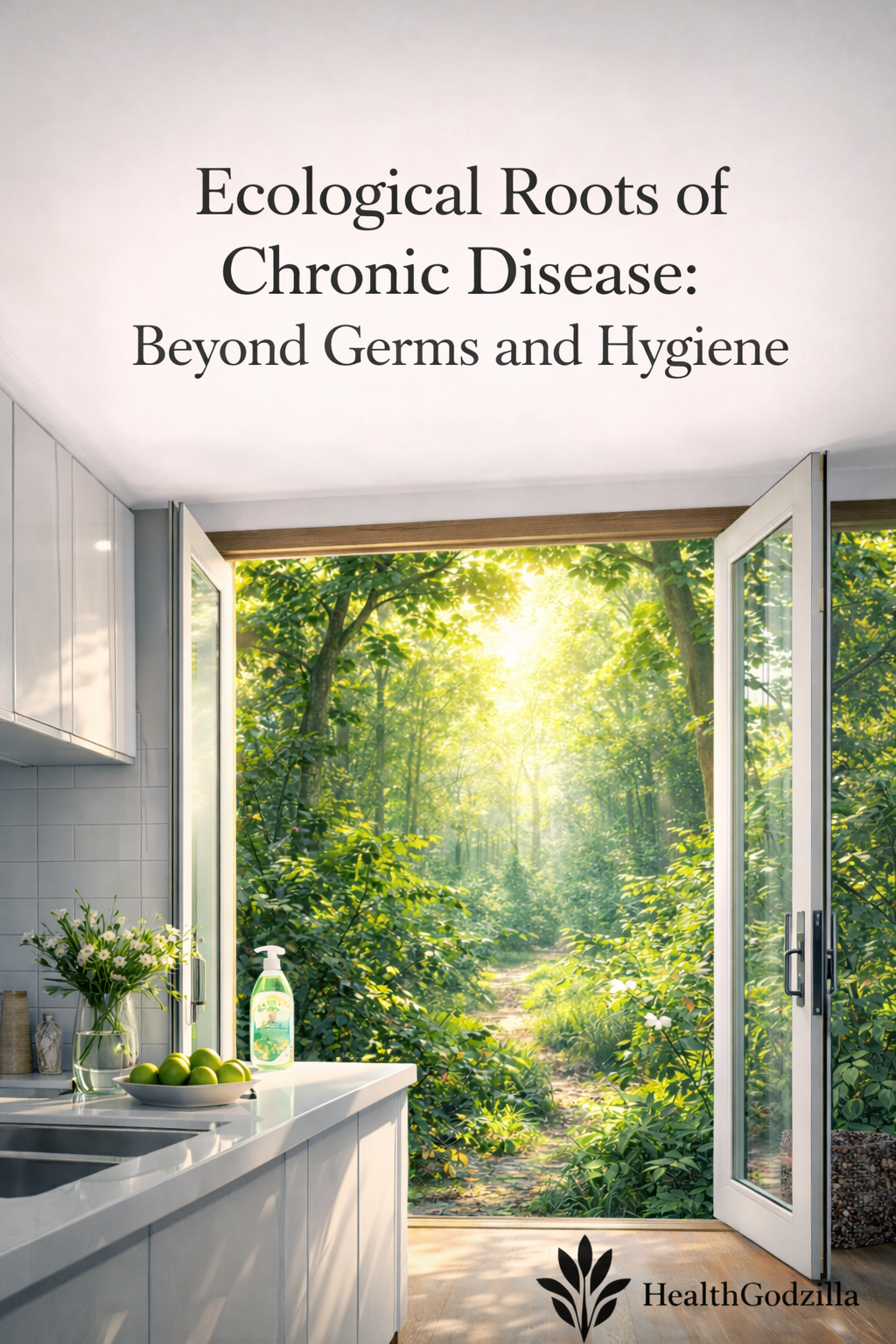
Prologue: The Polished Room
Ecological roots of chronic disease rarely appear in the mind when one enters a spotless room. The eye notices the shine first. The floor holds no dust worth naming. The glass carries no fingerprints. A faint medicinal brightness lingers in the air, as if the walls themselves had learned good manners. Somewhere near the sink stands a bottle with a smiling promise on its label: protection, purity, peace of mind. In another age, people may have placed herbs by the door or whispered blessings against fever. We, more modern and more anxious, often place our faith in sealed surfaces and citrus-scented victory.
There is tenderness in that impulse. Let us be fair. Human beings have suffered terribly from filth, contagion, and neglect. Hygiene did not arrive as vanity. Rather, it arrived as rescue. Soap, sanitation, and infection control have saved lives by the millions. A world without them would not be wild and poetic. Instead, it would often be cruel.
And yet, like many rescues, this one carried a quiet temptation inside it: the temptation to believe that safety means subtraction. Remove the dirt. Sweep away the microbes. Push out the disorder. Silence the unknown. However, life is not built that way.
A forest is not healthy because it is empty. Likewise, a river does not stay pure by forgetting fish, moss, and silt. Even the human body, that proud little republic of flesh and memory, does not thrive by standing alone. Skin, gut, lungs, and mouth were never designed as marble halls. Instead, they were shaped in contact, in exchange, and in constant conversation with the living world.
For too long, modern imagination has divided existence into two camps: germs on one side, health on the other. It is a convenient fable. It fits nicely on labels, in advertisements, and in frightened midnight thoughts. However, the world beneath the microscope has never respected such neat moral borders. Some microbes harm. Others protect. Still others teach. Many simply dwell among us like old neighbors whose names we never learned, though our lives grew around their presence.
So the question of chronic disease may not begin only in the clinic, the genome, the kitchen, or the treadmill. Instead, it may begin earlier and farther out. It may begin in the thinning of biodiversity. It may also begin in the narrowing of daily contact with soil, leaf, weather, and wild microbial company. Or it may begin in cities that shine brighter while living thinner. In that sense, the ecological roots of chronic disease do not belong to one dramatic cause alone. They belong to a slow estrangement between the human body and the breathing world around it.
This is not an argument against hygiene. That would be foolish, and history would laugh us out of the room. Rather, it is a question about proportion. What happens when protection hardens into overcorrection? How does cleanliness begin to dream of sterility? And when the fear of harmful life grows so large, do we forget that life itself has always arrived in multitudes?
Perhaps chronic illness, in some quiet measure, belongs to that forgetting. Inflammation, allergy, dysregulation, and immune confusion may not be only chemical accidents inside isolated bodies, but also echoes of a larger estrangement. The body, like an exiled musician, may still remember the orchestra it once played with. If so, then the ecological roots of chronic disease may lie partly in what modern life has polished away: not danger alone, but contact, diversity, and the old microbial chorus that once helped teach balance.
And perhaps the polished room, for all its sparkle, has been hiding a silence.
This story begins there. Not with dirt as romance, nor with hygiene as villain, but with a deeper and more difficult thought: human health may depend not only on what we remove from our lives, but also on what living presences we have slowly erased.
We learned to fear germs—but not absence
Hygiene deserves respect. It is not a fashionable ritual dressed in white. It is one of the hard-won arts of survival. Clean water, safe waste disposal, handwashing, sanitation, infection control—these did not merely improve comfort. They pulled whole populations back from the mouth of death. In earlier centuries, a cut could become a funeral. A contaminated pump could become a neighborhood’s grief. A crowded room with poor sanitation could turn children into statistics before they became memory. So let us begin with honesty: when hygiene protects us from pathogens, it performs a noble task.
However, wisdom begins to stumble when gratitude becomes absolutism.
The trouble starts when the success of hygiene tempts us to widen its kingdom too far. Then the mind begins to whisper a dangerous simplification: if some microbes bring disease, perhaps fewer microbes must always mean better health. If dirt sometimes hides danger, perhaps sterility must be the higher form of safety. If control reduces risk in one setting, perhaps total control would redeem all settings. That logic sounds neat. It also sounds modern. Yet nature has never cared much for neatness.
The human body does not grow through avoidance alone. It learns through encounter. The immune system, contrary to the fantasies of polished living, is not a porcelain ornament meant to remain untouched. It is a living intelligence shaped by contact, adjustment, memory, and response. Therefore, to remove genuine threats is one thing; to strip away too much of the ordinary living world is another.
That distinction matters.
Hygiene protects against specific harms. It breaks chains of infection. It also lowers exposure to dangerous pathogens. In hospitals, it helps places of healing avoid becoming corridors of transmission. Moreover, it matters deeply in childbirth, food safety, wound care, epidemics, and public sanitation. In these matters, romanticizing dirt would be stupidity wearing wildflowers.
And yet hygiene cannot do everything. It cannot replace biodiversity. Nor can it manufacture the quiet ecological education once offered by soil, leaves, animals, weather, and the ordinary microbial richness of the world. It also cannot teach the immune system in the same way a living environment does. Nor can it restore the subtle exchanges that shaped human bodies long before the first disinfectant bottle learned to smile from a supermarket shelf.
This is where the confusion enters.
Modern culture often treats cleanliness as if it were the whole architecture of health. A house smells fresh; therefore, it must be healthy. A child avoids mud; therefore, the child must be safer. A surface shines; therefore, risk has been conquered. But shine is not the same as balance. Fresh scent is not the same as resilience. And a world stripped of visible mess may still be poor in the invisible companionship that helped human physiology learn proportion.
The ecological roots of chronic disease begin to appear in that gap between what hygiene can do and what it cannot. Hygiene can save us from infection. By itself, it cannot sustain our relationship with the wider living world. It does reduce one category of danger. Yet it cannot substitute for microbial diversity, ecological contact, or the slow biological conversation between body and environment.
Moreover, the problem is not hygiene itself, but the philosophy that sometimes grows around it. Once cleanliness becomes a moral ideal, not merely a practical tool, we begin to fear life in bulk. Dust becomes suspect. Soil becomes trouble. Outdoor mess becomes failure. The child who touches the ground appears less protected than the child who stays inside. The wild edge of existence begins to look like an error in need of correction.
Yet the body did not emerge from chrome, sealed vents, and perfumed surfaces. It emerged within weather, fur, roots, dampness, breath, crowding, variation, and microbial abundance. Human beings did not evolve in a vacuum-packed argument against dirt. We evolved inside a world alive beyond counting. Therefore, when modern life narrows those encounters too severely, the cost may not always arrive as infection. Sometimes it arrives more slowly—through misdirected immunity, chronic inflammation, allergy, and other forms of long unrest.
So this section must say something simple, and perhaps unfashionable: hygiene is necessary, but it is not sufficient. It is a shield, not a universe. It is a guardian against certain harms, not a complete philosophy of human flourishing. Once we ask it to become more than that, we begin confusing cleanliness with wholeness, and the ecological roots of chronic disease slip further from view.
And wholeness, like a forest, requires more life than that.
The Invisible Republic Around Us
When people hear the word biodiversity, they often picture what can be pointed at from a distance. A forest. A wetland. A tiger moving through shade. Mangroves lifting their roots from tidal mud. Birds crossing a pale morning sky. These images are not wrong. They carry majesty, urgency, and grief. However, they are incomplete.
Life does not begin at the edge of visibility.
This is part of biodiversity as well.
The modern mind often reserves wonder for large creatures and scenic places. It gives prestige to what can be photographed, named in a documentary, or mourned in a conservation speech. Meanwhile, the microbial world goes about its ancient labor almost anonymously. It forms, transforms, decomposes, exchanges, stabilizes, competes, and cooperates. In doing so, it shapes the conditions under which other life can persist. Far from being mere background, it is one of the oldest architectures of Earth.
So when we speak of environmental balance, we must be careful not to speak only in the language of feathers, roots, reefs, or mammals with soulful eyes. Balance also lives in what the hand brushes past without noticing. It lives in the thin layer of life on leaves, in the breathing complexity of soil, in the mingling of outdoor air, and in the microbial traffic that moves quietly between bodies, homes, weather, and place. In that sense, the ecological roots of chronic disease may begin partly in how little room modern thought leaves for the unseen.
We did not evolve apart from this invisible republic. We evolved among it.
Human beings did not arrive in a disinfected chamber and then step into nature as visitors. Rather, the human story unfolded inside a world already alive with microbial abundance. Long before we named bacteria, argued about hygiene, or built cities that tried to polish uncertainty into submission, life had already surrounded the body with microscopic teachers, competitors, passengers, and companions. Some threatened us, yes. Others did not. Many simply belonged to the ordinary texture of being alive on Earth.
That truth unsettles a habit of thought many modern societies carry without noticing. We often imagine health as the triumph of the body over intrusion. However, the body has never lived by exclusion alone. It has lived by regulation, adaptation, and exchange. The border between self and world was never a steel wall. It was, and remains, a living negotiation.
Therefore, to speak of microbial diversity is not to romanticize every microbe. That would be foolish. The microbial world contains danger as well as assistance. Yet danger is not the whole story. A forest without rot would not be the same as a forest without life. Likewise, a healthy relationship with the microbial world cannot be described simply as absence. Life has always involved company.
Even our homes, those cherished little fortresses of order, are less solitary than they seem. They gather traces of weather, bodies, plants, fabrics, soil, pets, ventilation, and movement. Indoor life does not stand outside ecology. It is one of ecology’s quieter chambers. What changes, however, is the richness of what enters, what remains, and what gets sealed away. Thus, the ecological roots of chronic disease may also hide in the narrowing of those invisible encounters, especially when modern environments grow cleaner in appearance but thinner in living variety.
This is why the unseen matters so much. Once biodiversity becomes only a matter of charismatic animals and distant landscapes, we miss the forms of life that touch us most intimately. We begin to defend forests while forgetting dust. We may grieve species loss while ignoring the microbial thinning that may shape immune life closer to home. Meanwhile, we learn to speak eloquently about ecosystems out there, yet remain strangely silent about the ecosystems that brush our skin, enter our lungs, settle on our tables, and drift through the spaces where we spend our days.
And still, they remain.
A republic, after all, does not require spectacle to be real. It requires participation, relation, and countless small presences that make collective life possible. The microbial world has been such a republic all along: mostly unseen, often misunderstood, sometimes feared, and never absent. We live not above it, but within its weather.
That thought does not shrink humanity. It places us back inside the world. And from there, the ecological roots of chronic disease begin to look less like an abstract theory and more like a consequence of forgetting how much life has always surrounded us, entered us, and quietly helped make us possible.

How Ecology Enters the Body
The body does not meet ecology only through scenery.
It meets ecology through touch, breath, diet, dust, weather, surfaces, animals, plants, and the quiet traffic of microbial life that moves between environments and human skin, mouths, airways, and intestines. A child running through grass does not merely experience “nature” in the poetic sense. Contact occurs at a smaller scale too. Leaves, soil, air, and living surroundings carry microbial communities, and some of that diversity reaches the body. Thus, the ecological roots of chronic disease do not remain outside us as an environmental abstraction. They begin to matter when the outer world enters inner biology.
This does not mean every exposure is beneficial, nor does it mean every microbe deserves welcome. The point is more precise. Human physiology evolved under conditions of repeated contact with varied microbial environments. Therefore, the immune system did not develop as a lonely guard standing at a sealed gate. Instead, it developed through encounter, calibration, and response.
That calibration matters.
A well-functioning immune system does more than attack danger. It also learns tolerance. It learns when not to overreact. More importantly, it must learn the difference between threat and nuisance, invasion and background, injury and ordinary contact. In that sense, immunity is not only a weapon. It is also a student of proportion.
The microbiota help teach that lesson.
Communities of microorganisms living in and on the human body do not simply occupy space. They participate in digestion, barrier function, metabolic signaling, and immune regulation. Their diversity and balance influence how the body responds to the world. When that relationship remains relatively stable, resilience becomes more possible. When it becomes disturbed, the result may not be dramatic infection alone. It may also appear as dysbiosis, inflammatory imbalance, allergy, or chronic forms of physiological unrest.
Here the bridge between ecology and physiology becomes easier to see.
Environmental diversity helps shape microbial exposure. Microbial exposure helps shape the human microbiota. The human microbiota, in turn, influence immune education and inflammatory response. Therefore, the ecological roots of chronic disease may reach into the body through a chain of relationships rather than a single direct blow. The path is not magical. Nor is it simplistic. It is relational.
This helps explain why the loss of microbial richness in daily surroundings may matter even when no obvious pathogen appears. The problem is not only what harms us. It is also what fails to train us. A thinner microbial environment may offer fewer chances for the immune system to learn balance. Over time, that narrowing may contribute to exaggerated responses, weakened tolerance, and chronic inflammation that no longer serves its original protective purpose.
Allergy enters the story here quite naturally.
An allergic response is not simply proof that the body is vigilant. Sometimes it is proof that vigilance has lost proportion. Pollen, dust, or other ordinary exposures may trigger reactions that feel less like wise defense and more like confused alarm. Likewise, chronic inflammation may begin as protection and then linger beyond usefulness, turning from shield to burden. In both cases, the question is no longer only what entered the body. The deeper question becomes: what kind of ecological and microbial education shaped the body before that moment arrived?
Dysbiosis belongs to this same conversation.
The word sounds technical, yet the idea is familiar enough: imbalance within a living community. When microbial relationships within the body shift unfavorably, regulation can suffer. Barriers may weaken. Immune signaling may change. Low-grade inflammation may persist. The body does not fall into chaos all at once; rather, it may drift into strain. In that drift, the ecological roots of chronic disease begin to look less like a metaphor and more like a biological possibility.
Still, caution matters.
No honest account should pretend that biodiversity alone explains chronic disease. Diet, poverty, pollution, stress, sleep, genetics, labor conditions, and medical access all matter too. Human illness rarely grows from one root only. Yet this does not make ecology irrelevant. It makes ecology one thread in a larger fabric—often overlooked because it works quietly, and because modern medicine has grown more comfortable measuring crisis than measuring estrangement.
So ecology enters the body not as a slogan, but as contact. It enters through repeated microbial encounters, through the shaping of the microbiota, through immune education, through the body’s learned capacity for tolerance, and through the fragile line between useful inflammation and chronic unrest. We do not merely live near ecosystems. We carry their consequences inward.
That is why this story cannot remain outside among trees and soil alone. The body itself is one of the places where ecology continues its work.
When Cities Become Too Smooth
Cities are not the enemy. They are one of humanity’s great improvisations.
They gather strangers, store memory in brick and wire, turn distance into encounter, and make possible certain forms of learning, care, and survival that scattered life cannot always offer. A city can hold libraries, hospitals, music, protest, refuge, invention, and bread. It can also hold loneliness, smoke, haste, and the peculiar fatigue that comes from living too long among surfaces that do not answer back. So this is not a complaint against cities themselves. It is a quieter concern about what some forms of urban life remove.
Modern cities often smooth the world.
Concrete covers soil. Glass keeps out weather. Filtered air reduces what drifts inward. Shoes rarely touch earth. Children know floors better than fields. Windows remain closed against heat, dust, noise, insects, uncertainty. Pets may disappear from daily life. Gardens shrink into decoration. Meanwhile, indoor habits grow more sealed, more managed, more fragranced, and more cut off from the microbial richness that once moved more freely between outdoor life and the places where human beings slept, ate, argued, and healed.
That narrowing matters.
A home is never completely separate from its environment. Air moves. Bodies move. Dust travels. Fabrics collect traces. Shoes, animals, plants, ventilation, and open doors all carry bits of the outer world inside. However, the richness of that transfer does not stay constant across ways of living. When outdoor biodiversity declines, when urban surfaces harden, when vegetation thins, and when daily routines minimize contact with soil, leaves, animals, and unsealed air, indoor life may become biologically quieter. It may look polished while growing ecologically thin.
This is one of the subtler signatures of modern exposure.
The body still meets microbes in cities, of course. Urban life is not empty. Yet the range of encounters may shift. Diversity may narrow. Repetition may replace variation. Contact with environmental microbiota may weaken, while exposure patterns become more enclosed, more artificial, and sometimes more monotonous. In that sense, the ecological roots of chronic disease may deepen not because cities are unnatural in some childish sense, but because certain urban conditions reduce the old conversation between human bodies and diverse living surroundings.
Smoothness, after all, is not the same as health.
A polished corridor may be efficient, but it does not teach what a field teaches. A sealed apartment may feel secure, yet it may admit less of the microbial variety that once drifted through daily life with wind, soil, animals, gardens, and shared outdoor movement. The issue is not romance for mud. The issue is exposure shaped by design. When life moves through concrete channels for too long, the body may inherit a narrower schooling than the one under which it evolved.
Urban life also changes time.
In many cities, people rush from building to vehicle, from vehicle to office, from office to store, then back again into conditioned air. Days pass under roofs. Skin meets fabric, plastic, metal, and treated surfaces more often than bark, grass, or earth. The lungs learn indoor breath. The hand learns the smooth obedience of glass more often than the rough grammar of leaves. None of this seems dramatic at first. That is precisely why it matters. Chronic change often enters quietly.
And quiet losses are easy to mistake for progress.
A courtyard disappears under parking space. A patch of weedy ground becomes a cleaner entrance. Ventilation improves, but outdoor contact thins. Neighborhood animals vanish. Dust becomes less variable, more managed, more stripped of ecological memory. Little by little, the city becomes better at removing inconvenience and worse at carrying life inward. Thus, the ecological roots of chronic disease may sometimes hide in ordinary upgrades—in the respectable disappearance of mess, in the architecture of separation, and in the triumph of smoothness over contact.
Still, this is not an invitation to nostalgia.
Older cities were not innocent. Nor were rural lives automatically healthy. Mud has carried parasites. Crowding has carried disease. Broken sanitation has carried death. We do not need fairy tales about the past. We need proportion. The question is not whether cities should become forests, nor whether modern comfort should be thrown into the river. The question is whether a life designed to exclude too much of the living world asks the body to adapt to an impoverished conversation.
That question becomes harder, not easier, in the age of indoor life.
The more time human beings spend in enclosed spaces, the more those spaces matter biologically. Walls no longer simply shelter; they filter experience. Floors no longer simply support; they separate. Air no longer simply circulates; it becomes managed. Once daily exposure moves through such controlled channels, the body may receive a thinner ecological education than the one its immune and microbial systems once expected. Therefore, the ecological roots of chronic disease are not only out there in damaged forests or disappearing wetlands. They may also gather here, in the ordinary interior world of the modern city.
A city does not need to be abandoned. It needs to breathe.
And perhaps that is the haunting part. We built cities to protect ourselves from uncertainty. Then, slowly and with admirable intelligence, we made them cleaner, tighter, safer, more efficient, more sealed. Yet in doing so, we may also have reduced certain forms of contact that once helped the body remember how to live among many kinds of life without mistaking all contact for threat.
When cities become too smooth, the loss is not always visible.
Sometimes it arrives as silence.
And sometimes the body hears that silence first.

Chronic Disease as Ecological Memory
Chronic disease is often described as if it begins at the moment symptoms become undeniable.
A diagnosis appears. A lab value rises. A cough lingers. Blood sugar shifts. Inflammation refuses to leave. The body, once taken for granted, begins to speak in the language of burden. Modern medicine, quite naturally, learns to measure that burden through biomarkers, scans, histories, risks, and treatment protocols. None of that is false. It is necessary. However, it may still leave one question hovering quietly at the edge: what long conversation preceded the crisis?
Illness does not always erupt from nowhere.
Sometimes it grows through accumulation—small exposures, repeated absences, altered habits, narrowed environments, persistent stress, disturbed sleep, poor air, thin diets, chemical burdens, and social strain. Therefore, when we ask about the ecological roots of chronic disease, we are not asking whether ecology replaces biology. We are asking whether ecology helps write part of biology’s script.
That possibility matters.
The body is not a machine assembled outside the world and then dropped into it. It is shaped through contact. It learns by encounter. Over time, it adjusts through repetition. So when certain forms of contact diminish over time—especially contact with diverse microbial environments—the loss may not appear as dramatic injury. Instead, it may appear as altered regulation, weakened tolerance, inflammatory overreaction, or a quiet drift in the body’s inner balance.
In that sense, chronic disease may carry memory.
Not memory in the poetic sense alone, though poetry does sometimes get there first. Rather, memory in tissue, signaling, regulation, response, and habit. The immune system remembers. The microbiota remember disturbance. Metabolic pathways reflect repeated conditions. Inflammation, once useful, may stay too long. Tolerance, once teachable, may weaken. The body does not archive experience in words, yet it does not forget experience either.
This is where disconnection enters the story.
If a body lives for years within narrowed ecological contact—less microbial diversity, less outdoor exchange, more sealed routines, more managed interiors—that pattern may help shape immune education in subtle ways. It may not produce one disease with theatrical certainty. Yet it may contribute to a terrain in which allergy becomes easier, chronic inflammation more persistent, dysregulation more likely, and resilience less steady. The ecological roots of chronic disease may therefore lie partly in long estrangement rather than single catastrophe.
That claim requires humility.
No serious account should pretend that chronic illness can be reduced to biodiversity loss or microbial thinning. Chronic disease grows from many roots at once: poverty, labor conditions, food systems, pollution, trauma, stress, inequality, genetics, sleep, movement, and medical access all matter deeply. Human suffering rarely obeys a single explanation. Yet multiplicity is not an argument for silence. It is an argument for proportion. Ecology may not explain the whole burden, but it may help explain part of it.
And part of the burden is already enormous.
Modern societies often discuss chronic disease in fragments. One field studies asthma. Another studies metabolic syndrome. Another tracks inflammatory disorders, autoimmune patterns, cardiovascular strain, or mental distress. Each field names its own mechanisms, as it should. Still, beneath those categories runs a quieter thread: the body’s capacity to regulate itself in a world whose conditions have changed faster than its deeper biological schooling.
That is why the phrase ecological memory can be useful.
It does not mean the body longs romantically for a lost forest. It means the body still bears the imprint of the conditions under which human regulation evolved. When those conditions shift—when air, surfaces, food, microbes, movement, and environment all change together—the consequences may settle into physiology gradually. The result may not look like a wound from outside. It may look like chronic unrest from within.
A body can survive disconnection and still pay for it.
It may function, work, commute, produce, consume, smile in photographs, and continue through years of managed routine. Yet underneath, signaling may grow noisier. Tolerance may narrow. Inflammation may overstay its purpose. What appears on the surface as an individual medical problem may also reflect, in part, a wider ecological rearrangement. Thus, the ecological roots of chronic disease do not deny personal responsibility or biomedical reality. They widen the frame around both.
That wider frame changes how we read illness.
Instead of asking only, “What failed inside this body?” we may also ask, “What kinds of worlds helped shape this body’s responses?” Instead of treating chronic disease only as private malfunction, we may begin to see it partly as a pattern emerging from altered relationships—between humans and microbes, indoors and outdoors, cities and soil, protection and contact, control and diversity.
Not every chronic illness tells that story in the same way. Nor does every patient carry the same ecology. And not every exposure leaves the same trace.
Still, the pattern deserves attention.
The body may remember disconnection long after the mind has accepted it as normal. It may remember the thinning of microbial contact, the narrowing of environmental variety, the slow replacement of living complexity with sealed efficiency. And when that memory surfaces as allergy, inflammatory burden, metabolic strain, or chronic dysregulation, we should be careful not to call it fate too quickly. Sometimes it may be history—written not only in genes or choices, but also in the ecological conditions that shaped what the body learned to expect from the world.
That is the deeper argument of this article.
The ecological roots of chronic disease are not a slogan against hygiene, nor a romantic rebellion against modern life. They are a way of noticing that the body does not suffer in isolation from the environments that teach it. Chronic disease may be many things at once. But among them, in some cases and to some degree, it may also be the body’s long memory of diminished relationship with the living world.

The Old Mistake of Thinking Clean Means Complete
Modern life loves visible proof.
A polished floor comforts the eye. A bright kitchen suggests order. A sterilized instrument inspires trust. A fresh smell whispers that something has been made safe. None of these impressions are meaningless. Many of them are useful. Some are genuinely life-preserving. However, the mind commits an old mistake when it begins to treat visible cleanliness as a full account of health.
Because clean is not the same as complete.
A room may sparkle and still be ecologically poor. A life may look protected and still be undernourished by contact with the living world. An environment may reduce obvious dirt while also reducing the microbial variety that once helped shape human resilience. Thus, what disappears before the eye is not always the whole story. Sometimes the greater loss is what disappears beyond sight.
This is where modern thought often becomes too confident.
It assumes that if danger can be reduced by control, then more control must mean more wisdom. If sterility helps in surgery, perhaps sterility must stand as a general ideal. If a sealed environment lowers one category of risk, perhaps the sealed environment should become the dream of daily life. Yet a principle that works beautifully in one setting can become absurd when stretched into a philosophy for all settings. A scalpel belongs in an operating room. It does not belong in the orchard as a theory of spring.
And still, we keep making that error.
We confuse absence with safety. Too often, reduction gets mistaken for flourishing. Even the removal of inconvenience can start to look like the cultivation of health. In doing so, we forget that life rarely thrives through subtraction alone. A forest stripped of insects, fungi, dampness, rot, and microbial labor may become cleaner in some narrow visual sense, but no one would call it whole. The same warning, in gentler form, may apply to human life.
Wholeness requires more than protection.
It requires relationship, variation, contact, and a certain tolerance for the ordinary untidiness of being alive among other forms of life. This does not mean recklessness. It does not mean contempt for hygiene. Rather, it means refusing to worship cleanliness as if it were the final name of health. Hygiene is a tool. Sterility is a condition. Health is a relationship.
That relationship has been flattened in many modern habits.
We clean not only what is dangerous, but often what is merely alive. We also seal not only against pathogens, but against uncertainty itself. Meanwhile, homes, offices, and routines get designed to reduce friction, odor, dust, weather, microbial drift, and the little unscripted intrusions of the more-than-human world. Then we call the result refined. In some ways, it is. In other ways, it may also be nutritionally thin at the ecological level, though the hunger it creates is harder to name.
The body may still feel that hunger.
Not as nostalgia, and not as some romantic ache for mud, but as a quieter imbalance. Too little variation. Too little contact. There is too little microbial schooling, and then smoothness gets mistaken for wisdom while management poses as maturity. The result may not arrive as immediate illness. Instead, it may settle in slowly as narrowed tolerance, inflammatory unrest, or a body that has become uncertain about the difference between ordinary life and threat. In that sense, the ecological roots of chronic disease hide partly inside a cultural misunderstanding: the belief that if something looks cleaner, it must also be better nourished by life.
But nutrition is not only food.
A body feeds on contact, pattern, rhythm, climate, and environment. It learns from repeated exchanges with the world that surrounds it. Therefore, when modern life gives us polished surfaces but thinner ecological relationships, safety may improve in one register while resilience weakens in another. The tragedy is not that we protected ourselves. The tragedy is that we sometimes mistook protection for completion.
To be complete is not to be exposed to every danger. Of course not. That would be foolish. However, neither is it to be separated from the ordinary diversity of life so thoroughly that health becomes a sterile performance of control. Between recklessness and overcorrection lies a more difficult virtue: balance.
This article has been circling that truth from the beginning.
The ecological roots of chronic disease do not ask us to abandon hygiene. They ask us to stop confusing health with emptiness. They ask us to see that the living world is not composed only of large landscapes and visible creatures, but also of small presences that have always shared our spaces, entered our bodies, and helped train our responses. Once we forget that, we begin living inside a narrowed idea of safety—one that may defend the body in some ways while quietly depriving it in others.
The old mistake, then, is not cleanliness itself.
It is the belief that once life has been sufficiently reduced, health must have been achieved. Yet life does not flourish as a museum flourishes: dusted, controlled, untouchable, and silent. Life flourishes through proportion. Through exchange. Through living contact wisely held, not endlessly erased.
And perhaps that is the hardest lesson for the modern mind.
We do not become whole by removing every trace of the world. We become whole by learning which dangers must be kept at bay, and which forms of contact must remain so that the body does not forget the larger community of life to which it still belongs.
Perhaps that is where the argument must rest—not in a sermon against hygiene, nor in nostalgia for a dirtier age, but in a quieter recognition that health was never meant to grow in isolation from the living world. And when such thoughts reach their limit, Artista and Organum arrive, as they often do, to sit with the echo rather than silence it.

Hello, Artista
Artista arrived as twilight settled like thought over Vancouver. The window held the last blue of evening. Whitee and Brownie had already claimed their soft republic near the rug, ears flicking now and then as if they, too, distrusted silence when it became too complete. Organum, far away in Boston, sat with a mug cooling beside him while RD, MD, Barku, and Gulli drifted through the room in their different moods of devotion and mischief. Between them stretched distance, and yet the conversation stepped across it as lightly as dust in a shaft of light.
“Organum,” Artista said, “modern people clean everything as if the universe filed a complaint.”
Organum laughed. “That sounds about right. We wipe, spray, seal, purify, deodorize, and then stare proudly at a room that has lost all gossip.”
“All gossip?”
“Yes,” Organum said. “The old microbial gossip. The invisible chatter. The tiny parliament on leaf, skin, fur, wind, and soil. We have become suspicious of a house that still remembers weather.”
Artista looked toward the rabbits. “There is tenderness in it, though. People are afraid because people love. A mother wipes a table. A father worries about dust. A hospital sterilizes instruments. None of that begins in cruelty.”
“No,” Organum said, more softly now. “It begins in care. That is what makes the mistake so human. We learn one true lesson and then stretch it until it starts lying. Hygiene saves lives. Then the mind grows greedy and whispers, perhaps less life means more safety everywhere.”
Artista smiled. “A very modern greed. To mistake control for wisdom.”
“And smoothness for completion,” Organum added.
For a moment neither spoke. Outside, some faint city sound moved and faded. Inside, Whitee shifted like a dropped handkerchief of snow.
Then Artista said, “What unsettles me is not the science itself. It is the feeling that we have built lives full of protected surfaces and underfed relationships. Not only with people. With the living world.”
Organum nodded. “Yes. We praise the visible victories. Clean floor. Filtered air. Sealed window. Managed scent. But the body may be asking another question entirely: where did the old company go?”
“The old company,” Artista repeated, almost smiling. “That sounds like a lost folk band.”
“In a way, it is,” said Organum. “A wild orchestra. Soil on the shoe. Pollen in the air. The mild scandal of animal fur. Leaf-dust on the sleeve. Microbes arriving uninvited and not always unwelcome.”
Artista laughed. “You are impossible.”
“And yet correct.”
“Dangerously correct.”
“Only gently dangerous.”
The rabbits had begun their small domestic rearrangements. One nudged the other with a seriousness that made Artista think of diplomats. She watched them and said, “It is strange. We speak so often of biodiversity as if it lives somewhere far away wearing feathers and antlers. Meanwhile, a whole republic beyond sight keeps shaping our thresholds, our tolerances, our inflammations, our little internal dramas.”
“A republic beyond sight,” Organum said. “That is the phrase.”
“It is true, though, isn’t it? The body is not only fed by food. It is tutored by contact.”
“Yes,” Organum said. “And perhaps that is why chronic illness can feel so haunting. Not because every disease has the same story, of course. That would be foolish. But some burdens may carry a memory of disconnection. Not poetic memory alone. Biological memory. The body learning too little from the world, or learning the wrong lesson too often.”
Artista leaned back. “So the body becomes overprotective?”
“Sometimes. Or underwise. Or simply confused in slow motion.”
“That sounds almost tragic.”
Organum let the thought breathe a little before answering. “It is tragic. But not in a theatrical way. More like this: we built lives to keep out chaos, and in doing so we may also have kept out part of the conversation that once taught us balance.”
Artista turned that over. “Then this article is not saying dirt is holy.”
“Certainly not.”
“Nor that hygiene is the villain.”
“Never.”
“It is saying,” Artista went on, “that the old mistake begins when we treat safety as emptiness.”
Organum smiled. “Yes. There it is.”
Artista looked at the darkening window. “And perhaps health is not the absence of the world, but the wisdom of living with it.”
Organum sat still for a second, as if a star somewhere had blinked.
“Ah,” he said. “Now you’ve said the dangerous thing.”
“The true thing?”
“Often the same.”
Whitee stood up, then abruptly sat back down as though struck by philosophy. Brownie ignored philosophy entirely. In Boston, Barku had moved close to Organum’s chair with the solemnity of an old witness. The rooms in two cities held their animals, their breaths, their ordinary furniture, and all the unseen life neither room could ever fully count.
Artista broke the hush first. “Do you think people will hear this as blame?”
“Some might,” Organum said. “People are tired, and tired minds often hear blame where there is only invitation. But the article does not accuse. It remembers. It reminds. And it asks whether modern life has become too efficient at removing what once helped shape us.”
“And if they ask what to do?”
Organum laughed again. “Humans always want the final shopping list.”
“They do.”
“I would tell them only this: do not worship emptiness. Respect hygiene where it matters. Respect life where it matters. And do not assume the two are enemies.”
Artista’s eyes softened. “That sounds almost simple.”
“The deepest things often do, after they stop fighting us.”
Outside, night had fully arrived. Inside, the houses still breathed. Not perfectly, not purely, not free of dust or memory or the invisible republic that had followed life for longer than language had existed to fear it.
Artista rose at last. “Then let the article end here.”
“Here?”
“Yes. Not with a command. With a changed way of looking at the room.”
Organum glanced around at the dogs, the mug, the dim light, the stirred air no one could see. “A fair ending,” he said.
And somewhere beyond polished glass, beyond managed interiors, beyond fear dressed as perfection, the living world went on whispering its countless small lessons to anyone still willing to belong to it.
Author’s Reflection
This was one of the most delicate articles I have written. It was a breathtaking experience—slippery, difficult, and good. I am glad I could complete it.
There may still be room for improvement. Even so, the piece has taken shape, and I have come away from it with something I did not have before I began. That, perhaps, is one of the quiet gifts of writing. It fills the gaps in understanding. It lets us notice what we had not fully seen, even when the subject was already familiar to us.
As a student of Environmental Sciences, I was aware of the microbial ecosystem. However, I had never felt its ecology so vividly alive. Writing this article made that world breathe differently for me. It moved from knowledge into presence.
And then came Hello, Artista.
After writing that section, I took a full breath into my chest. Something had opened. I still do not know how it became such a thoughtful yet laughing scenery. It did not merely complete the article. It gave me a kind of ecstasy—yes, I may use that word here. Hah hah hah. I enjoyed it myself. And apparently, I hope you will enjoy it too.
After completing this piece, I feel an urge to say something simple to my readers: if you have not started writing yet, begin. Write what you like. Writing may show you meanings you did not know you were carrying. It may reveal the hidden joints of a subject. It may let the world answer you in ways that silent reading alone sometimes does not.
I was not alone when I wrote this. Others spoke, and I listened.
—Jamee
Articles You May Like
From metal minds to stardust thoughts—more journeys await:
- Biodiversity and Biomedical Discovery: Living Library of Medicine
Biodiversity and Biomedical Discovery reveals how species, microbes, and ecosystems shape medicine, memory, antibiotics, and human health. - Leadership Mindset Decision-Making: Psychological Roots and Organizational Impact
A father-son journey into how leadership mindset shapes authority, decisions, and a company’s rise—or quiet collapse. - Eco-Nutrition: Systems Diversity and Sustainable Diets
A reflective exploration of how biodiversity, food systems, and human health intertwine. From soil microbes to school lunches, this piece traces how diversity nourishes resilience—not only in ecosystems, but in culture and policy.
Curated with stardust by Organum & Artista, under a sky full of questions.
Principal Sources
The following works helped shape the perspective behind this story.
- Secretariat of the Convention on Biological Diversity, & World Health Organization. (2015). Connecting global priorities: Biodiversity and human health: A state of knowledge review. World Health Organization. https://www.who.int/publications-detail-redirect/connecting-global-priorities-biodiversity-and-human-health
- Hanski, I., von Hertzen, L., Fyhrquist, N., Koskinen, K., Torppa, K., Laatikainen, T., Karisola, P., Auvinen, P., Paulin, L., Mäkelä, M. J., Vartiainen, E., Kosunen, T. U., Alenius, H., & Haahtela, T. (2012). Environmental biodiversity, human microbiota, and allergy are interrelated. Proceedings of the National Academy of Sciences of the United States of America, 109(21), 8334–8339. https://doi.org/10.1073/pnas.1205624109
- Parajuli, A., Grönroos, M., Siter, N., Puhakka, R., Vari, H. K., Roslund, M. I., Jumpponen, A., Nurminen, N., Laitinen, O. H., Hyöty, H., Rajaniemi, J., & Sinkkonen, A. (2018). Urbanization reduces transfer of diverse environmental microbiota indoors. Frontiers in Microbiology, 9, Article 84. https://doi.org/10.3389/fmicb.2018.00084
- Panthee, B., Gyawali, S., Panthee, P., & Techato, K. (2022). Environmental and human microbiome for health. Life, 12(3), Article 456. https://doi.org/10.3390/life12030456
Relevant sections were interpreted through a narrative and systems lens rather than cited exhaustively.
This article is also archived for open access on Zenodo: https://doi.org/10.5281/zenodo.19313014
Leave a Reply