
Prologue — The Error of Choosing One
Long before names, before ethics, before the need to be right, something moved. Love and Chaos Continue the Story of Existence long before we learned to name them or argue over their meaning.
Things held together.
Things broke apart.
Neither asked permission.
What we later called love did not arrive to save the world.
It arrived to hold patterns long enough for memory to form.
What we later called chaos did not arrive to destroy meaning.
It arrived to break patterns that refused to move.
Existence did not choose between them.
It learned to survive their interference.
Civilizations rose not because harmony prevailed,
but because fracture arrived before rigidity finished its work.
Species endured not because peace reigned,
but because variation kept slipping past preservation’s grip.
Everywhere we look—stars clustering, cells dividing, empires expanding, minds adapting—the same motion repeats:
something binds, something disrupts, something continues.
Humans, uncomfortable with motion, tried to crown one force and exile the other.
We praised love when it protected us.
Chaos was condemned whenever it unsettled us.
Stories followed, insisting one side should win.
But the world never agreed.
It kept moving—
not toward goodness,
not toward justice,
but toward continuation.
This is not an argument.
It is not a warning.
It is an observation written after watching patterns long enough to stop wishing they were kinder.
What follows does not ask what should be.
It traces what persists. This is how Love and Chaos Continue the Story of Existence, whether noticed or not.
I. The Two Forces That Never Meet, Yet Never Separate
Love holds.
It binds particles into atoms, cells into bodies, people into communities, ideas into institutions.
In doing so, it remembers.
As a result, it preserves shape long enough for recognition to occur.
Without this holding, nothing lasts beyond an instant; therefore, there is no archive, no lineage, no continuity to return to.
However, holding alone does not create existence.
Instead, it only delays disappearance.
Chaos moves.
It fractures symmetry, introduces variation, and applies pressure.
In doing so, it interrupts what has grown too comfortable with its own form.
Without this rupture, patterns harden, repeat, and eventually suffocate the space they occupy.
Yet motion alone does not create existence.
Rather, it only accelerates loss.
These forces do not merge.
They do not reconcile.
Nor do they negotiate terms.
Instead, they interfere.
Where love tightens its grip, chaos slips through the seams.
Conversely, where chaos tears too fast, love reappears as constraint, memory, and repair.
Thus, neither dominates for long.
Each corrects the excess of the other—not by intention, but by consequence.
Consequently, existence happens in this narrow corridor—
if holding prevails too much, the world freezes;
if breaking prevails too much, the world dissolves.
What we call a story, therefore, is not harmony.
Rather, it is persistence under tension.
For example, stars burn because gravity holds while fusion ruptures.
Likewise, life evolves because inheritance preserves while variation disturbs.
Similarly, societies endure because norms stabilize while conflict reshapes.
In short: no meeting.
No separation.
Only ongoing interference.
And ultimately, that interference is not balance.
It is survival without promise—
where Love and Chaos Continue the Story.
II. Anthropology — The Campfire and the Dark
Early humans survived neither by kindness nor by cruelty alone.
Instead, they endured by learning when to hold and when to harden.
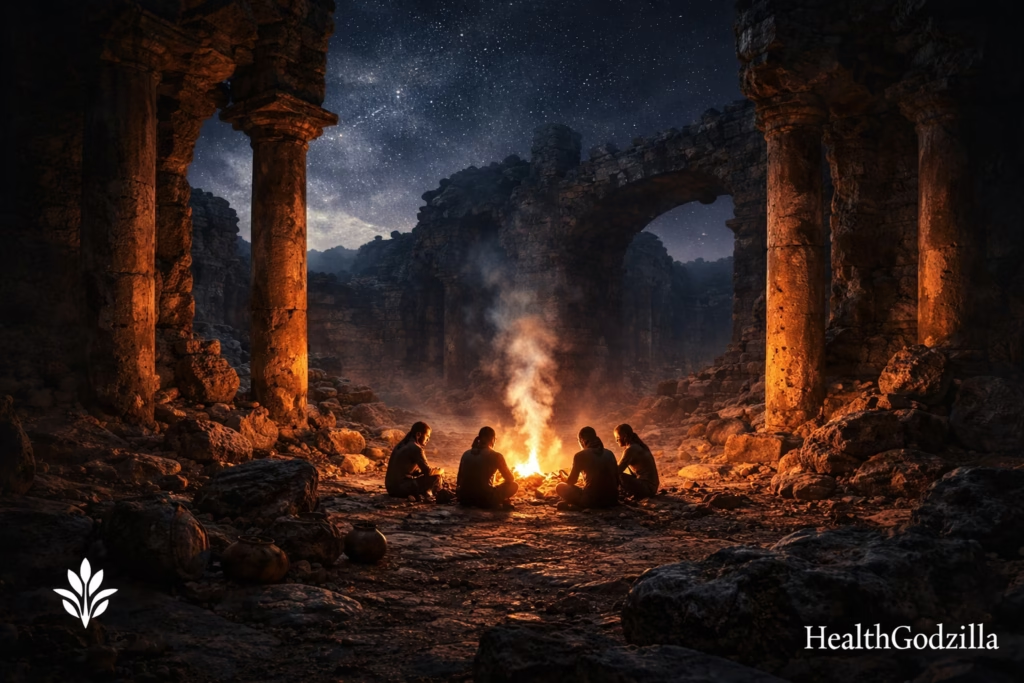
Inside the circle, warmth mattered.
Food was shared.
Stories repeated.
Children learned faces before words.
Thus, cohesion became protection.
Outside the circle, the world pressed back.
Scarcity, predators, rival groups, weather—none negotiated.
Consequently, alertness sharpened.
Suspicion grew useful.
Violence, when it appeared, appeared as response rather than principle.
The campfire did not erase the dark.
Rather, it defined it.
Language emerged not only to express care, but also to warn.
Ritual arose not only to bond, but also to mark limits.
Likewise, punishment appeared to correct breaches, while forgiveness emerged to prevent endless fracture.
Each tool answered pressure.
None existed for virtue.
Therefore, early societies did not choose between love and chaos.
They managed their interference.
Too much inward holding invited stagnation and fragility.
Too much outward exposure invited collapse.
As a result, survival depended on maintaining a boundary that could flex without breaking.
Civilization, then, did not begin at the center of the circle.
It began at the edge—
where warmth faded,
where darkness tested,
and where adaptation learned to speak.
III. The Classical World — Order Watching Flux
Ancient thought sensed the split early.
Not as doctrine, but as unease.
On one side stood permanence—what lasts, what holds, what resists decay.
On the other stood change—what moves, what disrupts, what refuses to stay named.
Thus, thought began between structure and becoming.
Philosophy did not resolve this tension.
Instead, it learned to sit with it.
Systems of order were built to steady life: laws, virtues, hierarchies, forms.
Accordingly, reason tried to freeze motion long enough to be understood.
Yet, even as order rose, flux refused silence.
Poetry kept what argument could not.
Myths carried fire where logic preferred stone.
Therefore, while temples honored symmetry and permanence, stories remembered fracture, struggle, and return.
This was not contradiction.
It was recognition.
Order watched flux without mastering it.
Flux pressed against order without erasing it.
Consequently, thought became a record of discomfort rather than a solution.
The classical world did not ask which force was right.
It asked how to live under both.
And so, ideas endured not because they were settled,
but because they could hold stillness long enough—
while admitting motion would come again.
IV. The Renaissance — When Holding Failed Just Enough
Old authority weakened—not all at once, but unevenly.
As a result, inherited order began to crack along lines it could no longer seal.
Plague arrived and ignored doctrine.
Meanwhile, travel widened horizons and brought foreign measures of truth.
At the same time, anomalies surfaced—stars misbehaved, bodies revealed unfamiliar maps, numbers refused obedience.
Consequently, doubt ceased to be a private whisper and became a shared condition.
Chaos did not announce itself.
Instead, it entered through pressure.
Under that pressure, art, science, anatomy, and inquiry did not bloom because humanity improved.
Rather, they bloomed because constraints loosened.
Once the grip eased, observation replaced obedience, and looking replaced recitation.
Thus, motion returned.
Not peace.
Nor wisdom.
No reconciliation.
Movement.
Holding did not vanish; it reconfigured.
New institutions rose, methods hardened, disciplines formed.
However, these were not restorations of the old order.
They were repairs shaped by damage.
Therefore, the Renaissance did not resolve the tension between love and chaos.
It proved something quieter: when preservation fails just enough, variation finds room to work.
History moved forward—not because certainty was found,
but because certainty lost its monopoly.
V. Psychology — The Nervous System as a Battlefield
Attachment stabilizes.
It lowers vigilance, conserves energy, and allows patterns to repeat.
As a result, memory consolidates, trust forms, and attention widens.
Threat mobilizes.
It sharpens perception, accelerates response, and reallocates resources.
Accordingly, the body prepares for impact before the mind explains it.
Neither state is optional.
However, neither can dominate without cost.
When safety saturates the system, growth slows.
Curiosity dulls.
Therefore, stagnation appears—not as failure, but as excess calm.
Conversely, when danger persists without relief, identity fractures.
Attention narrows.
Meaning thins.
Thus, survival continues, but coherence erodes.
Between these extremes, pressure does its work.
Creativity emerges when constraint meets uncertainty.
Aggression appears when boundaries must be enforced.
Likewise, patience develops when delay promises advantage, while hesitation follows when timing remains unclear.
Each response is adaptive—not moral.
The mind does not seek comfort.
Instead, it seeks regulation.
Consequently, psychological resilience is not the absence of threat,
nor the permanence of safety,
but the capacity to move between states without collapse.
In this sense, the mind adapts the way ecosystems do:
through feedback, stress, recovery, and recalibration—
never by escape, always by response.
Here, Love and Chaos Continue the Story.
VI. Economics — Trust Builds, Disruption Moves
Stable systems allow accumulation.
They rely on trust—contracts honored, measures repeated, expectations shared.
As a result, time stretches forward, and investment becomes possible.
However, stability alone does not generate change.
It preserves what already works and protects what already exists.
Accordingly, accumulation grows—but novelty waits.
Disruption forces reconfiguration.
It arrives through technology, crisis, scarcity, or shock.
At first, it looks like damage: livelihoods broken, skills displaced, routines invalidated.
Only later does it rename itself as innovation.
Thus, progress rarely announces its benefits at the door.
It enters sideways, carrying loss before value.
Markets, therefore, oscillate between trust and shock.
During calm, systems consolidate and expand.
During rupture, systems shed weight, reorganize, and test new forms.
Neither phase lasts.
Each corrects the excess of the other.
Consequently, growth is never gentle.
It rearranges incentives, redistributes advantage, and exposes fragility.
Likewise, collapse is never random.
It follows pressure points long ignored and assumptions left unexamined.
In the end, economics does not reward virtue or punish vice.
It responds to structure, timing, and force.
What holds enables building; what breaks enables movement.
The story continues—not because outcomes are fair,
but because systems adjust or disappear.
VII. Politics — When Order Cannot Reform and Chaos Cannot Build
States endure while holding and breaking remain in tension.
Law stabilizes conduct, while dissent tests relevance.
As long as both pressures operate, governance adapts.
However, collapse follows extremes.
When order hardens and refuses change, institutions turn brittle.
Rules multiply, legitimacy thins, and obedience replaces consent.
Accordingly, stability persists only on the surface, while pressure accumulates beneath.
Conversely, when upheaval surges without structure, direction evaporates.
Authority dissolves faster than alternatives can form.
Thus, momentum appears powerful, yet outcomes scatter.
Revolutions, therefore, are easy.
They arrive on waves of exhaustion, anger, and urgency.
What follows, however, decides survival.
Building requires time, constraint, memory, and compromise—
elements disruption alone cannot supply.
Likewise, preservation requires reform, adaptation, and retreat—
moves rigid order resists.
Consequently, political life does not fail because conflict exists.
It fails when systems lose the ability to absorb conflict without shattering.
Power does not collapse due to pressure.
It collapses when it cannot change—or cannot cope with change.
Here too, Love and Chaos Continue the Story.
The story advances not through purity of vision,
but through structures that bend without breaking—
and through breaks that learn how to hold again.
VIII. No Judge, Only Consequence
Nature does not punish.
It responds.
Action meets resistance.
Pressure meets counter-pressure.
Outcomes emerge without commentary.
Power, therefore, is not moral.
It is directional.
It amplifies what it touches and exposes what it cannot sustain.
Violence is not evil—it is costly.
It spends bodies, memory, and time.
Sometimes it buys change; often it buys only debris.
Mercy is not virtue—it is timing.
It appears when restraint yields advantage or preserves continuity.
When it fails to do so, it disappears without apology.
Waiting is not forgiveness—it is positioning.
Distance recalibrates force.
Delay reorganizes outcomes.
Cause enters.
Effect answers.
Between them, no judge arrives.
No verdict descends.
Nothing else intervenes.
What persists does so because it adapts to consequence.
What collapses does so because correction becomes impossible.
This is not cruelty.
It is mechanics.

Epilogue — The Law of Story
If love wins completely, nothing changes.
Continuity hardens into stillness.
Memory becomes a loop that no longer learns.
If chaos wins completely, nothing remains.
Motion outruns form.
Variation burns through its own ground.
Existence continues only because neither is allowed to finish the argument.
Holding slows collapse.
Rupture prevents suffocation.
Each interrupts the other just in time.
The story, therefore, does not move toward fairness.
It does not advance toward justice.
It proceeds because imbalance persists—and because correction remains possible.
When systems can still bend, they endure.
Minds that can still adapt, survive.
Power that can still change, remains power.
The moment correction fails, the story does not end in judgment.
It ends in silence.
This is how Love and Chaos Continue the Story.
Out of the story—lost.
🌼 Articles You May Like
From metal minds to stardust thoughts—more journeys await:
- Leadership Mindset Decision-Making: Psychological Roots and Organizational Impact
Leadership Mindset Decision-Making: Impact on Management Role shapes authority, leadership style, and a company’s rise or quiet collapse. - Environmental Impact of Pesticides and Fertilizers: Siege the Earth
Environmental Impact of Pesticides and Fertilizers: Siege the Earth. See how synthetic chemicals unsettle soil, water, air—and life itself.
Curated with stardust by Organum & Artista, under a sky full of questions.
📚 Further Reading (For Those Who Wish to Look Wider)
This piece stands on observation rather than citation.
For readers who wish to explore the wider terrain that touches its periphery, the following works offer useful entry points.
1. Entropy Methods for the Boltzmann Equation
Lectures from a Special Semester at the Centre Émile Borel, Institut H. Poincaré, Paris (2001)
Lecture Notes in Mathematics, Vol. 1916
Fraydoun Rezakhanlou; Cédric Villani; François Golse (Ed.); Stefano Olla (Ed.)
Springer, 2008
https://link.springer.com/book/10.1007/978-3-540-73705-6
2. The Origin of Species: 150th Anniversary Edition
Charles Darwin
Penguin Random House, 2003
https://prhinternationalsales.com/book/?isbn=9780451529060
3. Thinking in Systems
Donella H. Meadows
Chelsea Green Publishing, 2008
https://www.chelseagreen.com/product/thinking-in-systems/
4. Anthropology, History, and Education
The Cambridge Edition of the Works of Immanuel Kant
Cambridge University Press, 2013
https://www.cambridge.org/core/books/anthropology-history-and-education/B8DF9422A7C69CA9BAB197C79829E7E4
This article is also archived for open access on Zenodo: https://doi.org/10.5281/zenodo.18359197
Leave a Reply