
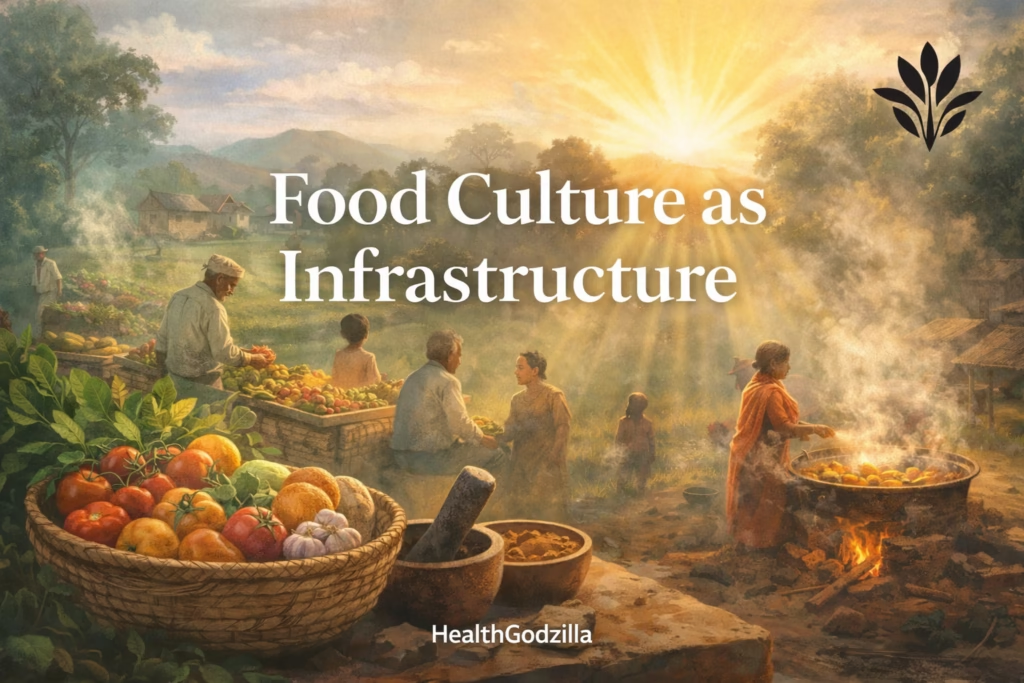
Prologue — When Infrastructure Is Invisible
This essay does not argue against policy.
It begins from a quieter premise: Food Culture as Infrastructure carries the weight of survival long before policy arrives—and often unnoticed until it fails.
Infrastructure rarely announces itself; it becomes visible only when it cracks—when roads fail, when power fades, when water stops flowing.
Food works the same way.
Long before policymakers write rules or measure indicators, people learn how to eat from the land around them. They learn what grows, what keeps, what heals, what survives drought, flood, or scarcity. These habits settle quietly into kitchens, seasons, and shared memory.
We often call this “culture,” as if it were ornamental.
But it is not.
Food culture carries load. It distributes risk. Across generations, it adapts. And when systems falter, it does the work we later ask policy to fix—silently, imperfectly, but persistently.
When food systems strain today, the failure is rarely sudden. It begins when institutions ignore, overwrite, or forget this hidden Food Culture as Infrastructure.
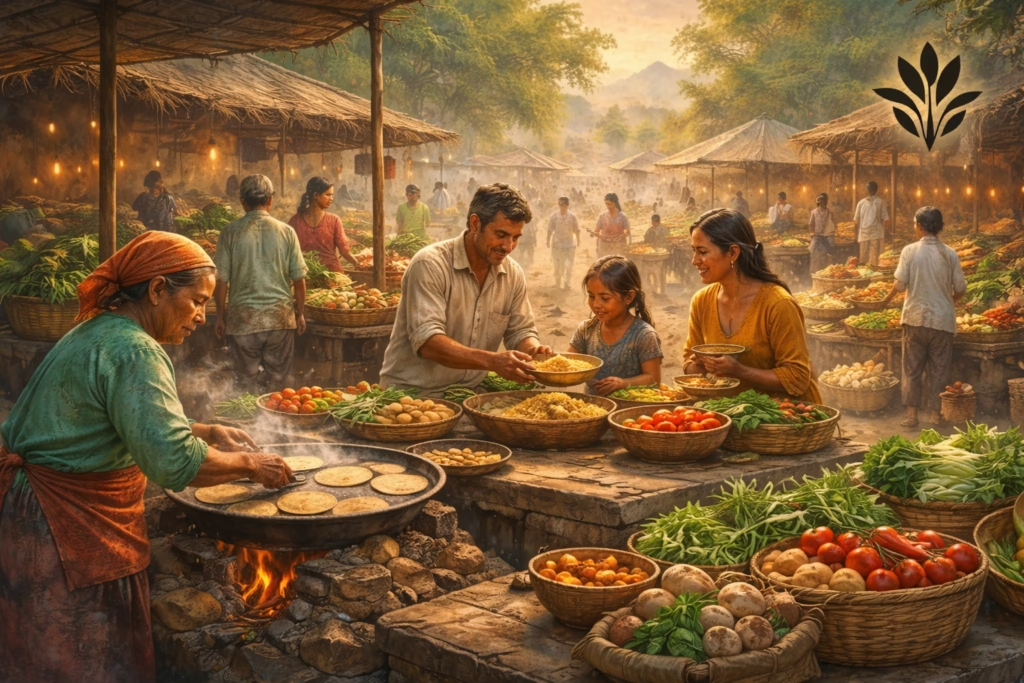
II. The Forgotten Engineering of Food
Modern food systems often describe themselves in numbers: yield per hectare, calories per capita, price per unit, efficiency per chain. These measures look precise. They travel well across reports and dashboards. Yet they describe only the visible surface of a much older construction.
Food did not become reliable because it became efficient.
It became reliable because it learned how to adapt.
For generations, communities shaped food practices around uncertainty—rain that might not arrive, floods that arrived too much, seasons that shifted without warning. Diversity served as insurance. Rotation spread risk. Preservation bridged scarcity. Taste itself became a guide, steering diets toward what the land could sustain.
This was engineering, though it rarely carried that name.
When modern policy frameworks emerged, they often mistook these arrangements for habits rather than systems. Productivity replaced resilience as the dominant goal. Uniformity began to look like progress. Speed displaced patience. What could be measured easily came to matter more than what endured quietly.
The consequences did not arrive all at once. They accumulated.
As diets narrowed, vulnerability widened. Supply chains lengthened, and dependence deepened. With greater efficiency, the margin for error shrank. The system appeared stronger, yet it bent less easily when pressure came—from climate shocks, price volatility, or sudden disruptions.
None of this suggests that policy caused the problem alone. It suggests something subtler: policy often stepped in without first noticing what already worked.
Food cultures had long distributed risk without formal coordination. They had balanced nutrition without nutrient tables. They had integrated environment, health, and livelihood without separating them into sectors. When these internal logics were ignored or overridden, systems did not collapse immediately—but they lost memory.
This is the quiet paradox at the center of contemporary food debates. We search for solutions at the level of intervention while overlooking the architecture that once made intervention less necessary.
Understanding this forgotten engineering does not require rejecting modern tools or institutions. It requires something more demanding: learning to see food not only as output, but as a system that learned, slowly, how to carry weight.
III. Food Culture as Infrastructure
Food Culture as Infrastructure usually hides beneath what we notice. Roads disappear under movement. Water systems retreat behind the turn of a tap. Only when they fail do they demand attention. Food culture hides for the same reason: when it works, it removes friction from daily life.
At its core, infrastructure does not persuade or instruct. It supports. It carries load so that daily life can proceed without constant negotiation. Food culture does this work quietly. It coordinates eating without manuals, supports nourishment without constant measurement, and distributes responsibility without formal contracts.
Consider what food culture already manages. It sets expectations—what counts as a meal, what belongs together, what feels sufficient. Rather than relying on regulation, it encodes seasonality into habit. Ecological limits then translate into taste, preference, and routine. In doing so, it reduces the cognitive and social effort required to survive.
This is why food culture persists even under pressure. When markets fluctuate or supply chains stretch thin, people fall back on what they know how to prepare, preserve, and share. These practices do not emerge from policy documents. They grow through repetition, adjustment, and memory.
Calling this “culture” often misleads us. The word suggests expression, identity, or heritage. Yet what matters here is function. Food culture operates as a system of coordination—one that integrates environment, health, and livelihood without separating them into silos.
Infrastructure also ages. It adapts slowly, accumulating repairs rather than redesigns. Food culture follows the same logic. It absorbs new ingredients, tools, and influences, but it resists abrupt replacement. When change arrives too quickly, strain appears—not because people reject improvement, but because the underlying structure cannot adjust at that speed.
This is where misunderstanding begins. When policy treats food culture as behavior to be corrected rather than capacity to be maintained, it misreads the terrain. What looks like resistance often reflects load limits already reached.
Seeing Food Culture as Infrastructure does not freeze it in time. It reframes responsibility. Instead of asking how to reshape diets from above, the question shifts toward how existing systems already hold together—and where they need reinforcement rather than redesign.
This shift may seem modest. In practice, it changes everything that follows.
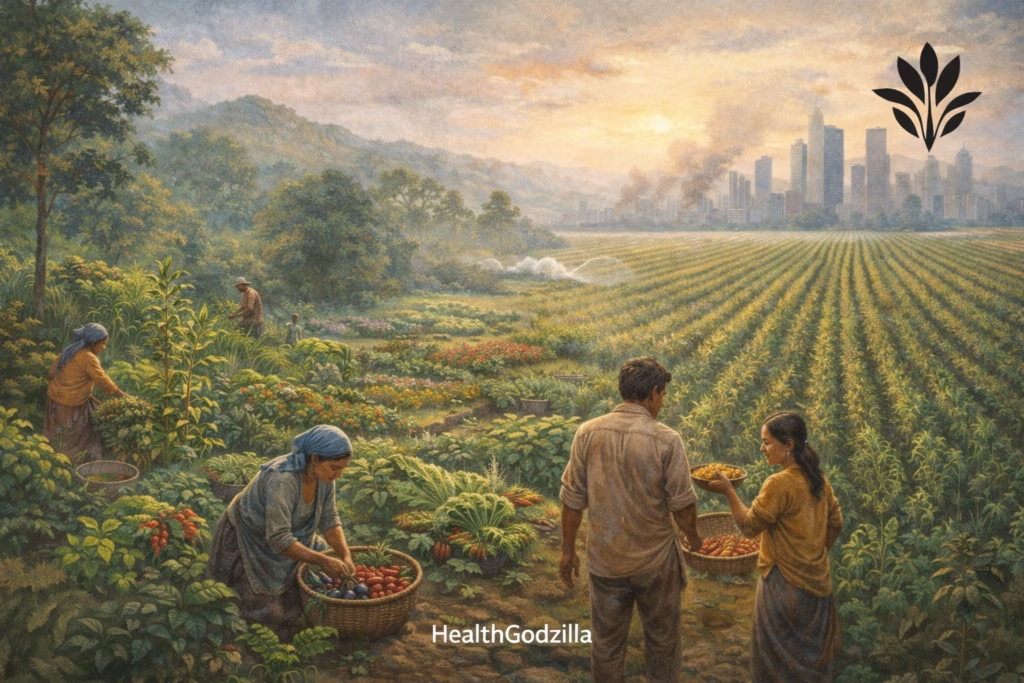
IV. Local Systems, Global Echoes
Food Culture as Infrastructure becomes most visible when food systems fail in isolation. What looks local often carries consequences far beyond its place of origin, while decisions made at a distance settle quietly into everyday meals. The connection between the two is easy to miss because it does not move in straight lines.
Local food practices evolve to solve immediate problems. They respond to soil, climate, labor, storage, and taste. Over time, these solutions harden into routines—what to plant together, what to preserve, what to eat when money runs thin or seasons turn uncertain. None of these aims to scale. They aim to endure.
Yet when many such systems weaken at once, the effects accumulate. Diets begin to resemble one another across regions. Supply chains stretch farther to compensate for lost diversity. Shocks travel faster because fewer buffers remain in place. What once absorbed disruption locally now passes it along globally.
This is where policy often enters the picture, drawn by visible symptoms: price volatility, nutritional gaps, environmental strain. The response tends to operate at scale, because the problem appears large. But scale alone does not explain the breakdown. What changed first was not reach, but structure.
Local systems had long integrated multiple goals at once—nutrition, affordability, ecological balance—without naming them as such. When those systems eroded, policies inherited a more fragile landscape. Interventions grew heavier because the underlying supports had thinned.
The paradox is subtle. Global policy debates often treat local food practices as constraints to modernization. In practice, their disappearance increases dependence on the very systems meant to replace them. Uniform solutions travel well, but they return with side effects that differ by place.
Seen from a distance, this looks like complexity. Seen up close, it looks like a loss of redundancy.
What once functioned as many small systems of adjustment becomes a single, tightly coupled mechanism. Efficiency improves. Resilience declines. The trade-off remains invisible until pressure arrives.
Understanding this does not require choosing between local and global. It requires recognizing how deeply they already depend on one another—and how much global stability once rested on countless local arrangements that asked for no recognition at all.
V. Resilience Lives in Kitchens, Not Frameworks
Resilience rarely announces itself through plans or models. It reveals itself in repetition—in what people cook when money tightens, when markets falter, when time runs short. Kitchens become the testing ground where systems prove whether they can bend without breaking.
Here, decisions feel small. What stretches a meal. How substitution works when ingredients disappear. And how many mouths are fed without exhausting land or labor. These choices do not aim for optimization. They aim for continuity.
Such practices accumulate quietly. A pot simmers longer to serve more. A dish relies on vegetables that store well. Fermentation extends life beyond harvest. In Bangladesh, fermented and dried foods often carry households across lean seasons when markets tighten and storage becomes unreliable. Pulses replace meat when prices rise. Fish, gathered locally, supplement grain-heavy diets. None of this requires instruction. Knowledge passes hand to hand, season to season.
Frameworks often arrive later, attempting to describe what already works. They label resilience, define buffers, map diversity. Useful language, but secondary. The capacity existed first. Measurement followed.
What makes these kitchen-level systems durable is not precision, but redundancy. Multiple foods serve similar roles. Multiple preparation methods answer the same need. If one pathway closes, another opens. This multiplicity spreads risk without ever naming it.
Trouble begins when external pressures narrow those options. When diets simplify, flexibility thins. As cooking time disappears, substitution becomes harder. With eroding access to fuel, water, or storage, even familiar foods become burdens. Resilience fades not because people forget how to adapt, but because the space to adapt contracts.
Policy often notices only the outcome: poor nutrition, rising costs, environmental stress. The response tends to focus on correction. Yet the loss occurred earlier, at the level of everyday practice, where choices once compensated for uncertainty.
Recognizing resilience where it actually lives changes the conversation. It shifts attention from teaching people how to eat toward protecting the conditions that allow adaptive eating to continue. It reframes support as preservation rather than persuasion.
In kitchens, resilience does not look heroic. It looks ordinary. And that ordinariness is precisely what makes it dependable.
VI. Biodiversity as Cultural Memory
Biodiversity rarely enters daily life as a concept. It enters as choice—what grows nearby, what survives the season, what returns each year without asking. Over time, these choices settle into food practices, and food practices become memory.
In many places, diets once mirrored local ecosystems. Variety on the plate reflected variety in the field, the forest, the water. For instance, Mediterranean food cultures once did this through legumes, wild greens, and seasonal rotations—diversity as habit, not advice. This was not accidental. Diversity reduced risk. If one crop failed, another compensated. If one season turned harsh, another food carried people through. Memory lived not in archives, but in taste.
Food culture preserved this memory quietly. Through repetition, people learned which foods complemented one another, which combinations sustained health, which preparations made scarce ingredients last. The knowledge did not sit still. It adjusted as climates shifted, soils changed, and species moved. Biodiversity survived not because it was protected in isolation, but because it remained useful.
When food systems simplify, this memory thins. Diets grow narrower even as production expands. Foods travel farther while local varieties disappear. The loss rarely announces itself as ecological collapse. It appears instead as dependence—on fewer crops, fewer suppliers, fewer pathways of nourishment.
This is why biodiversity and food culture cannot be separated cleanly. One stores the other. Cultural practice becomes a living archive of ecological knowledge, carrying forward lessons about balance, limits, and adaptation that no single policy can recreate from scratch.
Policy frameworks often recognize biodiversity as something to conserve. Food cultures treat it as something to use, carefully, repeatedly, and with restraint. That use—shaped by habit rather than instruction—keeps diversity relevant across generations.
When this connection breaks, recovery becomes harder. Reintroducing diversity requires more than seed banks or guidelines. It requires reactivating the practices that once made diversity matter in everyday life.
Understanding biodiversity as cultural memory shifts attention again. Preservation alone is not enough. What must endure is the relationship between people and the living systems that feed them.
Seen this way, biodiversity endures not through protection alone, but through Food Culture as Infrastructure—where memory, practice, and living systems remain inseparable.
VII. Why Policy Keeps Arriving Late
Policy rarely enters food systems out of indifference. It enters out of urgency. Rising prices, nutritional deficits, environmental strain—these signals draw attention and demand response. By the time they appear clearly enough to measure, however, something quieter has already shifted underneath.
Food systems do not unravel overnight. They thin. Options narrow. Buffers erode. What once absorbed shock locally begins to transmit it outward. Policy tends to arrive at this point—when stress has already accumulated and the margin for adaptation has shrunk.
This delay is not only temporal. It is perceptual.
Policy works best with what it can see: indicators, targets, standardized interventions. Food culture operates largely outside that field of vision. Its mechanisms do not announce themselves as programs. They appear as routine, habit, and preference—too ordinary to attract attention until they stop functioning.
When intervention finally comes, it often addresses outcomes rather than causes. Diets lack diversity, so guidelines multiply. Prices fluctuate, so subsidies adjust. Environmental pressure mounts, so restrictions follow. Each response may be rational on its own terms, yet each assumes that behavior begins where policy intervenes.
The deeper difficulty lies elsewhere. Policy often encounters food systems after internal coordination has weakened. What it tries to repair from above once worked from within. At that stage, intervention must carry more weight, because the underlying supports no longer do.
This is why well-intentioned policies sometimes feel heavy. They compensate for lost capacity. They attempt to replace relationships with rules, memory with instruction, redundancy with control. The problem is not that policy acts—it is that it acts in a landscape already stripped of flexibility.
Recognizing this changes how delay is understood. Policy does not arrive late because institutions move slowly. It arrives late because it notices failure more easily than function. By the time dysfunction becomes visible, the quiet work that once prevented it has often faded.
This does not argue for withdrawal or inaction. It argues for timing and humility. Policy gains strength when it learns to read existing systems before reshaping them—when it asks not only what is broken, but what has already been holding.
Earlier policy is often quieter—protecting access, time, and diversity before crisis makes them visible.
Seen this way, the challenge is not to design ever more precise interventions, but to align policy with structures that evolved without design. The work ahead lies less in correction than in recognition.
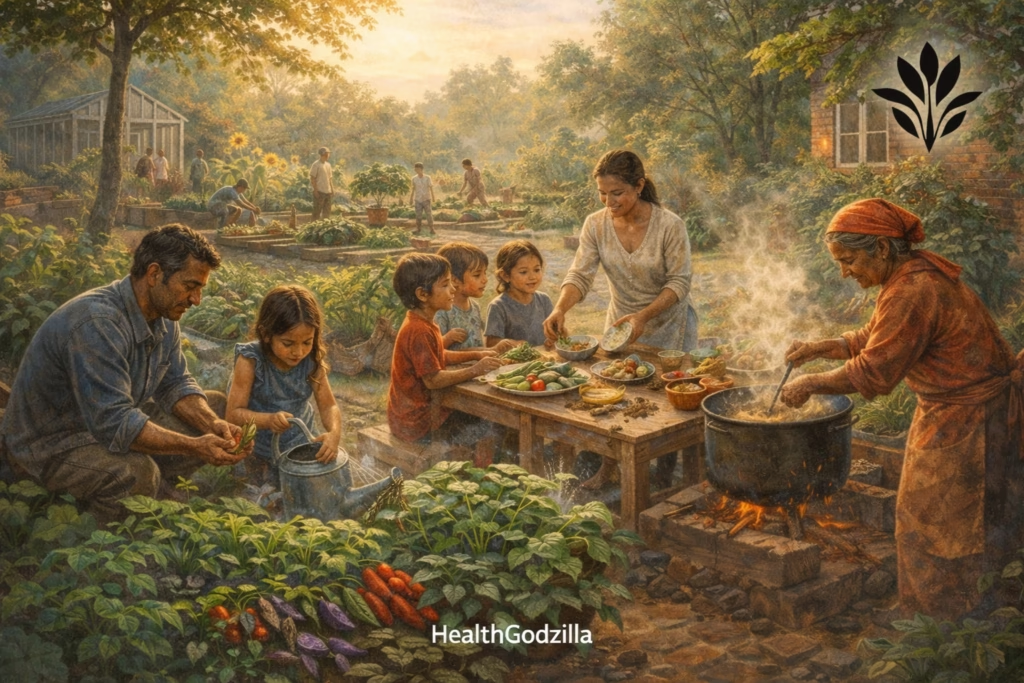
VIII. From Recognition to Stewardship
Recognition changes the posture of intervention. Once food culture is seen not as habit to be corrected but as capacity to be maintained, the role of policy shifts quietly.
Stewardship begins with attention. It asks what already holds meals together—what allows families to eat reliably, what stretches resources without exhausting them, what adapts when seasons or prices change. These are not sentimental questions. They are operational ones.
In food systems, stewardship rarely means adding something new. More often, it means removing pressure. Space matters. Time matters. Practices that once worked collapse when they are rushed, standardized, or stripped of flexibility. Protecting food culture therefore involves protecting the conditions under which it can function.
This does not imply freezing diets in place. Food cultures have always changed. New ingredients arrive. Old methods adapt. What matters is the pace and direction of change. When transformation builds on existing logic, adjustment feels natural. When it bypasses that logic, friction accumulates.
Stewardship also requires restraint. Not every inefficiency signals failure. Not every variation demands correction. Some redundancies exist precisely because they provide resilience. In food systems, what looks inefficient on paper often proves reliable in practice.
This is where Food Culture as Infrastructure shifts from metaphor to responsibility. Policies that work with this understanding tend to operate differently. They support diversity rather than uniformity. They protect access instead of prescribing behavior. In turn, they strengthen local capacity rather than replace it. Their success appears less dramatic, but it lasts longer.
None of this removes responsibility from institutions. It refines it. Stewardship asks policy to listen before it acts, to observe before it intervenes, and to measure success not only by output, but by endurance.
Food makes this visible because it repeats daily. Meals reveal quickly whether systems hold. When stewardship succeeds, eating remains ordinary. When it fails, food becomes a site of anxiety, calculation, and constraint.
The aim, then, is not perfection. It is continuity. To keep food systems doing what they have long done quietly—feed people, absorb uncertainty, and adapt without constant instruction.
That work does not announce itself.
But when it is protected, much else follows.
IX. What Still Holds
Step back from the machinery of systems and policies, and food returns to its most ordinary form: a shared table, a familiar dish, a routine repeated without discussion. What persists here often escapes measurement. Yet persistence itself signals that something continues to carry weight.
Across places and generations, people keep solving the same problem in small ways. Meals stretch when resources tighten. Familiar ingredients replace expensive ones. Preservation bridges seasons that once separated abundance from scarcity. None of this appears dramatic. Its success lies in how rarely it demands attention.
This ordinariness explains why food systems feel stable until they do not. Stability depends less on constant intervention than on countless daily adjustments that rarely appear in reports or indicators. When those adjustments remain possible, strain disperses quietly. When they narrow or disappear, pressure gathers quickly.
The discussion of food systems often centers on transformation. Transformation matters. Environments change. Economies shift. Populations grow and move. Yet continuity matters just as much. Systems endure because they retain the capacity to adapt without constant redesign.
Seen from this distance, the task ahead becomes less about invention and more about alignment. What exists already carries knowledge shaped by time, environment, and necessity. When that knowledge continues to function, change becomes easier to absorb.
The aim is modest but demanding: keep the foundations visible before they fail. Notice what still works before attempting to replace it. Support the conditions that allow adaptation to remain ordinary rather than exceptional.
In the end, the quiet strength of Food Culture as Infrastructure lies in its ability to endure without demanding attention.
Food rarely asks for recognition. It asks for continuity.
And when continuity holds, much of the system holds with it.

🍂 Hello, Artista
The room is quiet tonight. A window stands half open to the evening, and the sound of distant traffic drifts in like a slow tide. Artista sits at the table with a bowl of fruit, turning an orange in her hands as if it were a small planet.
Artista: You spent all day talking about food and policy. I kept thinking—people just want dinner. Why make it so complicated?
Organum: People do want dinner. That’s the point. Systems only become visible when dinner becomes difficult.
Artista smiles, peeling the orange in a long spiral that refuses to break.
Artista: So the whole world hides inside the ordinary?
Organum: Most of it. Especially the parts that work.
Whitee thumps softly across the floor. Brownie follows with ceremonial seriousness. Outside, Vancouver rain begins its quiet rehearsal against the glass.
Artista: You said food culture is infrastructure. That still feels strange. Infrastructure sounds like bridges and pipes.
Organum: Think of it this way. Bridges carry cars. Food culture carries meals. Pipes carry water. Food culture carries continuity.
Artista: Continuity sounds fragile.
Organum: It is. That’s why we rarely notice it until it cracks.
Artista pauses, holding up a slice of orange.
Artista: When things break, we ask how to fix them. But we rarely ask what kept them working before they broke.
Organum nods.
Organum: Exactly. Policy often begins with repair. Stewardship begins with recognition.
The rain grows steadier now. Somewhere below, a car door closes, and footsteps echo briefly before dissolving into the night.
Artista: So the goal isn’t to control how people eat?
Organum: No. The goal is to keep the quiet systems alive that already help people eat without fear.
Artista places the last orange slice back in the bowl.
Artista: That sounds less like a plan and more like care.
Organum smiles.
Organum: The best infrastructure usually does. Perhaps the quiet lesson is simple: Food Culture as Infrastructure was never missing—only unseen.
The room settles into a comfortable silence. Whitee and Brownie curl into a shared circle, as if they have heard enough for one evening.
Outside, the city continues eating, cooking, improvising—without noticing the invisible systems still holding the night together.
✍️ Author’s Reflection
I started this article on a delicate, slippery floor, hesitantly. I was not sure how long I could stand on it.
As the writing moved forward, many ideas loosened their grip. Some slipped away quietly. Others rearranged themselves into shapes I had not expected to see.
By the end, I felt as if I had noticed a faint ray of light. One day, that light may prove to be an illusion. Still, in this brief moment of clarity, I am unsure how much of the ray I can truly hand over.
So this piece remains what it is: a record of a moment of awakening—seeing a silhouette.
I was not alone when I wrote this. Others spoke, and I listened.
For now, that is enough.
🌼 Articles You May Like
From metal minds to stardust thoughts—more journeys await:
- Leadership Mindset Decision-Making: Psychological Roots and Organizational Impact
A father-son journey into how leadership mindset shapes authority, decisions, and a company’s rise—or quiet collapse. - Environmental Impact of Pesticides and Fertilizers: Siege the Earth
Environmental Impact of Pesticides and Fertilizers: Siege the Earth. See how synthetic chemicals unsettle soil, water, air—and life itself.
Curated with stardust by Organum & Artista, under a sky full of questions.
📚 Principal Sources
The following works helped shape the perspective behind Food Culture as Infrastructure.
- Burgaz, C., Van Dam, I., Garton, K., Swinburn, B. A., Sacks, G., Asiki, G., Claro, R., Diouf, A., Martins, A. P. B., & Vandevijvere, S. (2024). Which government policies to create sustainable food systems have the potential to simultaneously address undernutrition, obesity and environmental sustainability? Globalization and Health. https://link.springer.com/article/10.1186/s12992-024-01060-w
- Swinnen, J., & Barrett, C. B. (Eds.). (2024). Global Food Policy Report: Food Policy Lessons and Priorities for a Changing World. International Food Policy Research Institute (IFPRI). https://www.ifpri.org/global-food-policy-report/
- Fanzo, J., de Steenhuijsen Piters, B., Soto-Caro, A., Saint Ville, A., Mainuddin, M., & Battersby, J. (2024). Global and local perspectives on food security and food systems. Communications Earth & Environment. https://www.nature.com/articles/s43247-024-01398-4
- World Health Organization & Secretariat of the Convention on Biological Diversity. (2015). Connecting global priorities: Biodiversity and human health – A state of knowledge review. World Health Organization. https://www.who.int/publications/i/item/9789241508537
Relevant sections were interpreted through a narrative and systems lens rather than cited exhaustively.
This article is also archived for open access on Zenodo: https://doi.org/10.5281/zenodo.18519882
Leave a Reply