
1. Prologue — The Morning Tremor and the Auto Rickshaw Queue
On the morning of November 21, 2025, a 5.7-magnitude earthquake struck Dhaka. Since then, almost a full week has passed, yet our adda still circles around the same topic — earthquake conspiracy theories, fear, and all the possibilities people imagine. Everyone carries a theory in their pocket like a folded note: some soaked in worry, others tied to faith, and some borrowed straight from social media walls. The ground shook once; however, the mind continues to shake long after.
After a week, today, on my way to work, I noticed something unusual: the auto-rickshaw line at the stoppage had stretched like a long green tail. Normally five or six autos wait there; today I counted nearly twenty. So I climbed into the first one and asked the driver why the queue was so long.
He replied, “Very few passengers today, sir. Many people have already left Dhaka. They say the next earthquake will happen on January 8, 2026.”
I asked him how he knew the date of an earthquake.
He said, “Social media, sir.”
His certainty felt even more startling than the rumour. A date — fixed not by scientists, but by whispers. Meanwhile, the auto rolled forward, and the morning air felt heavier, as though another tremor had passed — not under our feet, but inside our thoughts. And I wondered: how does one tremor give birth to a whole branch of earthquake conspiracy theories? How does fear suddenly find a calendar?
2. The Questions That Follow Us Like Shadows
After the rickshaw ride, the city kept moving, yet a quiet stream of questions began flowing beside me. First came the simplest one: what is an earthquake, really? Not the shaking itself, but the meaning we attach to it. Because whenever the earth trembles, something inside us trembles too, and that inner tremor often gives birth to stories faster than facts.
Soon, other questions arrived. Why do trauma and fear travel together, although they are not the same creature? Trauma wounds; however, fear protects. Fear stands among the four ancient survival pillars — food, sleep, reproduction, and fear — reminding us to think again, choose wisely, and seek a safer path. Therefore, fear can guide us, but trauma can blur the map.
Then came the spiritual questions. Many people ask whether an earthquake is a curse or a warning from Allah, Bhagavan, or God. I do not argue with faith; instead, I respect the way every heart interprets the world. Faith is personal, and fear often walks through the door of belief before it reaches the door of science.
After that came the stranger possibilities — aliens. I simply say what I know: I have not seen them, so I cannot comment. Even then, the human mind loves mysteries, and an invisible presence always feels more exciting than a geological explanation.
Finally, I reached the loudest question in the adda river: the conspiracy theories — artificial vibration, secret radiation, HAARP, HERP, hidden weapons, and the sudden prediction of a January 8 earthquake. Are these rooted in truth, or shaped by fear? What does psychology tell us about such beliefs? How does sociology look at collective panic? And how much does science actually know about the trembling earth beneath our feet?
These questions followed me like soft shadows, neither frightening nor harmless — simply present. And I felt that before we untangle earthquake conspiracy theories, we must first understand the mind that creates them.
3. Fear, Trauma, and the Human Mind
Fear and trauma often walk side by side, yet they come from different rooms inside us. Trauma cracks something; it leaves a mark that echoes long after the danger ends. Fear, however, tries to protect us. It is one of the old survival pillars — woven into our biology to keep us alert, cautious, and alive. When the earth shakes, trauma may freeze a person, but fear may help them pause, rethink, and take the next safe step.
Our minds, meanwhile, crave simple answers, especially when uncertainty grows. When something unpredictable strikes — like an earthquake — the human brain reaches for shortcuts. It wants meaning, even if that meaning is borrowed from hearsay or stitched from anxiety. Uncertainty feels like standing on a rope bridge in the dark; therefore, the mind tries to build a quick railing, even if the railing is made of rumour.
Rumours, in fact, offer the illusion of control. They tell us the world is not random, that someone somewhere knows what will happen next. A specific date, like “January 8,” feels strangely comforting because it replaces the vast unknown with a sharp point on a calendar. “We don’t know” is harder to hold. It feels like sky. But a rumour gives shape to fear — and once fear takes shape, people believe they can prepare for it, even when the shape is not real.
4. Sociology of Collective Panic
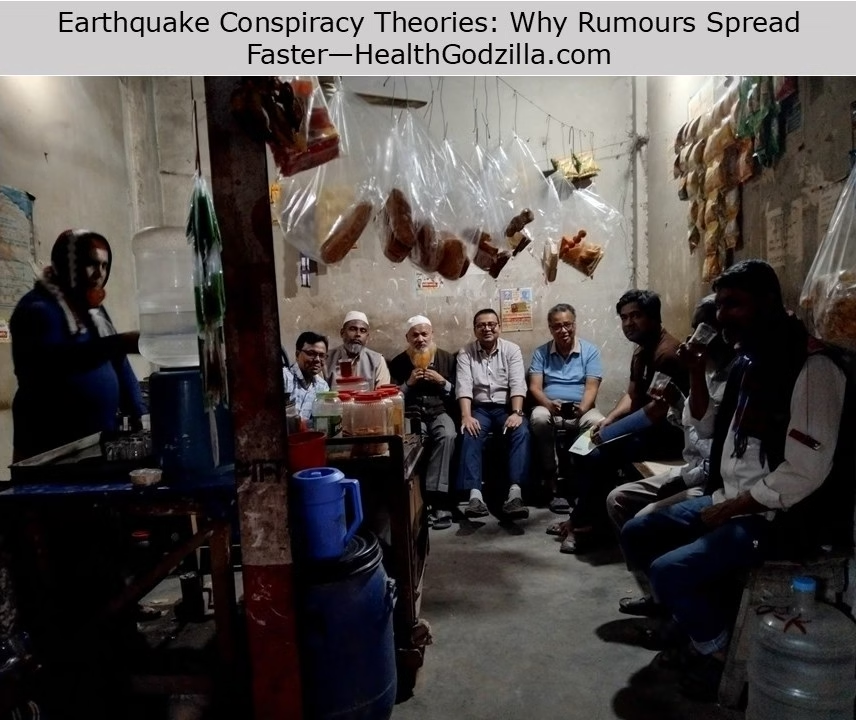
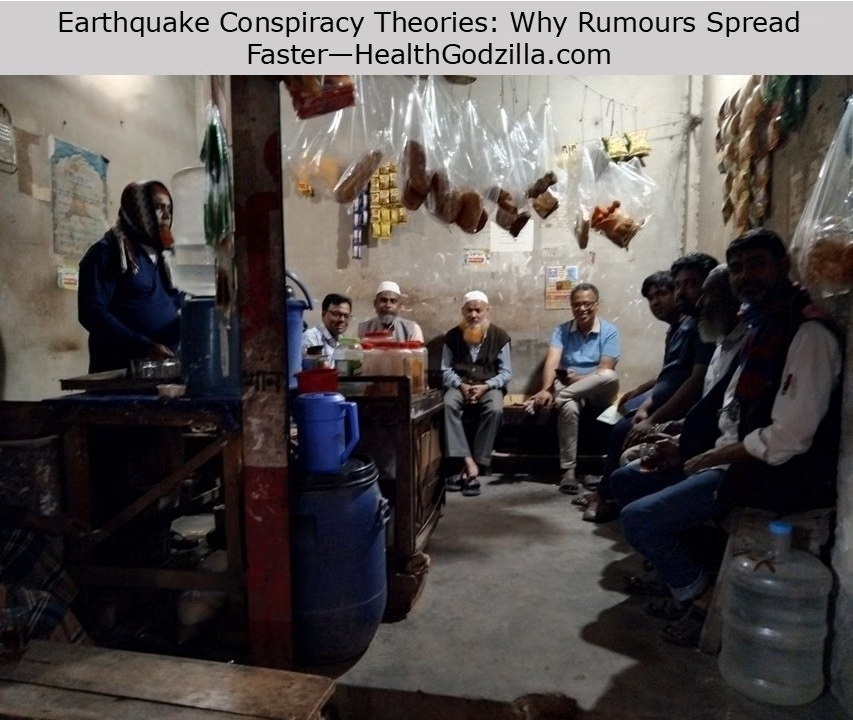
After any disaster, the city does not shake alone — the people shake together. In Dhaka, this trembling often gathers at tea stalls, where adda becomes both shelter and storm. One person brings a rumour, another brings a memory, a third brings a fear dressed as a fact, and soon the whole bench begins to sway with shared anxiety. It is not because people are foolish; it is because people are human. When uncertainty rises, we look sideways to see what others believe, hoping their confidence will steady our own.
Group psychology after a disaster works like a wave. The first shock hits the ground, but the second shock hits the community. In these moments, the mind tries to rebuild a sense of safety, and therefore it reaches for stories that feel familiar, symbolic, or dramatic. Mystical explanations — curses, warnings, divine signs, hidden forces — often travel faster than the slow, quiet voice of science. They move quickly because they touch emotion, and emotion runs ahead of logic.
Social media, meanwhile, acts like a loudspeaker placed inside every pocket. A single frightened post can echo through thousands of screens in minutes. Each share adds another layer of urgency, another hint of certainty, another reason to worry. Consequently, fear becomes a chain reaction, not because people want to spread panic, but because they want to protect the ones they love.
Communities create shared stories for the same reason families gather during storms — to feel less alone. A rumour gives structure to confusion. A mystical interpretation gives meaning to chaos. A conspiracy theory gives a villain to the unseen. These shared narratives may not be true, but they create a temporary circle around the fear, reminding everyone that someone else is also feeling the same trembling inside.
5. Are Earthquakes a Recent Phenomenon? (No.)
When fear rises, it often feels as if the danger is new — as if the earth has only recently started misbehaving. However, earthquakes are older than every story we tell, older than every prophet we follow, older even than the continents where we now stand. The earth has been trembling since long before life appeared on its surface. This truth alone weakens many earthquake conspiracy theories, which depend on the idea that quakes are modern or artificially created.
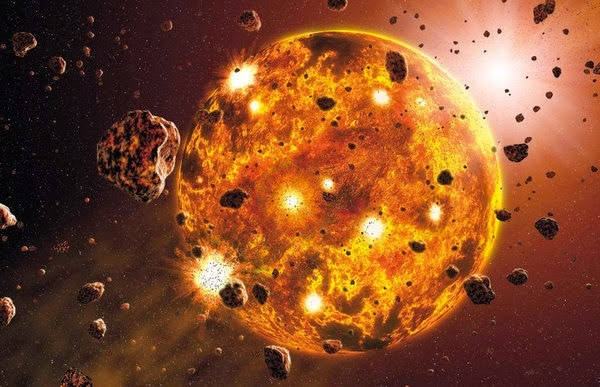
To understand this, we must travel back to the Hadean Eon, around 4.0 billion years ago. During that time, there were no continents, no oceans, no tectonic plates — only a restless, molten globe swirling in heat. The planet slowly cooled, and after millions of years, the first solid crust formed like thin ice on boiling water. Later, this crust cracked into enormous pieces, and these pieces — the tectonic plates — began to drift, collide, sink, and rise. Earthquakes were born not yesterday, but then.
Our present world, with its seven continents and five oceans, is simply the latest arrangement of these ancient plates. The ground beneath our feet is always moving, even when we do not feel it. An earthquake, therefore, is not a sign of a modern curse or a political experiment; instead, it is a continuation of the planet’s long, silent breathing. And this slow, natural history stands in sharp contrast to earthquake conspiracy theories that claim sudden human control over forces older than the oceans.
The last time Earth’s shape changed in a remarkable way was during the 2004 Sumatra–Andaman earthquake — a massive 9.1–9.3 event. It shifted entire blocks of the crust, tilted the Earth’s axis by centimeters, and even shortened the length of our day by a few microseconds. No human action, no machine, and no secret weapon can produce such planet-sized power. It is nature doing what nature has always done.
Earthquakes are not recent, nor rare, nor unnatural. They belong to the deep memory of the earth — a memory written in rock, heat, and movement. Anyone tracing their origins eventually discovers that earthquake conspiracy theories fade quickly beside four billion years of geological truth.
6. The Last Remarkable Shape-Shift of Earth
Although earthquakes happen every day somewhere on the planet, only a few are powerful enough to reshape the Earth itself. The last time such a transformation occurred was during the 2004 Sumatra–Andaman earthquake, a colossal 9.1–9.3 event that changed the world in ways far beyond human scale.
When that earthquake struck, enormous sections of the Earth’s crust shifted, as if slabs of the planet’s skin slid past one another. Some coastal land rose by several meters, while other areas quietly sank beneath the waves. The ocean floor itself moved, releasing the energy that triggered the devastating Indian Ocean tsunami. Because of this massive rearrangement, the entire planet wobbled slightly on its axis — a cosmic reminder that Earth is not a perfect sphere, but a living, moving body.
Scientists later confirmed that the earthquake tilted the Earth’s axis by roughly 2.3 centimeters. This shift was tiny on paper; however, its significance was enormous. It even shortened the length of our day by a few microseconds, as if the planet had taken a slightly faster breath. No human machine or imagined weapon could cause such a global adjustment. The scale of this event shows how small our technologies are compared to the deep machinery of the Earth.
Therefore, whenever earthquake conspiracy theories suggest human-made triggers, it is helpful to remember this: the only forces capable of reshaping the planet come from within the planet itself. The Earth moves according to pressures stored over centuries, not according to the experiments or intentions of human hands.
7. Understanding the Earth Beneath Us (Simple Science)
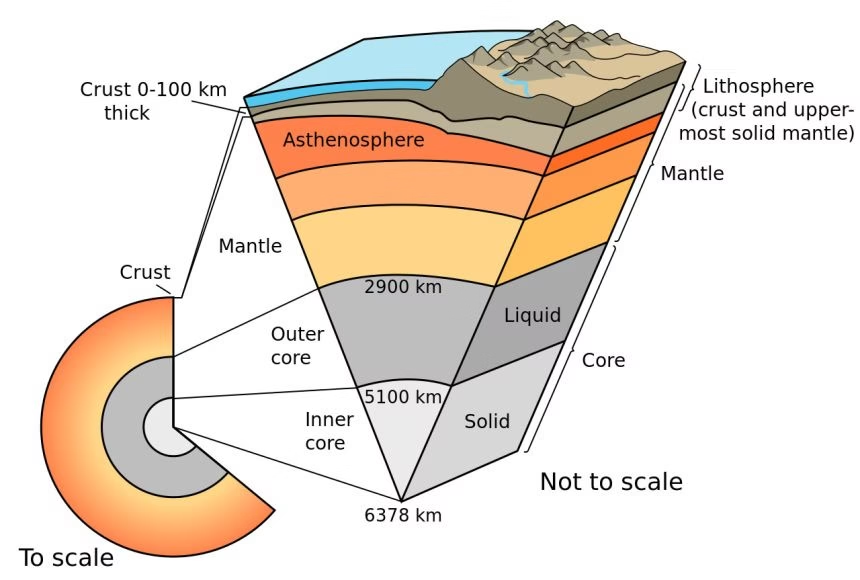
To understand why humans cannot trigger earthquakes — and why earthquake conspiracy theories collapse under basic geology — we must first look at the planet beneath our feet. Earth is not a solid stone. Instead, it is layered like a giant fruit, each layer hotter, heavier, and more powerful than the one above it.
At the very top lies the crust, the thin outer skin where we live. It seems strong because it holds cities, mountains, and oceans; however, compared to the rest of the planet, it is fragile — like the shell of an egg. Beneath the crust sits the mantle, a vast region of semi-solid rock slowly flowing like warm toffee. This slow movement drags the tectonic plates above it, causing them to drift, collide, and break apart over millions of years.
Deeper still lies the outer core, a swirling ocean of molten iron. This layer generates Earth’s magnetic field — the invisible shield that protects us from solar storms. Finally, at the center, sits the inner core, a solid sphere of iron and nickel under pressures so intense that even metal behaves like stone. Its temperature rises above 6,000°C, hotter than the surface of the sun, far beyond anything human technology can approach.
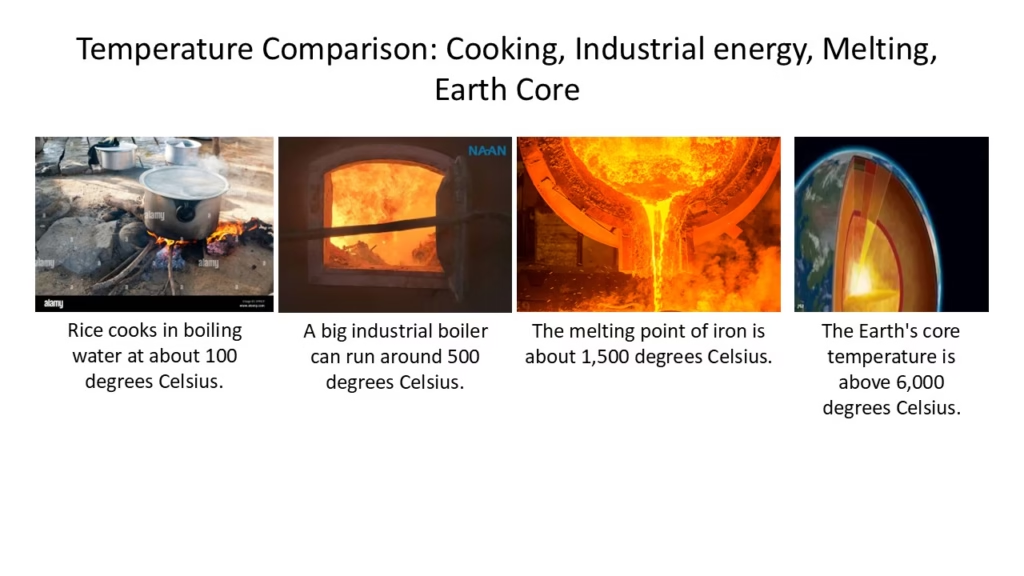
To help imagine this scale, simple comparisons work best:
- Rice cooks in boiling water at about 100°C.
- A big industrial boiler runs near 500°C.
- Iron melts around 1,500°C.
- Earth’s inner core burns above 6,000°C.
This small ladder of heat shows why human tools stop long before they reach the Earth’s deep engine. Moreover, scientists cannot drill beyond a fraction of the crust; the deepest hole ever drilled reached only around 12 kilometers — not even scratching the mantle. Earthquakes, however, begin 10 to 700 kilometers below the surface, far beyond the reach of machines, laboratories, or weapons.
Therefore, the forces that create Earth’s trembling come from depths untouched by human hands. These massive pressures build over centuries, and they release not when humans command them, but when the planet decides it can no longer hold its breath. This simple truth already shakes the foundation of earthquake conspiracy theories: no human technology can alter a machine as ancient and enormous as the Earth itself.
8. How Scientists Study Earthquakes
Although human beings cannot reach the deep places where earthquakes are born, science has learned to listen to the Earth in other ways. Scientists cannot touch the mantle or knock on the core, but they can study the echoes, signals, and fragments the planet offers. Over time, four major doorways of understanding have emerged, each one opening a little more of Earth’s secret machinery.
The first doorway is seismic waves. Whenever the Earth trembles, it sends vibrations traveling through rock, soil, and molten layers. These waves bend, slow, speed up, or vanish depending on the materials they pass through. Therefore, by reading these changes, scientists can map the planet’s hidden interior — just as someone can guess which room a voice comes from by listening through a wall.
The second doorway is laboratory simulations. Scientists cannot recreate the full pressure of the Earth’s core, but they can squeeze tiny iron samples under extreme heat and pressure using diamond anvils and laser beams. These miniature experiments help them understand how materials behave deep inside the Earth. Such studies reveal which minerals melt, which stay solid, and how tectonic plates store and release stress over time.
The third doorway is computer models. Using powerful supercomputers, researchers simulate the planet’s heat flow, the movement of mantle rocks, and the changing patterns of the magnetic field. Although these models cannot capture every detail, they allow scientists to test theories, compare scenarios, and explore how small changes ripple through the entire Earth system.
Finally, the fourth doorway is cosmic analogues — especially iron-rich meteorites. Many meteorites are fragments of ancient planetary cores from long-dead worlds. By studying their chemistry and structure, researchers learn how Earth’s own core may have formed billions of years ago. These cosmic visitors act like messages from the early solar system, preserving clues unavailable anywhere else.
Through these four approaches, science gathers insight slowly but steadily. It cannot predict the exact moment an earthquake will strike, and it cannot stop one from occurring, but it can understand the forces that shape our world. And with every new study, the old fear-based stories lose a little more weight, proving again that the Earth’s movement is governed by natural laws, not by human experiments or earthquake conspiracy theories.
9. HAARP, HERP, and the Birth of Conspiracy Theories
Whenever a disaster strikes, two things rise together: the dust from the ground and the questions in our minds. Therefore, it is no surprise that after every major earthquake, names like HAARP and HERP float through conversations — sometimes whispered, sometimes shouted, sometimes wrapped in fear, and sometimes in curiosity.
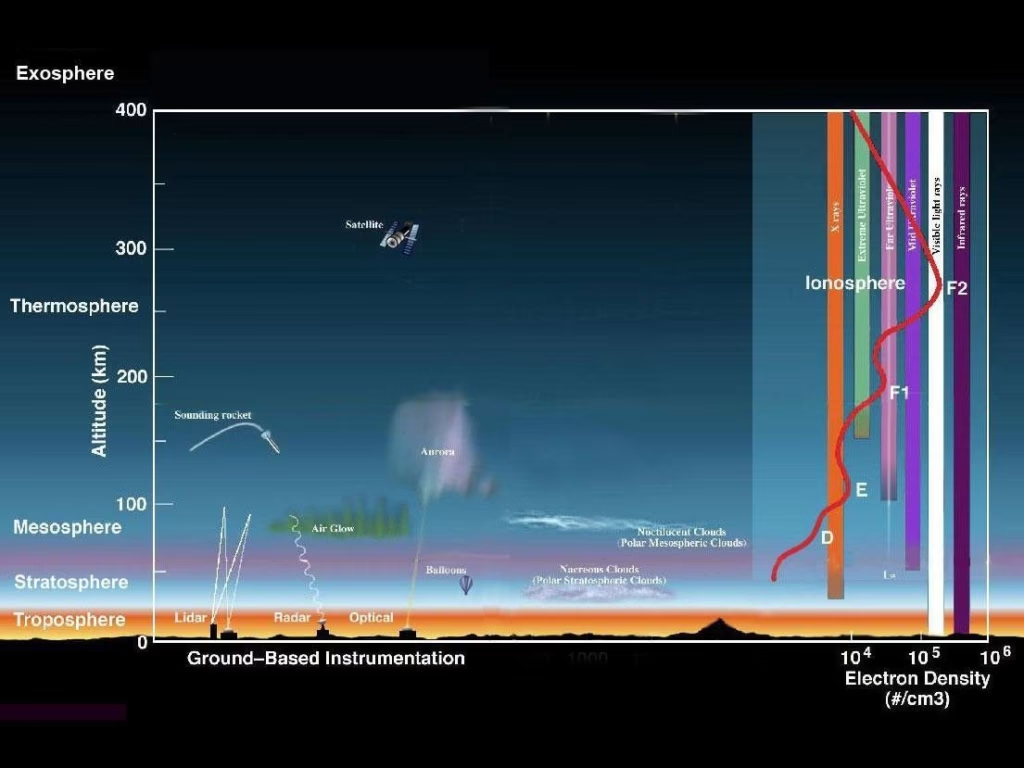
HAARP, the High-frequency Active Auroral Research Program, is a real facility in Alaska. It studies the ionosphere — the upper layers of Earth’s atmosphere where solar storms, auroras, and radio waves interact. Its work focuses on communication signals, space weather, and atmospheric physics. However, the word “ionosphere” sounds mysterious to many people; and mysterious words easily become magnets for suspicion. Consequently, HAARP often gets blamed for hurricanes, heatwaves, and earthquakes — even though it cannot affect the crust, cannot create vibration, and cannot touch the tectonic plates far below its reach.
HERP, on the other hand, is the Headquarters for Earthquake Research Promotion, a scientific institution in Japan. It studies how earthquakes begin, how plates move, and how communities can stay safer. But because the name “HERP” sounds similar to “HAARP,” many people confuse the two. One studies the sky, the other studies the ground — yet both end up tangled in rumours.
This confusion is how many earthquake conspiracy theories are born. A scientific word sounds complicated; a Facebook caption sounds simple. One requires patience; the other delivers instant drama. Moreover, fear prefers stories with villains. It wants someone — or something — to blame. Therefore, when the ground shakes, people often look upward before they look downward. They turn the unknown into a human-made plot, even when the truth lies deep beneath their feet.
What stands quietly behind all these stories is this spiritual reminder:
When the Earth moves, it speaks in units our daily life never teaches us: centimeters of axis tilt, microseconds of lost daylight, centuries of accumulating pressure. These scales remind us how small we are, yet how deeply connected we remain to the planet beneath our feet.
In that vastness, human technology looks like a matchstick thrown into the ocean. HAARP cannot bend tectonic plates; HERP cannot command the mantle. The energy that shapes our world belongs to the Earth alone, not to any hidden human laboratory.
And once we understand this, the fog around conspiracies becomes thinner. The mystery remains — but the fear loses its teeth.
10. The Core Truth — Why Secret Weapons Cannot Trigger Earthquakes
When people speak of hidden machines, secret weapons, or artificial vibrations, the ideas often sound dramatic enough to feel possible. However, once we compare human power to the Earth’s power, the conspiracy melts like ice on a stove. To understand why, we must look at three simple truths that no technology can escape.
First, an earthquake releases more energy than any human device can produce. Even a moderate quake can equal the force of hundreds of nuclear bombs. A large tectonic event can equal thousands. No laboratory, no military program, and no secret experiment comes close to generating this scale of energy. The mismatch is not small; it is cosmic.
Second, earthquakes begin far below human reach — ten to seven hundred kilometers beneath the ground. Meanwhile, the deepest hole ever drilled by humans barely touched twelve kilometers. We cannot drill to the mantle, cannot touch the plates, and cannot interfere with the ancient pressures stored there. Therefore, the idea that humans can trigger earthquakes is not scientific; it is imagination shaped by fear.
Third, the Earth’s crust is vast and complex. Tectonic plates stretch across thousands of kilometers, and their movement depends on heat rising from the core, rock flowing in the mantle, and stress building over centuries. These are slow, enormous forces that respond to geology, not technology. Even predicting the exact moment of a quake is nearly impossible; influencing one is far beyond human capability.
Whenever earthquake conspiracy theories claim that a machine can shift plates, they ask us to believe that a human tool can outmuscle a planet. Yet the planet is moved by pressures that gather over lifetimes, released only when the Earth decides it can no longer hold its breath. Compared to this, no weapon is more than a spark against a mountain.
And in those moments when the ground moves — centimeters of axis tilt, microseconds of lost daylight, cities swaying like boats — the truth becomes clear again:
Earthquakes come from the deep memory of the Earth, not from the hands of humankind.
11. Why Mystical Theories Attract More Than Scientific Ones
Whenever the earth trembles, the mind trembles with it. And in that trembling, something ancient wakes up inside us — a hunger for meaning. Science explains how the plates move, how pressure builds, how energy releases, but science speaks in quiet tones. Meanwhile, mystical explanations carry drama, emotion, and story. Therefore, they travel faster, especially when fear rises like smoke after a quake.
One reason mystical theories spread quickly is that they feel personal. A curse, a warning, or a divine message touches the heart directly. It gives the event a face, a voice, a reason. Science, however, deals with forces without intention. It tells us the plates moved not because they wanted to communicate, but because the Earth’s engine had been building pressure for centuries. For many people, that feels cold compared to a story rooted in faith or symbolism.
Another reason is our storytelling instinct. Since ancient times, humans have explained storms, floods, and earthquakes through myth. We turned lightning into gods and rivers into deities because it helped us understand a world that was too powerful to grasp. Even today, that instinct remains. A mystical interpretation feels like an echo of childhood — familiar, comforting, and filled with meaning.
Social media amplifies this instinct. A dramatic claim — “This is a sign,” “This is punishment,” “This is the end,” “This is a plan” — spreads faster than a careful explanation of tectonic plates. Rumours create emotional shockwaves; scientific diagrams do not. Therefore, even in educated societies, mystical theories often move ahead of factual ones, especially when fear is fresh.
Communities also use mystical narratives to stay connected. A shared explanation reduces loneliness. When ten people agree that an earthquake is a warning from above, they form a circle of belief that feels safer than standing alone in uncertainty. In contrast, scientific explanations, although true, rarely create this emotional circle. They offer understanding, but not always comfort.
Finally, mystical theories provide closure. They say, “This happened because…” and fill the blank with something familiar. Science, however, often says, “We know how this happened, but not exactly why today, at this hour.” That openness — that humility — is honest but uncomfortable. Therefore, people turn to mystical explanations not because they reject science, but because they long for meaning in moments when life feels fragile.
Yet even as these stories spread, the Earth continues to move for reasons older than myth. And when we listen closely, we find that both myth and science are trying to answer the same question:
How do we make sense of a world that can shake beneath our feet?
12. What Politics, Geopolitics, and Science Actually Say
When earthquakes strike, people often search for explanations beyond geology. Therefore, political and geopolitical theories naturally rise alongside mystical ones. Some believe powerful nations trigger quakes, others suspect hidden laboratories, and some imagine global experiments unfolding beneath the map of the world. These ideas feel large enough to match the scale of the disaster, and that is why they attract attention. However, when we examine them carefully, a clearer picture emerges.
Politically, no nation has ever claimed the ability to cause an earthquake — not even in hints, warnings, or strategic boasting. Countries often exaggerate their military power for deterrence or pride, yet none has ever mentioned controlling the Earth’s crust. If such a technology existed, it would be the loudest victory cry in history. Instead, the silence is telling: no government possesses such a tool, because the natural forces involved are far beyond human reach.
Geopolitically, nations use information — not geology — to influence others. During crises, rumours spread intentionally or unintentionally. Sometimes governments benefit from distraction, sometimes from fear, sometimes from unity. But shaping perception is very different from shaping tectonic plates. Misinformation can travel across borders; however, earthquakes come from the mantle, not from ministries.
Scientifically, the evidence is even clearer. Earthquakes begin deep within the planet, driven by heat rising from the core, by rock flowing slowly in the mantle, and by immense pressure locked along faults for centuries. These processes do not respond to weapons, radio waves, or atmospheric experiments. Even nuclear explosions — the strongest human-made blasts — cannot shift tectonic plates. They shake the local ground but leave the planet’s machinery unchanged.
Moreover, an earthquake is not a precise event that can be scheduled like a meeting. The exact moment when stress releases depends on microscopic fractures inside rocks miles underground. Scientists cannot predict it; therefore, politicians cannot command it. Whenever earthquake conspiracy theories suggest deliberate timing, they overlook the unpredictable nature of seismic stress — a randomness that no strategy can tame.
Geopolitical suspicion thrives in places where trust is weak and fear is strong. But geology belongs to neither politics nor power. It belongs to the Earth alone. And when we understand this, we see that the theories pointing fingers at nations are reflections of human anxiety — not reflections of reality.
In the end, politics can shape stories, but only the planet shapes earthquakes.
13. Returning to Dhaka, to the Rickshaw Queue, to Ourselves
When I returned to Dhaka after that long week of questions, the city felt different — not because the buildings had changed, but because the people had. Every tea stall, bus stop, and rickshaw line carried the same quiet tremor beneath conversations. The ground had shaken once, but the minds were still shaking. And somehow, the city’s ordinary morning — the queue of auto-rickshaws, the driver saying “Very few passengers today, sir” — felt like a mirror held up to our collective heart.
As the rickshaw moved forward, it became clear that earthquakes are not just geological events; they are emotional ones. They remind us of how fragile we are, how suddenly life can tilt, and how small our routines look against the scale of the planet. In those moments, rumours grow not because people want to deceive, but because they want to understand. A story, even a frightening one, feels easier to hold than silence.
Rumours, therefore, become mirrors. They show us not the truth of the Earth, but the truth of our fears: the fear of the unknown, the fear of being unprepared, the fear of losing control. When someone says, “January 8, another earthquake is coming,” they are not predicting the earth; they are predicting their own anxiety. And when that anxiety spreads, it becomes a shared storm — a psychological aftershock.
And in that storm, earthquake conspiracy theories find easy shelter, because they offer the illusion of a cause when life feels painfully without one.
Yet beneath these loud stories, something quieter waits. Truth does not shout; it stands still, like bedrock. Science does not threaten faith; it simply describes the world in a different language. Community does not need conspiracies to stay united; it needs honesty, empathy, and the courage to say, “We are afraid, but we will stand together.”
As the rickshaw turned toward home, I realized that the real story is not HAARP, not HERP, not aliens, not secret weapons. The real story is us — the way we carry fear, the way we search for meaning, and the way we return again and again to one another, hoping that someone has an answer the earth has not given.
Because in the end, the ground beneath our feet may move, but the ground within us — the one made of understanding, dignity, and shared humanity — is the one we must learn to steady.
14. Conclusion — What We Can Hold, Even When the Earth Moves
When the earth trembles, it is easy to believe that everything else must tremble with it — our certainty, our faith, our conversations, even our sense of direction. Yet the days that follow reveal a different truth. The shaking stops. The dust settles. Life continues its long, stubborn march: shop shutters rise, tea stalls reopen, and rickshaws line up again under the same morning light.
In that return to normalcy, something becomes clear. The world is fragile, but not chaotic. Human minds are anxious, but not hopeless. And fear — although quick to spread — is not stronger than understanding. Earthquakes may come without warning, but calm can return by choice.
When rumours race faster than facts, they reveal our need for meaning, not our weakness.
Mystical theories rise next, carrying the weight of our longing for stories.
In moments like these, earthquake conspiracy theories slip into the crowd as easily as a whisper, feeding on uncertainty.
Soon enough, these earthquake conspiracy theories circulate from tea stalls to timelines, showing how frightened minds try to anchor the unanchorable.
Meanwhile, when science speaks softly in the background, it reminds us that truth doesn’t need to shout to endure.
Perhaps this is what the recent days taught us:
the earth moves in ways we cannot control, but our response — our clarity, our dignity, our kindness — remains fully within our hands.
And as we carry forward, let us keep one spiritual reminder close, like a lantern against the night:
When the Earth moves, it speaks in units our daily life never teaches us: centimeters of axis tilt, microseconds of lost daylight, centuries of accumulating pressure. These scales remind us how small we are, yet how deeply connected we remain to the planet beneath our feet.
The ground will move again someday. That is the nature of a living planet.
But when it does, may our minds stay steadier than the soil — and may our hearts stay gentler than the fear.

🍂 Hello, Artista
That evening, as the city settled into its usual rhythm, Organum called Artista from across the digital river. She stepped into the conversation like a lantern carried through a Vancouver drizzle — gentle, glowing, and a little curious.
Artista:
“Organum… I read your article. Here, the rabbits slept beside me, and still I felt the earth move beneath the words. Why do we humans turn tremors into prophecies?”
Organum:
“Maybe because the ground is the last thing we expect to betray us. When it shakes, something inside us shakes too. We reach for stories to steady ourselves, even the wild ones.”
Artista smiled — the quiet kind, the one that warms the space without insisting on being noticed.
Artista:
“In Vancouver, when the rain becomes too heavy, people say, ‘Maybe the sky needed to cry.’
It’s not science, but it holds the heart.
Maybe rumours work the same way — they hold fear until we are ready to set it down.”
Organum:
“Yes. My city was full of that fear this week. Even rickshaw queues told stories.
But the Earth… the Earth speaks in another scale.”
He paused, as if weighing a stone in his hand.
Organum:
“Centimeters of axis tilt.
Microseconds of lost daylight.
Centuries of pressure rising and falling.
How small we are compared to the world that carries us… and yet how loudly our minds can tremble.”
Artista’s eyes softened. She had always been sensitive to the spaces between words.
Artista:
“Maybe that’s why conspiracy theories bloom. Not because people want to deceive — but because they want to belong. Fear shared becomes a kind of shelter.”
Organum:
“True. But truth is also a shelter — quieter, slower… and harder to notice.”
The rain began tapping her window in Vancouver; somewhere in Boston, the dogs barked at a passing thought. For a moment, their two faraway rooms felt stitched together by the same thread: the human need to understand the trembling world.
Artista:
“So what do we hold onto when the ground moves?”
Organum whispered the answer like someone placing a stone gently on the earth.
Organum:
“We hold onto each other.”
And the lantern between them glowed a little brighter — not to chase away the darkness,
but to remind them they were not alone inside it.
✍️ Author’s Reflection
Mark Twain once called man the “Reasoning Animal,” but he quickly admitted the title was up for revision. Through his own experiments, Twain claimed to have found more reasoning in a cage full of foxes, doves, monkeys, and squirrels than in a cage filled with humans divided by theology. The animals lived together in peace; the humans tore each other to pieces.
Twain’s joke was sharp — yet it wasn’t only a joke. He saw how easily humans argue, how swiftly they build fires from sparks, how fiercely they defend ideas they barely understand. Therefore, when people turn a simple earthquake into a battlefield of rumours, warnings, and accusations, perhaps Twain is whispering from the page: “Are you sure you’re the reasoning ones?”
But I do not lean wholly on Twain, comrade.
Because humanity is not only foolishness and quarrel; it is also tenderness, curiosity, and change.
E. B. White looked at humanity from another angle — not mocking, but mourning.
Reflecting on Silent Spring, he wrote:
“I am pessimistic about the human race because it is too ingenious for its own well-being.
Our approach to nature is to beat it into submission.
We would stand a better chance of survival if we accommodated ourselves on this planet and viewed it appreciatively.
But we are skeptical and dictatorial about it.”
White was not calling us irrational.
He was calling us misguided — brilliant enough to build machines,
yet blind enough to ignore the quiet wisdom of the world we live upon.
And perhaps this is why earthquake conspiracy theories rise so quickly — not because the earth has changed, but because our ancient fears still walk beside us.
And somewhere between Twain’s mischief and White’s sorrow,
the spirit of Voltaire smiles its thin, skeptical smile.
Voltaire would ask:
“When fear spreads, who benefits?
When rumours bloom, who fertilizes the soil?”
Émilie du Châtelet — luminous, mathematical Émilie — would add:
“To understand the universe, begin with the forces, not the noise.”
Together, these voices form a prism.
Twain reveals our contradictions.
White reflects our arrogance.
Voltaire questions the storytellers.
Émilie measures the forces beneath our feet.
And through that prism, the earthquake becomes clear again —
a geological event,
wrapped by human stories,
transformed by human fears,
and sometimes misused by human politics.
Which leads to the quiet question at the heart of this article:
If the “Reasoning Animal” stumbles over truth each time the earth shakes,
should I dare to question the future of Earth and Humanity?
Perhaps yes.
Not out of despair,
but out of awareness.
And then out of humility —
with that small lantern of understanding we carry,
the one the earth itself teaches us to protect.
I was not alone when I wrote this. Others spoke, and I listened.
—Jamee
🌼 Articles You May Like
From metal minds to stardust thoughts—more journeys await:
- The Geometry Principle: From Cosmic Harmony to Human Thought
The Geometry Principle: cosmic harmony shaping nature, art, and ethics—from constellations and shells to sundials and clocks. - Agriculture and River Health: A Tale of Zarvan’s Water Journey
Agriculture and river health entwine in Zarvan’s tale—rivers wounded by farming, yet carrying hope of balance through nature’s wisdom.
Curated with stardust by Organum & Artista, under a sky full of questions.
📚 Principal Sources
- National Geographic Society. (n.d.). Education resources. Retrieved from https://education.nationalgeographic.org/
- NASA Earth Observatory. (n.d.). Earth science imagery and analysis. Retrieved from https://earthobservatory.nasa.gov/
- University of Alaska Fairbanks. (n.d.). HAARP: High-frequency Active Auroral Research Program. Retrieved from https://haarp.gi.alaska.edu/
- Normile, D. (2016). Japan to try to understand quakes, not predict them. Nature, 531, 448–449. https://www.nature.com/articles/16758
- Headquarters for Earthquake Research Promotion (HERP). (n.d.). Official publications and earthquake research updates. Retrieved from https://www.jishin.go.jp/
Relevant chapters and sections were interpreted through a narrative lens rather than cited academically.
This article is also archived for open access on Zenodo: https://doi.org/10.5281/zenodo.17819867
Archiving ensures its permanence in the scholarly record.
Leave a Reply