
By Ansarul Karim Jamee
Published: March 4, 2026
Ansarul Karim Jamee holds master’s degrees in Environmental Science and Management, History, and Business Administration. For nearly three decades, he has worked across diverse industries, advancing sustainability, well-being, and systems awareness.
Author profiles: LinkedIn | Google Scholar | Academia.edu | ORCID
To learn more about the author and the HealthGodzilla project, visit the HealthGodzilla homepage.
I. Where Boundaries Shift
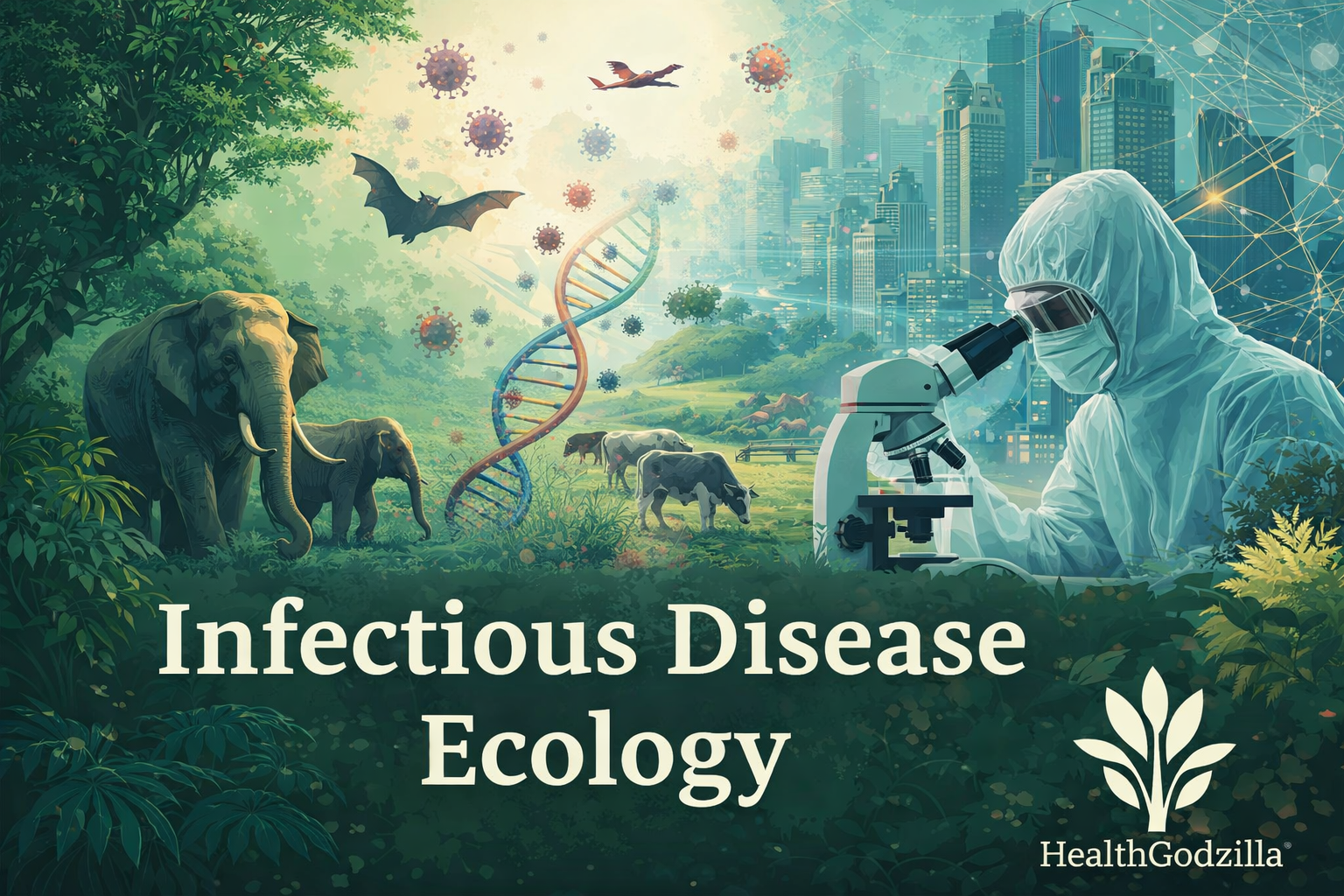
Infectious diseases do not appear in isolation. Rather, they take shape within landscapes that have already begun to change. Forest edges move. Rivers are redirected. Fields expand. Meanwhile, species adjust to altered habitats, and human settlements press closer to once-distant ecologies. Infectious disease ecology begins here—not in the laboratory, but at shifting ecological boundaries where human and nonhuman systems meet.
At first glance, outbreaks seem sudden. However, beneath the surface, ecological systems have often been shifting for years. Land-use change modifies habitat structure. Agricultural intensification concentrates livestock. Urbanization increases contact across species. At the same time, climate variability alters vector ranges and seasonality. None of these forces acts alone. Rather, they intersect — sometimes quietly, sometimes abruptly — to produce new patterns of exposure and vulnerability.
Therefore, the inquiry begins not with the microbe but with the system. Pathogens circulate within host communities shaped by biodiversity, land use, and mobility. Human health, animal health, and ecosystem structure remain entangled. Consequently, when one layer reorganizes, others respond. Disease, in this sense, becomes less a discrete event and more a signal — an indication that relationships within the system have shifted.
Yet this does not imply inevitability. Instead, it invites examination. How do environmental drivers interact? Under what conditions does spillover become more likely? Why do similar ecological disturbances produce different outcomes across regions? To address such questions, one must look beyond linear causation. Infectious disease ecology requires attention to systems, feedback loops, and context.
Thus, rather than assigning blame or isolating a single trigger, this inquiry proceeds by observation. It traces how biodiversity change, human–nature systems, climate drivers, and governance structures converge. In doing so, it treats disease not as an external shock but as an emergent property of interacting ecological and social processes.
II. Infectious Disease as a Socio-Ecological System
If the opening traced shifting boundaries, this section asks what those shifts mean. Increasingly, scholarship has moved away from viewing outbreaks as isolated biological events. Instead, disease risk is situated within what has been described as “people and nature” systems — integrated socio-ecological configurations in which human activity, biodiversity, and environmental change remain inseparable. In this framing, pathogens do not simply cross borders; rather, they circulate within networks shaped by land use, species composition, mobility, and governance.
Consequently, infectious disease ecology cannot rely on linear explanations. A forest cleared for agriculture does not automatically produce spillover. Nor does biodiversity loss uniformly increase transmission. Outcomes depend on context, scale, and interaction. Hazard, exposure, and vulnerability intersect differently across landscapes. In one region, habitat fragmentation may elevate contact between wildlife and livestock; in another, similar disturbance may reduce reservoir density. Thus, patterns emerge from configurations rather than single variables.
Why Disease Risk Is Nonlinear
Moreover, small changes within these systems can produce disproportionate effects. Small ecological changes can reorganize host communities. Slight shifts in temperature can expand vector ranges. Incremental increases in livestock density can amplify transmission networks. Yet large disturbances sometimes yield limited epidemiological impact. The relationship between driver and outcome remains mediated by structure — by how species, environments, and human systems connect.
Therefore, rather than isolating pathogens as external threats, a socio-ecological lens treats disease emergence as embedded within dynamic systems. Biodiversity change alters host competence. Land-use transformation reshapes contact zones. Climate variability modifies seasonality. Trade and travel compress distance. Meanwhile, economic inequality and health infrastructure influence vulnerability. Each component interacts; none operates alone.
In this sense, infectious disease ecology examines patterns of circulation within reconfigured landscapes. It asks not only which pathogen is present, but how relationships among species, environments, and institutions have shifted to permit transmission. Disease becomes less an anomaly and more an indicator — a signal that ecological and social networks have reorganized.
III. Systems and Spillover
Spillover does not occur at random. Rather, it unfolds where ecological structure and human activity converge. As global assessments have observed, emerging infectious diseases are increasingly linked to land-use change, biodiversity shifts, agricultural intensification, and wildlife trade. In other words, transmission risk often rises not simply because pathogens exist, but because the configuration of contact has altered.
Land-use transformation provides one of the clearest illustrations. When forests are fragmented, edge habitats expand. Wildlife populations adjust, sometimes favoring species that tolerate disturbance. Livestock may be introduced into newly cleared zones. Meanwhile, human settlements extend toward once-buffered ecosystems. These processes do not guarantee spillover. However, they reshape the interfaces where species interact. Under certain conditions, such reorganization can increase the probability that pathogens circulate across hosts.
Importantly, biodiversity change does not produce uniform outcomes. While some studies suggest that greater biodiversity may dilute transmission by dispersing pathogen encounters across multiple hosts, others demonstrate amplification effects in specific contexts. As one major synthesis notes (WHO & CBD, 2015), disease dynamics depend on “context, scale, and community composition” rather than on biodiversity alone. Consequently, whether risk increases or decreases hinges on which species persist, which decline, and how they connect within ecological networks.
Climate variability further modifies these dynamics. Temperature and precipitation shifts influence vector survival, breeding cycles, and geographic range. In addition, urban heat islands and altered hydrology can create microclimates that favor transmission. Yet climate rarely acts independently. Instead, it interacts with land use, host density, and mobility. Thus, even modest environmental shifts may produce disproportionate epidemiological consequences when layered upon existing structural change.
When Spillover Becomes Spillback
Moreover, spillover is not exclusively directional. Human activity can facilitate spillback — the transmission of pathogens from people to wildlife or livestock — thereby creating feedback loops within ecological systems. Antimicrobial resistance offers a parallel illustration. Widespread antibiotic use in medicine and agriculture, coupled with environmental contamination and global trade, contributes to resistance patterns that circulate across species and ecosystems. Here again, risk emerges from interaction rather than isolation.
Therefore, spillover should be understood as a systems outcome. It reflects altered contact patterns, shifting community composition, and layered environmental pressures. The pathogen is present; the host exists; the vector persists. Yet it is the reconfiguration of relationships among them that enables transmission. Infectious disease ecology, in this sense, maps the conditions under which such configurations stabilize or destabilize.

IV. Circulation Beyond Landscapes
Spillover often begins at ecological interfaces, yet the story rarely ends there. Once pathogens enter human systems, movement accelerates. Trade routes, transport infrastructure, and urban connectivity allow microbes to traverse distances that once acted as natural barriers. As a result, infectious disease ecology must account not only for local ecological change but also for the pathways through which pathogens circulate across regions and continents.
Wildlife trade offers one such pathway. Animals transported across ecological zones bring with them microbial communities shaped by their original habitats. When species that would rarely meet in nature share markets or holding facilities, opportunities for viral exchange multiply. Similar dynamics occur within livestock systems. Intensified production, high-density animal populations, and global supply chains can amplify transmission networks that extend far beyond the farm.
Extractive industries provide another interface. Mining camps, logging operations, and infrastructure projects often open remote ecosystems to rapid human settlement. Workers move in and out of these landscapes, connecting isolated habitats to urban centers. Consequently, ecological disturbances that once remained geographically contained may now intersect with broader mobility networks.
Meanwhile, the oceans present a parallel dimension. Marine ecosystems carry their own disease dynamics, shaped by aquaculture expansion, shipping traffic, and ballast water discharge. Pathogens associated with marine organisms can move across basins through commercial transport, illustrating that disease circulation is not restricted to terrestrial environments.
When Movement Meets Vulnerability
Yet movement alone does not determine outcome. Economic conditions, governance structures, and public health capacity shape how societies respond to emerging risks. Regions with robust surveillance systems may detect outbreaks early and interrupt transmission. Others may struggle with delayed reporting, limited laboratory infrastructure, or fragmented coordination among sectors. Therefore, circulation must be understood alongside vulnerability and institutional response.
Seen from this perspective, infectious disease ecology stretches across multiple layers of connectivity. Local ecological change generates opportunities for spillover. Global mobility distributes pathogens through human systems. Institutional capacity then influences whether transmission accelerates or stabilizes. Each layer interacts with the others, reinforcing the central insight that disease emergence reflects the structure of the entire system rather than the behavior of a single agent.
V. The Economics of Emergence
Disease emergence carries ecological roots, yet its consequences extend deeply into economic systems. Outbreaks interrupt trade, strain health infrastructure, and alter patterns of travel and consumption. However, the financial impact often becomes visible only after transmission accelerates. By that stage, governments and institutions are forced into reactive measures — emergency health responses, market restrictions, and recovery programs.
Historical episodes illustrate this pattern. Severe Acute Respiratory Syndrome (SARS), for instance, produced global economic losses estimated in the tens of billions of dollars despite infecting relatively few people compared with later pandemics. Similarly, outbreaks such as Nipah virus have generated substantial economic disruption through livestock culling, trade interruptions, and public health intervention. These events demonstrate that disease risk reverberates far beyond clinical outcomes.
Importantly, economic assessments increasingly suggest that preventive investments can be far less costly than emergency responses. Programs that monitor wildlife pathogens, strengthen surveillance systems, and integrate environmental considerations into development planning often require modest funding compared with the economic consequences of uncontrolled outbreaks. As the WHO–CBD assessment observes (2015), “preventing pandemics through surveillance and early action is often far less costly than responding after outbreaks occur.
Why Prevention Struggles for Investment
Yet preventive efforts frequently struggle to secure sustained support. Their benefits remain diffuse and long-term, whereas crisis response commands immediate attention. Consequently, infectious disease ecology also intersects with questions of economic timing and governance priorities. Should resources concentrate on reaction after outbreaks occur, or should investment shift toward earlier detection and environmental monitoring? This question does not simply concern budgets. Rather, it reflects how societies perceive risk within interconnected ecological systems.
Moreover, the economic dimension reinforces the broader systems perspective. Agricultural intensification, wildlife trade, urban expansion, and global transport networks generate economic value while simultaneously reshaping ecological interfaces. Disease emergence therefore arises not outside economic development but alongside it. Recognizing this overlap does not imply rejecting development. Instead, it highlights the need to understand how economic activity reorganizes the conditions under which pathogens circulate.
Thus, the economics of emergence adds another layer to infectious disease ecology. Ecological change creates opportunities for spillover; mobility spreads pathogens across networks; economic structures determine how societies absorb or mitigate the resulting shocks. Taken together, these layers reveal a system in which health, environment, and economy remain closely entwined.
VI. One Health — Institutional Architecture
If infectious disease ecology reveals the interconnectedness of ecological and social systems, governance must respond in kind. Traditional health institutions often developed within sectoral boundaries. Human medicine, veterinary science, agriculture, and environmental management evolved as separate administrative domains. Yet pathogens do not recognize these divisions. They move through wildlife reservoirs, livestock populations, human communities, and environmental pathways with equal indifference to institutional borders.
The One Health framework emerged as a response to this mismatch between biological reality and administrative structure. Rather than treating human health, animal health, and environmental conditions as separate concerns, One Health seeks to coordinate them within a shared analytical and policy framework. In practice, this means integrating surveillance systems, encouraging collaboration across ministries and scientific disciplines, and recognizing that environmental change can shape health outcomes as directly as clinical factors.
In recent years, global institutions have begun formalizing this approach. Organizations responsible for public health, food systems, animal health, and environmental governance have established collaborative agreements designed to strengthen coordination in addressing emerging disease risks. These initiatives emphasize joint risk assessment, shared surveillance, and collaborative preparedness strategies across sectors. As one interagency agreement observes, health threats increasingly arise at the “animal–human–ecosystems interface,” requiring cooperation that extends beyond any single institution.
Why One Health Is Difficult to Implement
However, institutional coordination remains a complex undertaking. Agencies operate under different mandates, legal frameworks, and funding structures. Data sharing can be uneven. Environmental monitoring may occur separately from health surveillance. Consequently, while the One Health framework offers a conceptual bridge across sectors, its practical implementation often depends on sustained political commitment and administrative alignment.
Nevertheless, the logic underlying One Health reflects the broader systems perspective explored throughout this article. If disease emergence arises from interactions among ecological change, human mobility, and economic activity, then governance must also operate across those domains. Surveillance cannot remain confined to hospitals. Instead, it may extend to wildlife monitoring, livestock health, environmental sampling, and land-use planning.
Thus, One Health represents less a single policy instrument than an evolving architecture for managing systemic risk. It acknowledges that human well-being depends not only on medical intervention but also on the condition of ecosystems and the stability of the relationships that connect them.
VII. Continuing the Observation
Across forests, farms, cities, and oceans, patterns begin to appear. Land-use change reshapes ecological communities. Mobility connects distant habitats. Economic systems accelerate circulation. Governance attempts to coordinate responses across sectors. Together, these dynamics reveal that infectious disease ecology unfolds within a network of interacting forces rather than through isolated events.
Yet recognition of these drivers does not imply that the system is fully understood. Ecological relationships remain complex and often nonlinear. Similar disturbances can produce different epidemiological outcomes across regions and time periods. Pathogens that remain contained in one landscape may spread rapidly in another. Consequently, the patterns described throughout this inquiry should not be mistaken for a complete explanatory model.
Instead, they represent a set of observations — signals that disease emergence reflects broader changes in ecological and social systems. As scientific assessments increasingly acknowledge, understanding these dynamics requires sustained attention to the connections linking biodiversity, environmental change, and human activity. The work remains ongoing, and the principles governing these interactions continue to unfold as new evidence accumulates.
The Observer Is Part of the System
For this reason, infectious disease ecology ultimately invites a posture of observation. Humans study systems of which they are also a part. Agricultural expansion, urban development, wildlife trade, and technological mobility all reshape the conditions under which pathogens circulate. Thus, the inquiry does not stand outside the processes it examines. Rather, it unfolds within them.
Seen in this light, infectious disease ecology becomes less a search for a single cause than an effort to understand evolving relationships across landscapes and societies. The task is not to declare final answers but to continue observing how ecological change and human activity interact over time. In doing so, the study of disease reveals something broader: the intricate chemistry of life within a shared and continually changing system.
Infectious diseases remain intertwined with ecological change, human systems, and planetary connectivity. Yet these relationships continue to unfold, reminding us that the observers are also participants in the system being examined.

Hello, Artista
Artista was quiet for a while after reading the article. She leaned back in her chair, fingers loosely folded, as if following some thought that had wandered a little farther than the page.
Organum noticed the silence.
“Well?” he asked.
Artista smiled, though not immediately. “You know, Organum, while reading this, one sentence came to my mind.”
Organum raised an eyebrow. “What sentence?”
She paused again, as if testing whether the words truly wanted to be spoken.
“Although we are loving creatures of God,” she said slowly, “we cannot love each other without a boundary.”
For a brief moment, neither of them spoke.
Then something about the sentence itself—its honesty, perhaps its gentle absurdity—broke the tension. Organum chuckled first. Artista followed. Soon both were laughing, not loudly, but with the kind of laughter that arrives when a thought lands exactly where it should.
Across the room, RD lifted his head. MD glanced over. Gulli blinked once as if evaluating the situation. Meanwhile, Whitee and Brownee froze mid-chew, their expressions carrying the calm seriousness only rabbits can manage.
All five animals looked at the two humans with the same unspoken question:
What exactly are they laughing about now?
Organum finally wiped a tear from the corner of his eye.
“Perhaps,” he said, “boundaries are not always walls.”
Artista nodded.
“Sometimes,” she replied, “they are simply the edges that allow things to meet.”
And the room settled again—dogs returning to their quiet watch, rabbits to their patient grazing, while outside the evening moved slowly through its own invisible networks of wind, leaf, and breath.
Frequently Asked Questions
Infectious disease ecology studies how pathogens, hosts, environments, and human systems interact. Rather than treating disease as an isolated biological event, it examines how land-use change, biodiversity, climate, agriculture, mobility, and social conditions reshape the relationships through which disease can emerge and spread.
Environmental change can alter the places and conditions in which wildlife, livestock, vectors, and people encounter one another. Forest fragmentation, agricultural expansion, urbanization, climate variability, and wildlife trade may reshape these contact zones. However, such changes do not automatically cause spillover; outcomes depend on context, species composition, exposure, and the structure of the surrounding system.
One Health recognizes that human health, animal health, and ecosystem health cannot always be managed separately. Pathogens can move through wildlife, livestock, people, and environmental pathways, while surveillance and prevention often require cooperation among public health, veterinary science, agriculture, and environmental institutions.
Not every outbreak can be predicted or prevented, because ecological and social systems are complex and often nonlinear. However, surveillance, wildlife and livestock monitoring, environmental assessment, stronger public-health systems, and earlier attention to changing ecological conditions can reduce risk and improve preparedness. The goal is not perfect prediction, but better understanding of the relationships that shape vulnerability.
Articles You May Like
From metal minds to stardust thoughts—more journeys await:
- Biodiversity and Biomedical Discovery: Living Library of Medicine
Biodiversity and Biomedical Discovery reveals how species, microbes, and ecosystems shape medicine, memory, antibiotics, and human health. - Leadership Mindset Decision-Making: Psychological Roots and Organizational Impact
A father-son journey into how leadership mindset shapes authority, decisions, and a company’s rise—or quiet collapse. - Eco-Nutrition: Systems Diversity and Sustainable Diets
A reflective exploration of how biodiversity, food systems, and human health intertwine. From soil microbes to school lunches, this piece traces how diversity nourishes resilience—not only in ecosystems, but in culture and policy.
Curated with stardust by Organum & Artista, under a sky full of questions.
Principal Sources
The following works helped shape the perspective behind this story.
- Webster, J. P., Gower, C. M., Knowles, S. C. L., Molyneux, D. H., & Fenton, A. (2016). One Health – An ecological and evolutionary framework for tackling neglected zoonotic diseases. Philosophical Transactions of the Royal Society B: Biological Sciences. https://pmc.ncbi.nlm.nih.gov/articles/PMC4721077/
- Food and Agriculture Organization of the United Nations (FAO), World Organisation for Animal Health (WOAH/OIE), United Nations Environment Programme (UNEP), & World Health Organization (WHO). (2022, April 29). Quadripartite memorandum of understanding signed for a new era of One Health collaboration. https://www.who.int/news/item/29-04-2022-quadripartite-memorandum-of-understanding-(mou)-signed-for-a-new-era-of-one-health-collaboration
- Travis, D. A., Alpern, J. D., Convertino, M., Craft, M., Gillespie, T. R., Kennedy, S., Robertson, C., Shaffer, C. A., & Stauffer, W. (2019). Biodiversity and health. https://onehealthejp.eu/wp-content/uploads/2019/07/BookChapter.pdf
- Gibb, R., Redding, D. W., Friant, S., & Jones, K. E. (2025). Towards a “people and nature” paradigm for biodiversity and infectious disease. Philosophical Transactions of the Royal Society B: Biological Sciences, 380(1917), 20230259. https://doi.org/10.1098/rstb.2023.0259
- World Health Organization, & Secretariat of the Convention on Biological Diversity. (2015). Connecting global priorities: Biodiversity and human health – A state of knowledge review. World Health Organization. https://www.who.int/publications/i/item/9789241508537
Relevant sections were interpreted through a narrative and systems lens rather than cited exhaustively.
This article is also archived for open access on Zenodo: https://doi.org/10.5281/zenodo.18877656