
Opening: The Price of a Plate
In a recent editorial note, Robert Guest, deputy editor of The Economist, described a moment from New York’s mayoral election campaign that deserves wider attention. At first glance, it seemed like a small story. Yet, it captures the heart of what many now call urbanization and the food insecurity myth—the belief that cities themselves make food unaffordable.
In one short video, the candidate Zohran Mamdani asked street vendors a simple question: why had a plate of halal meat and rice become so expensive? Surprisingly, the answer had little to do with cooking costs or urban crowding. Instead, each vendor explained that they had paid around $20,000 to a middleman for a permit.
Because the city issued too few permits, scarcity followed. As a result, permits began to trade informally at many times their official price. Over time, that hidden cost travelled—quietly but faithfully—into the food itself. Hungry New Yorkers paid the final bill. By contrast, more permits, the vendors explained, would mean cheaper meals.
In this case, as Guest observed, politicians spoke about an “affordability crisis” and diagnosed the problem correctly. The cause was not the city, nor the people, nor demand—but rather a bottleneck in access, enforced by policy and intermediaries.
Yet, such clarity is rare.
Elsewhere, in its cover leader that week, The Economist argued that while prices have risen in recent years, wages in most rich countries have risen faster. In that sense, life has become more affordable—even if specific things have not. Meanwhile, voters continue to make contradictory demands: higher wages but cheaper haircuts; rising home values for themselves, lower prices for their children.
Here lies the danger, as Guest warned. The problem is not discomfort alone, but also misdiagnosis. When this happens, politicians often resort to fixes that make matters worse—such as price controls, artificial caps, or pressure on institutions designed to resist short-term temptations.
Food insecurity, likewise, suffers from a similar misunderstanding.
Too often, cities are blamed. Density is accused. Urbanization stands trial. However, hunger rarely originates in cities themselves. Instead, it grows from how food moves, who controls access, how time is priced, and how supply chains are designed.
In the end, the myth is convenient.
By comparison, the truth is quieter—and far more useful.
Seen this way, urbanization and the food insecurity myth persists not because it is accurate, but because it is convenient.
I. The Parable We Keep Repeating: Urbanization and the Food Insecurity Myth
When hunger appears in cities, urbanization is often the first suspect. The logic feels intuitive: more people, denser living, stretched services. If food becomes expensive or scarce, the city itself seems to stand accused.
This reflex has a long history. Cities are visible. Crowds are countable. Growth feels tangible. By contrast, policies are abstract, markets are opaque, and power hides in paperwork. As a result, urbanization becomes an easy scapegoat—blamed not because it explains hunger well, but because it explains it quickly.
Yet this shortcut obscures more than it reveals.
Urbanization, as scholars have long pointed out, is not a single force acting on its own. It is a process shaped by economics, governance, labor markets, land policy, and political choice. Cities do not grow in isolation; they grow through decisions about housing, infrastructure, employment, transport, and food provisioning. When these decisions fracture, hunger follows—not because people live close together, but because systems fail to keep pace.
Population density, in this sense, is often mistaken for policy density. Crowded neighborhoods are blamed for problems that originate elsewhere: in licensing regimes, in land markets, in wage structures, in food distribution systems designed for efficiency rather than access. Density becomes the visible surface of deeper arrangements.
Moreover, the idea that “more people” explains hunger carries a quiet comfort. It suggests inevitability. If cities are simply too full, then hardship appears natural, even unavoidable. Responsibility dissolves into numbers. But this framing collapses under scrutiny. Many of the world’s densest cities have managed to feed their populations reliably, while less dense urban areas struggle. The difference lies not in headcounts, but in how food moves, who controls access, and which priorities guide policy.
Seen this way, the persistence of hunger in cities does not indict urban life itself. Instead, it reflects how urbanization has been governed. When cities expand faster than affordable housing, when food markets are shaped by exclusionary rules, when time poverty narrows dietary choice, hunger takes root—even in places surrounded by abundance.
The myth endures because it feels simple.
The reality is less tidy, but far more useful.
II. When Food Exists but Hunger Persists
If urbanization and the food insecurity myth blame cities for hunger, the everyday reality of urban life tells a more complicated story. In many cities, food is not absent. Markets function. Shelves are stocked. Street vendors cook from morning to night. And yet, hunger persists.
This paradox unsettles simple explanations. If food is available, why does insecurity remain?
The answer lies not in supply, but in access. Urban households rarely grow what they eat. Instead, food arrives through cash, time, mobility, and energy—resources that are unevenly distributed and often fragile. When wages lag behind living costs, when working hours stretch without relief, when transport becomes unreliable or unsafe, access quietly erodes. Food may be near, but it slips out of reach.
Time, in particular, becomes an invisible constraint. Urban life compresses hours. Long commutes, informal work, care responsibilities, and exhaustion narrow the window for shopping, cooking, and choice. Under these pressures, diets shift—not necessarily by preference, but by necessity. Cheap, filling, and fast foods replace diverse, nourishing meals. Hunger takes on new forms: not always empty stomachs, but thin nutrition.
Meanwhile, income volatility amplifies vulnerability. Many urban workers live close to the edge, dependent on daily earnings. A missed shift, a sudden illness, or a price spike can tip a household from stability into insecurity. In such moments, the presence of food in the city offers little comfort. Access, not abundance, determines who eats well.
This is where the myth becomes dangerous. By attributing hunger to urbanization itself, attention drifts away from the mechanisms that actually shape food security: wages, working conditions, transport, licensing, pricing, and the organization of markets. Structural barriers fade into the background, replaced by demographic blame.
Seen through this lens, urbanization and the food insecurity myth does more than misdiagnose the problem. It delays solutions. As long as hunger is framed as a natural consequence of city growth, rather than a product of how urban life is organized, policy responses remain misdirected—and the paradox endures.
III. The Forgotten Ingredient: Biodiversity
When conversations about hunger turn serious, biodiversity rarely enters the room. Calories take center stage. Yields are counted. Prices are compared. Yet something essential slips through the cracks—something older than markets and quieter than policy.
Biodiversity.
In food systems, biodiversity is not decoration. It is memory. It carries the accumulated knowledge of what nourishes bodies across seasons, cultures, and landscapes. Diverse crops once shaped diets that were resilient, not because they were abundant, but because they were varied. When that diversity thins, nutrition follows.
Urban diets reveal this erosion clearly. As cities grow and time tightens, food choices narrow. Meals become simpler, faster, and more standardized. A handful of staple grains and processed products begin to dominate plates that once carried many colors, textures, and tastes. This shift does not happen because people forget how to eat well, but because urban life quietly rewards uniformity.
The consequences are subtle at first. Calories remain sufficient. Hunger, when it appears, is often hidden behind fullness. But micronutrients decline. Diet-related illnesses rise. What disappears is not food itself, but the nutritional depth that food once carried.
This loss is not accidental. Biodiversity survives where food systems allow space for it—small producers, informal markets, seasonal variation, and local knowledge. When these spaces shrink, diversity retreats. Industrial supply chains favor consistency. Retail systems favor predictability. Over time, variety gives way to repetition.
Urban environments can either accelerate this process or resist it. Cities, contrary to common belief, are not inherently hostile to biodiversity. In fact, urban and peri-urban spaces have long supported diverse food practices—through informal vendors, community gardens, traditional markets, and culturally rooted cuisines. These spaces act as bridges between ecology and daily life.
However, when access to such spaces becomes constrained—by zoning, licensing, or economic pressure—biodiversity loses its foothold. Diets become thinner not because cities demand it, but because systems permit little else.
Seen this way, biodiversity is not a luxury to be added once hunger is solved. It is part of the solution itself. Without it, food systems may fill stomachs, but they struggle to sustain health.
The next question, then, is not whether cities can support diverse diets—but who controls the pathways through which food moves. That question leads us away from fields and kitchens, and into the middle of the system.
At this point, urbanization and the food insecurity myth begins to fracture, revealing not a failure of cities, but a failure in how institutions organize food pathways.
IV. The Middle Decides the Meal
Between farms and forks lies a stretch of terrain that rarely appears in public debate. It has no romance, no slogans, no elections. Yet this middle space quietly decides what people eat, what they can afford, and how far food must travel before it reaches a plate.
This is the midstream of the food system—the part most felt, least seen.
Here sit the wholesalers, transporters, brokers, permit offices, storage facilities, and market rules that determine which foods move smoothly and which stall. Individually, none of these actors appear powerful. Collectively, they shape diets more decisively than climate or culture ever could.
In cities, this influence becomes sharper. Urban residents depend almost entirely on purchased food. Unlike rural households, they cannot buffer shortages through gardens or shared harvests. Every meal passes through systems they do not control. As a result, even small frictions—fees, delays, licenses, transport costs—accumulate quickly.
Informality often fills the gaps. Street vendors, small traders, and informal markets adapt where formal systems fail to keep pace. They shorten supply chains, respond to demand, and keep food visible and alive in daily urban life. Yet these same actors frequently operate under fragile conditions. When regulations tighten without support, or when access to permits narrows, informality becomes expensive. Costs rise quietly and settle downstream, where consumers feel them as higher prices and fewer choices.
Across many urban food systems, studies suggest that costs introduced by intermediaries—through permits, transport, storage, losses, and informal fees—can raise food prices by 40 to 70 percent before a meal ever reaches the consumer.
The midstream also favors sameness. Standardized products travel easily. Diverse, seasonal, or perishable foods do not. Over time, supply chains reward uniformity, not nourishment. What moves fastest becomes what dominates diets. What nourishes most deeply struggles to survive the journey.
This is not a failure of intention. It is a consequence of design. Systems built for efficiency prioritize volume, speed, and predictability. In doing so, they narrow what remains affordable, available, and visible. Biodiversity fades not because it lacks value, but because it lacks pathways.
Importantly, these dynamics do not originate in cities alone. They emerge from policy choices—how markets are regulated, how infrastructure is financed, how risk is distributed across actors. Cities simply amplify their effects because dependence on the system is total.
Listening to the middle changes the story. Hunger no longer appears as an outcome of crowding or consumption alone. It emerges instead from the quiet accumulation of decisions that shape how food moves, who intermediates it, and which costs remain unseen until they reach the plate.
To understand what cities eat, then, we must look not only outward—to farms and ecosystems—but inward, to the structures that sit between. Only there does the full picture come into focus.
Here, urbanization and the food insecurity myth finally loses its grip, as attention shifts from cities themselves to the systems and dietary choices that reshape landscapes far beyond them.

V. Diets That Travel Farther Than Cities
When cities expand, their influence stretches well beyond their borders. Not through buildings or roads, but through appetite. What urban populations eat reshapes fields, forests, and waters—often far away, often unseen.
Here, the focus shifts from where people live to what they consume.
Urban diets tend to simplify over time. As incomes rise unevenly and time grows scarce, food preferences tilt toward convenience, durability, and familiarity. Staples replace variety. Processed foods crowd out local diversity. Animal-source foods, once occasional, become routine. These shifts feel personal, even mundane—but their ecological footprint is anything but small.
Recent research from Africa makes this pattern unmistakable. The study shows that biodiversity loss does not track city size as closely as it tracks dietary change. As urban diets converge around a narrower set of foods, agricultural systems respond by narrowing too. Farmers intensify production of a few crops. Landscapes simplify. Habitats fragment. Nutritional diversity erodes alongside ecological resilience.
Importantly, this transformation does not require megacities. Even modest urban growth, when paired with dietary transition, can exert strong pressure on surrounding ecosystems. The driver is not density alone, but demand—channeled through supply chains that favor scale over diversity.
Rural areas feel the impact first. Fields once planted with multiple crops give way to monocultures. Indigenous varieties disappear quietly. Pollinators lose habitat. Soils tire. What begins as a shift in urban consumption ends as a change in how land breathes.
This is why blaming cities misses the point. Urbanization does not dictate diets; systems do. Marketing, pricing, availability, and policy shape what becomes normal to eat. When those forces reward uniformity, landscapes pay the price.
Yet this story is not fixed. Diets can also restore. Where food systems value diversity—through local markets, seasonal eating, cultural continuity, and fair access—biodiversity finds room to return. Cities, with their concentration of people and ideas, can accelerate that shift just as powerfully as they accelerated its opposite.
The question, then, is no longer whether urban growth harms ecosystems. It is whether the diets urban systems promote will continue to flatten landscapes—or help them recover.
That question leads us to the final turn of this journey: not blame, but responsibility. Ultimately, urbanization and the food insecurity myth distracts us from the quieter truth: hunger persists not because cities grow, but because systems decide who eats well and who waits.
VI. Responsibility Without Blame
Responsibility is a delicate word. It often arrives with accusation close behind. Yet here, it asks for something else—not guilt, not finger-pointing, but attention.
If cities are not the cause of hunger, then neither are individuals alone. Responsibility settles instead in the spaces between—between policy and plate, between market design and daily choice, between what systems reward and what they quietly discard.
Food insecurity does not emerge overnight. It accumulates. Each permit restriction, each transport bottleneck, each pricing rule, each dietary shortcut adds a small weight. None feels decisive on its own. Together, they tip the scale.
Responsibility, then, lies in noticing accumulation.
Responsibility settles in institutions that shape access without seeing faces.
It moves through supply chains that value speed over nourishment.
And it hides within metrics that count calories but forget diversity.
And it lies, gently, with all of us who participate in systems we did not design—but still sustain.
This is not a call to purity. Cities cannot return to imagined pasts. Food systems cannot shed complexity. But they can choose differently. They can widen pathways instead of narrowing them. They can make room for diversity—not as nostalgia, but as resilience.
Urban life, at its best, concentrates more than people. It concentrates possibility. Markets can shorten distances. Policies can open gates. Diets can reconnect landscapes to health. None of this happens by accident. All of it begins with design.
When we stop blaming cities—when we let go of urbanization and the food insecurity myth—we free ourselves to ask better questions.
Not how big is the city?
But who controls access?
Not how much food is produced?
But who can reach it, in time, with dignity?
Not what grows fastest?
But what sustains longest?
Responsibility begins there—not as a burden, but as a choice to see clearly.
And clarity, once found, rarely leaves us unchanged.

🍂 Hello, Artista
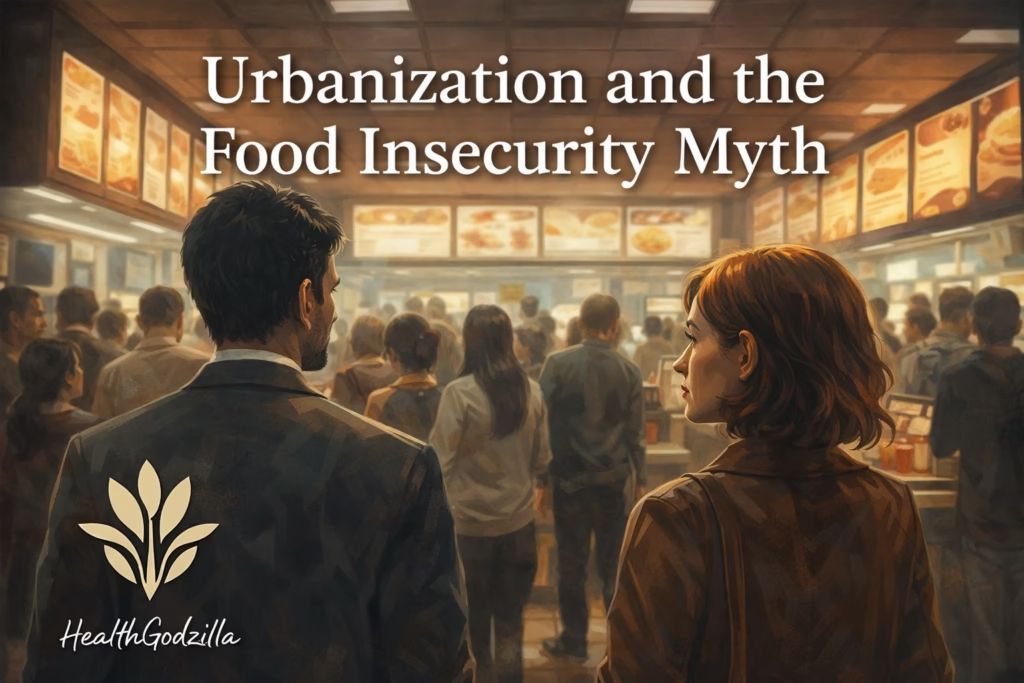
The place was loud in the way cities breathe—orders called out, trays sliding, people standing close without touching. A familiar chain food shop. Bright lights. Fast hands. Endless lines.
Organum watched the counter for a while before speaking.
“Artista,” he said, half-smiling, “have you ever thought about how a city feeds itself?”
She looked up from her tray. Steam rose quietly between them.
“All the time,” she replied. “Why?”
He gestured around them—at the crowd, the screens, the rhythm.
“Look at this. Thousands of people, every hour. Meals arriving as if on cue. Don’t you think it feels a little like magic?”
Artista watched a child counting fries like treasure.
“Magic,” she said, “is what we call systems when they work so smoothly we forget they can break.”
She followed the path of a tray from counter to table—then another, then another.
“It feels like magic,” she continued slowly, “because we don’t see the hands that make it possible.”
Organum nodded.
“Or the roads.”
Then, after a pause, “the rules.”
“And the waiting,” she added.
They sat in silence for a moment. Outside, traffic hummed. Inside, food moved fast.
“The city doesn’t grow food,” Organum said. “Yet it eats endlessly.”
“And it eats on trust,” Artista replied. “Trust that roads will open, permits will exist, prices will stay just low enough, and tomorrow will resemble today.”
She paused, then added, “It eats through systems—some generous, some tight, some invisible.”
Breaking a piece of bread, she set it down again.
“When food arrives this easily,” she said, “we forget how fragile the path is. One rule changes. One permit disappears. One price rises. And suddenly, the magic stutters.”
Organum smiled—not sadly, not sharply—just awake.
“So the miracle isn’t the city.”
“No,” Artista said. “The miracle is access. And access is never accidental.”
They finished their meals. Around them, the city kept feeding itself—efficiently, unevenly, endlessly.
As they stood to leave, Artista glanced back once more.
“Magic,” she said, “only lasts when someone keeps the pathways open.”
Organum held the door. The crowd flowed on.
And the city, for now, kept eating.
Somewhere far away, fields adjusted.
Somewhere closer, a vendor recalculated.
The city never noticed—but the system did.
🌼 Articles You May Like
From metal minds to stardust thoughts—more journeys await:
- Leadership Mindset Decision-Making: Psychological Roots and Organizational Impact
Leadership Mindset Decision-Making: Impact on Management Role shapes authority, leadership style, and a company’s rise or quiet collapse. - Environmental Impact of Pesticides and Fertilizers: Siege the Earth
Environmental Impact of Pesticides and Fertilizers: Siege the Earth. See how synthetic chemicals unsettle soil, water, air—and life itself.
Curated with stardust by Organum & Artista, under a sky full of questions.
📚 Principal Sources
- World Health Organization, & Secretariat of the Convention on Biological Diversity. (2015). Connecting global priorities: Biodiversity and human health – A state of knowledge review. World Health Organization.
https://www.who.int/publications/i/item/9789241508537 - Food and Agriculture Organization of the United Nations. (2023). Urbanization affects agrifood systems, creating challenges and opportunities to ensure access to affordable healthy diets. FAO.
https://openknowledge.fao.org/server/api/core/bitstreams/f1ee0c49-04e7-43df-9b83-6820f4f37ca9/content/state-food-security-and-nutrition-2023/urbanization-affects-agrifood-systems.html - Choudhary, N., & Brewis, A. (2024). Urban nutrition in the Global South: A narrative review of current research. Journal of Urban Health, 101(6), 1279–1294.
https://doi.org/10.1007/s11524-024-00944-x
https://pmc.ncbi.nlm.nih.gov/articles/PMC11652467/ - Satterthwaite, D., McGranahan, G., & Tacoli, C. (2010). Urbanization and its implications for food and farming. Philosophical Transactions of the Royal Society B: Biological Sciences, 365(1554), 2809–2820.
https://doi.org/10.1098/rstb.2010.0136
https://www.iied.org/sites/default/files/pdfs/migrate/G03152.pdf - De Vos, K., Janssens, C., Jacobs, L., Campforts, B., Boere, E., Kozicka, M., Leclère, D., Havlík, P., Hemerijckx, L.-M., Van Rompaey, A., Maertens, M., & Govers, G. (2024). African food systems and biodiversity are mainly affected by urbanization via dietary shifts. Nature Sustainability.
https://www.nature.com/articles/s41893-024-01362-2 - The Economist. (2025, December 30). The truth about affordability.
https://www.economist.com/leaders/2025/12/30/the-truth-about-affordability
Relevant sections were interpreted through a narrative and systems lens rather than cited exhaustively.
This article is also archived for open access on Zenodo: https://doi.org/10.5281/zenodo.18197714
Leave a Reply